
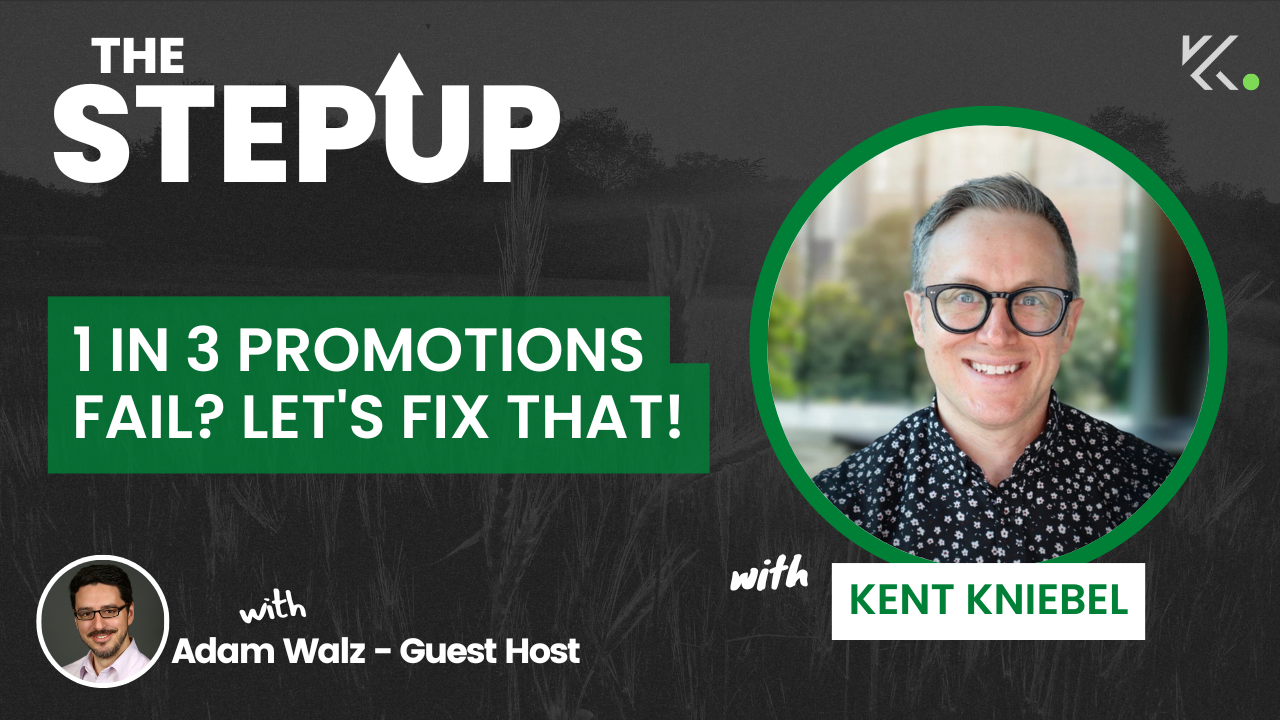
Today is a unique episode. Future guest, Adam Walz, is guest hosting today with me, Kent Kniebel, as the guest!
We've got a real gem for you today: we're diving into the nitty-gritty of why a shocking one in three promotions tank within the first 18 months, and trust me, it’s a topic that hits home for a lot of us. Our expert guest is here to lay down some solid insights on how organizations can step up their game and actually support leaders in making those tricky transitions from one level to the next. We chat about the staggering costs associated with failed promotions—think $200,000 to even $5 million—and how investing in coaching could be a game-changer. Seriously, it's like paying a small ticket price to avoid a massive concert disaster. Plus, we sprinkle in some personal stories and practical tips that can help anyone navigating the wild world of leadership. So, grab your headphones, kick back, and let’s unpack this crucial convo on leadership growth together!
Diving into the world of leadership transitions can feel like jumping into the deep end without a life jacket. The conversation really heats up around the challenges newly promoted leaders face when stepping up their game. Kent and Adam share their personal experiences, revealing that just because someone was a superstar in one role doesn’t mean they’ll shine in the next. The duo highlights the alarming statistic that about one in three promotions end in failure, often due to a lack of support. They advocate for a proactive approach to coaching, suggesting that organizations should invest in resources to help new leaders navigate their roles successfully. From hiring a coach to creating a support network, the guys emphasize the importance of not just winging it and instead, fostering an environment where asking for help is seen as a strength, not a weakness. It’s all about setting leaders up for success, and they stress the need for companies to acknowledge that transitioning to a new role requires different skills and approaches.
But that’s not all! The episode also touches on the financial implications of leadership failures—ranging from hundreds of thousands to even millions of dollars lost due to poor transitions. They frame this in terms of risk management, equating the investment in coaching as a safety net against potentially catastrophic losses. Kent shares his thoughts on the necessity of recognizing the value of coaching—not just for the individual but for the organization as a whole. They drive home the point that investing in leadership development is not just a cost; it’s a strategic decision that can save money and improve organizational health in the long run.
As they wrap up, Kent and Adam remind listeners of the importance of building a community of support for new leaders. They suggest that sharing experiences, asking for advice, and being transparent about the challenges can make a huge difference in navigating those tough waters of leadership. It’s a refreshing take on what it means to step up and really lead, and it’s packed with actionable insights for anyone looking to enhance their leadership journey. So, whether you’re a new leader or someone supporting one, this episode is a must-listen for valuable tips on making those transitions smoother and more successful!
Takeaways:
- Investing in a leadership coach can save you big bucks in the long run, trust me.
- Transitioning to a new leadership role is tough; don’t hesitate to ask for help or guidance.
- Companies often give more support to external hires than to internally promoted leaders, which is wild!
- Many organizations fail to provide proper coaching for new leaders, leading to costly failures.
- Internal promotions have a higher success rate when leaders receive more systematic support during their transition.
- Understanding the difference in responsibilities at each leadership level is key to success.
Links for today's show:
**Music for this podcast comes from the song Needle & Thread and is provided with permission by Pert' Near Sandstone. Check them out on PertNeaerSandstone.com and on all major streaming platforms.**
*Editing by Fynn Gentle / www.fynngentle.com
Kent Kniebel (guest)
00:00:04.160 - 00:01:31.550
I actually would be a huge advocate for it. You know, working with some of the bigger houses, you're going to end up paying 20 to 30 grand for six months of coaching.
And I would say even in the case of it, this being on the lower end of a loss, right. Let's say we think this loss is, you know, a $200,000 failure, even 30 grand against that is only 15%.
And so from an insurance perspective, even if you were to hire a $30,000 coach, $30,000 to save yourself the pain of 200, 600, or even a 5 million dollar cost, it's a hedge, it's a drop in the bucket. Right? Hi there and welcome to the Step Expert Voices for Leadership Growth. I'm your host, Kent Knievel.
Every week I talk to experts who focus on helping leaders step up their leadership game. If you're new to the show, then on whatever platform you're using, I encourage you to subscribe so you never miss an episode. One last thing.
As a leadership development consultant and executive coach, I have a particular interest in supporting recent internally promoted leaders.
If that's you, or if you support a leader who has been recently promoted, I encourage you to visit my website at Kent Coach Playbook and download a free copy of my 90 day blueprint filled with practical advice for you or the leader you support in hitting the ground running and truly stepping up to their new leadership level. Without further ado, on with the show.
Adam Walz (guest host!)
00:01:33.230 - 00:01:56.670
Welcome everyone into another exciting episode of the Step up podcast. I'm not Kent Knieble, but I'm excited to be here with the man, Ken Knieble. We go way back to the PDI days.
I guess this is a little bit of like a late night show, talk show host takeover. Yeah. I don't know if I'm Stephen Colbert or who I'm supposed to be today, but anyways, buddy, it's good to see you. How you doing?
Kent Kniebel (guest)
00:01:57.040 - 00:02:11.040
I'm great. I'm great. Thank you. So I think for the audience, right.
Adam and I are former coworkers, good friends, and Adam agreed to come on today as the guest host for this episode.
Adam Walz (guest host!)
00:02:11.040 - 00:02:18.240
I'm so used to being the sidekick, so making me the main character, man, this is amazing. This is corporate sidequest coming to real life right here.
Kent Kniebel (guest)
00:02:18.560 - 00:02:27.840
I like it.
So, but before I go into my intro and we'll have you on in the future, but why don't you tell the audience a little bit about yourself first before I fully turn everything over to you?
Adam Walz (guest host!)
00:02:28.440 - 00:06:36.470
Yeah. So for folks that are following Kent, but Who have no clue who this guy is. So I spent about 20 years in the leadership development space.
So I started my career at Personnel Decisions International pdi. For any alum out there, I'm actually a Midwestern guy, so born and raised in South Dakota.
So if you've been out to the Black Hills area, see Mount Rushmore and all that. And then I migrated over to Minnesota. So I went to the University of Minnesota, did my undergrad, my graduate.
I think at one time I talked Kent into joining the, the Masters of Education program there in the Human resource partner. What's up? What's up? So anyways, love, love my time in the Midwest, but man, 12 frozen cold, blizzardy tundras later, like I'm, I'm out. Peace.
So I thought I might move to New York or Chicago or San Francisco. Started falling in love with the idea of San Francisco.
But then I got a call from Susie Brock, someone who was coaching us, a dear, dear friend at the time. And she said, what do you think about something further west of San Francisco? Like what? Like Hawaii?
What, what are we, what do we, what are we talking about, Susie? And she mentioned that there was an opportunity in Hong Kong. So that actually took me on.
You know, I thought it was going to be a six month chapter, a five year chapter out in Asia Pacific starting kind of servicing greater China.
So a lot of time based out of Hong Kong and then eventually an APAC wide role where I was cruising around to different cultures, different countries, supporting leadership assessment, leadership development, succession, kind of the, the whole kit and caboodle. At that time Korn Ferry had also acquired pdi.
So I kind of have both experiences kind of living at hq, also going out to a, out to a field office and then eventually made it back to the U.S. found my home in San Francisco. I've been out here for about a decade. We made a pandemic move, let's call it about five years ago to the suburbs.
And I'm a suburban dad with you know, salt and pepper beard and doing the things, man. So anyways, and then I should say the last six years of my 20 year career was at Autodesk.
So I dreamed kind of the technology sector, a phenomenal company, really do a lot of things right when it comes to culture DEI leadership development, just supporting and building a great place to work.
So I led the manager enablement or manager development, so built programs to help people that went from individual contributors to first time managers and also partnered with several people to do some kind of bespoke off sites you know, speak with senior leaders, talk talent, all the things, man. So it's a great ride. And then maybe I'll end here. Last year, I was part of the tech layoffs, right? The statistics that everyone has seen in the.
In the newspaper articles and all the TikTok reels, that was me. So my wife and I, inside of six days, both lost our jobs.
Two different tech companies, two different situations, but went from two w, two incomes to nothing. And anyway, we. We kind of looked at each other. We were a little panicked in the moment. We went to Asia to go see her family.
We took some time off to think about it, and then she doubled down. She's finishing, actually.
She's on her last chapter, but she's writing a personal memoir in a book about her life coming from Vietnam and coming over to the States. She actually is an alumni of the University of Minnesota, which is kind of crazy. We never met.
I don't know if you know that or not, but we met at a comedy club in Hong Kong. We were both doing comedy at the time. And, and, and anyways, I decided to double down in real estate.
So I am actually, as you're talking to me right now, we're recording this kind of mid late October. I'm under contract on my first boutique hotel. So. Talk about strapping on, you know, your learning shoes.
And, you know, I think the best coaches, the best consultants, like, they've done it before. So anyways, I'll. I'll stop there, but hopefully that's a little bit of a taste of who this guy is.
I'm usually the sidekick, but thank you so much, Kent, for having me on today to again guest host and hear a little bit about you, by the way, because I think you do such a nice job on the Step up podcast of featuring other people and sharing their stories. But quite frankly, I think it's. It's time that somebody shot that camera right back at you, brother.
Kent Kniebel (guest)
00:06:36.470 - 00:06:59.300
So, yeah, I appreciate. And I was. I was going to say it's giving me an appreciation for being on the other side.
I've only guessed it on one other podcast before, and you would think this would be a lot easier, but even in our pre conversation, I'm like, how exactly is this going to go so well? We'll see. We'll see. I feel like. I feel like I'm in good hands. I feel like I'm in good hands.
Adam Walz (guest host!)
00:06:59.530 - 00:07:15.770
Absolutely. Absolutely.
Well, look, you know, we don't need to start all the way back in the crib or anything like that, but you know, you, you heard my life story in three minutes. So give us your story, man. Like, where does it all start for you? What were some of the big major chapters? And.
And why are you doing what you're doing today?
Kent Kniebel (guest)
00:07:16.250 - 00:08:50.360
Yeah, yeah, thank you.
I'll try to keep it simple enough, but I will shout out and say, hey, if you're interested in real estate and purchasing a boutique hotel, Adam puts out some really cool posts on LinkedIn, kind of along the journey of getting this hotel. So would it encourage people to go check that out? So, but about me again, I will relinquish control again.
So I am affectionately, in what I call chapter three of my career, chapter one. Similarly to you, Adam, being almost 10 years with PDI and Korn Ferry. So nobody starts their career at, at least at PDI at the time.
So I would say a, I was among the youngest consultants there back in 06 when I joined and really learned the assessment side of the business. So I spent a big chunk of time doing simulation based assessments for selection development.
I think you and I really met pretty early on, but particularly when I started dipping my toes into leadership development workshops, facilitation, got involved in some succession, high potential consulting while I was there and to keep the story shorter, managed a team for some time while I was there. And I like to say a, my very first team that I ever managed, my very first management experience was with a virtual team.
And this was pre, pre ubiquitous webinar technology like teams or Zoom. So this was, you know, primarily phone calls managing people.
Adam Walz (guest host!)
00:08:50.520 - 00:08:59.800
We're still, we're still doing the, yeah, that little alien telecom thing in the middle of a conference hall going, yeah, okay, yeah. Are you, are you there? John? Are you there? Are you on the phone?
Kent Kniebel (guest)
00:09:01.240 - 00:09:24.110
Exactly. Oftentimes direct dialing sometimes. And I still remember putting the phone number, comma, access code on people's calendars.
So if they were lucky, if they were lucky enough to be using a smartphone, you could click the button and it would dial and pause and put your code in and remember that real quick.
Adam Walz (guest host!)
00:09:24.110 - 00:10:11.870
Just because this is fun for me to kind of go down memory. Was it Harry Brule that did like, had a secretary that didn't do emails or. I remember coming in and Luke was, I mean, an amazing, legendary figure.
Got a ton of mentoring, coaching from him. But like, he was, he showed me his like, calendar and it was still pen and paper. Like I felt like we were, like, we were literally coming in.
Like I was born in 81, so I'm 44. Like we're this interesting generation where we're coming in where everyone was used to fax machines, pager, like the old analog world.
And then we showed up as kind of young bucks going, hey, put me in coach. And by the way, everyone's got no hair or gray hair and are talking about their hips and their grandchildren and I are 20 year olds going unmarried.
Kent Kniebel (guest)
00:10:12.350 - 00:10:14.510
No children when we first got there. Yeah.
Adam Walz (guest host!)
00:10:14.510 - 00:10:54.730
And by the way, like all of our peer group, I don't know if this is true for you, but like, you know, they took jobs at Best Buy, at General Mills, at Target. They're 20 year olds hanging out with 20 year olds. Meanwhile, you and I are like, you know, getting, getting a caesar salad with 65 year olds.
Now, now, again, not to disparage, but just to point out it was a very 100 interesting world to grow up in. And what I think, you know, again, like talk about just a learning cauldron where like, you know, we went from zero to a thousand very, very quickly.
Yeah. And I do remember you when you got a team because we talked about as you're transitioning. I was remembering Ken. You used to, you saw his rock.
A tie, if I'm not mistaken. Like you, you were, you dressed so impressively.
Kent Kniebel (guest)
00:10:55.450 - 00:11:54.080
Yeah. Yes. Shirt and tie at all times. And a lot more, a little less gray hair and a lot more gel or pomade. Mad Men was very popular at the time.
I think I went there with that, with that haircut. No, really good point though because I don't think I play that up enough. I don't think I talk about that enough.
So yes, I mean to talk about Harry as well. I think he was dictating his reports into. Exactly still and having someone else type them.
But, but to your point, right, My peer consultants, your peer consultants were probably 30 years older on average. Right. I think there was a few of us that were under the age of 40 right. At the time. But most, the vast majority were, yeah. Like 30 years our senior.
Right. But to that point, now on the one hand, I think you probably just like me. I'm like teaching people how to use their computers.
While however, good trade off while they're teaching me so much of the business. Right.
Adam Walz (guest host!)
00:11:54.320 - 00:12:12.920
Learn so much from pdi. So again, Nina Backer, Mark Sickle, Donna Demena. Come on, man. Chris Fisher, like this place was just loaded. It's like the 85 bears or something.
This was like a world class, you know, like championship squad. So I'm so grateful for, for starting there.
Kent Kniebel (guest)
00:12:13.240 - 00:14:04.020
I had the unique position. So when I First started, I was in more of an assessment shared services group or shared assessments. It was SaaS, Shared Assessment Services.
And I, while I was in the Minneapolis office, I was technically supporting the global company. So you're throwing out all these Minneapolis names and I'm not going to name drop like you ha. But fine.
But you know, like I was working with people in Texas, out east, over overseas, the San Francisco office, I think, you know, I had such a connection globally to folks too, and so just learned so much about leadership, leadership behavior, leadership development. And then just for the sake of the, you know, story, you know, I'm literally teaching people how to use their Windows computers.
But again, it was tech support. Very good trade off.
And realistically, when Korn Ferry acquired us, the median age at the organization dropped by about, you know, 20, 25 years, which was interesting.
And when Korn Ferry acquired us, I actually made this move into the Korn Ferry Institute for a time and I was a part of this sort of scrappy team that was primarily rationalizing competing ip.
So I had this interesting opportunity to learn more sort of broad boardroom facilitation, so to speak, and design thinking facilitation, as we were say. Like, you know, because at that time Korn Ferry had Lominger and they had acquired PDI and Global Novations.
And anybody that's listening, that was at the third place. They acquired like three companies at one time.
And at that time PDI was the biggest acquisition before the HAY Group acquisition, which was then just a massively large, larger acquisition.
Adam Walz (guest host!)
00:14:04.020 - 00:14:05.940
Ninth House. Ninth House as well, right?
Kent Kniebel (guest)
00:14:05.940 - 00:14:21.460
Yep, yep, yep. We had acquired 9th house. Yep. But for example, you know, Lomminger had a competency model. Yeah, I had a competency model.
So the team that I worked on, we kind of fanned out to different intellectual property corners to say, hey, we can't have two competency models. Right.
Adam Walz (guest host!)
00:14:21.460 - 00:14:33.500
Like, yep, Leadership architect was it. Got it down to 38, I think, which was crazy because Humminger had 67. PDI had all this. So again.
Kent Kniebel (guest)
00:14:33.500 - 00:15:13.360
Or we had rationalized two differential assessments too. Right. We had, we had our own assessment of leadership potential.
Korn, I can't remember what PDI was called actually, but you know, and Korn Ferry had Via Edge. And how do we bring them together? In some cases it was choosing one thing over another.
In some cases it was putting them together because we weren't, you know, PDI wasn't measuring this other aspect of, of high potential that Korn Ferry was measuring. Right. And they weren't measuring what we were Measuring. So we actually, you know, combine those to a best of both worlds. So.
But to your point, right, so here I met my wife while I was there as well. By the way, shout out, hey.
Adam Walz (guest host!)
00:15:13.360 - 00:15:14.040
That's a good thing.
Kent Kniebel (guest)
00:15:14.040 - 00:17:04.220
Yeah. Yeah. And okay, so chapter two of my career.
I went into HR because here I was probably on the doorstep of my 30s, if not getting into my 30s, and, you know, people are living longer, working longer. And so I was sort of sitting here looking at another maybe 30 years or more of work.
And while I do miss PDI and Korn Ferry for sure, I was sort of like, I don't know that I want to be here for 40 years.
And so really started looking at wanting to get inside, get into the organization, into an HR role, to see kind of how what we do comes to life truly on the inside. And I think I had this. This feeling as well, of like.
I was like, I wonder if I would like being a part of things from end to end versus feeling like I'm kind of paratrooping in to do one thing and then getting the heck out of there. So I'm going to speed this along a little bit, but I went into leadership development at Buffalo Wild Wings, where I was there for two years.
They were sold. People were sort of getting their invite to move themselves to Atlanta or invited to go Knife.
Quickly found a nice landing spot at Cargill, which I had wanted to work there for a number of years. Buffalo Wild Wings, super fun place to work. I love. I love the restaurants Inspire Brands now is the kind of the. The umbrella organization.
But love all my people from Buffalo Wild Wings still to this day. Still, you know, huge fan.
Loved being able to do leadership development with regional leaders, with restaurant operators who just grew up in the business and never, never once were taught kind of some of the nuance of leadership development. They were certainly taught how to hire, how to fire, how to jump in on the line and keep things moving if a line cook called in sick.
Anywho, jumped into Cargill, where I'd wanted to be for a long time.
Adam Walz (guest host!)
00:17:04.220 - 00:17:26.230
And by the way, I got to tell one B Dub story, because right on campus, I think I was maybe coming back from Hong Kong or something like that. I distinctly remember being over at a friend's house and the hot ones came out, and it was.
I can't remember the guy's name, but it started on YouTube. I think it got picked up. It's on like, yeah, major networks now. That guy's incredible. As this interviewer.
Kent Kniebel (guest)
00:17:26.230 - 00:17:26.710
Amazing.
Adam Walz (guest host!)
00:17:26.710 - 00:17:29.750
10 questions with increasingly High Scovilles.
Kent Kniebel (guest)
00:17:30.070 - 00:17:38.870
Yeah, I'd probably be watching more of that because he is. Interestingly, people point to him as being an amazing interviewer, actually. Yeah.
Adam Walz (guest host!)
00:17:39.080 - 00:18:00.200
Oh, incredible. Because he. Because he does these deep cuts and again, like reveals something in a pretty compressed amount of time.
But it's educational, it's funny, it's entertaining, you know, watching Shaq or whoever just sweat it out, you know, as they get to the. The big one. So anyways, I just remember distinctly us watching like four or five of those and we go, we should go do this.
Kent Kniebel (guest)
00:18:00.200 - 00:18:04.240
Oh, man, I. I tried, dude.
Adam Walz (guest host!)
00:18:04.240 - 00:18:20.940
And we went to B Dubs on campus at the University of Minnesota and I tried the hottest one they had. It was some ghost pepper or something. I have no idea. I'm not. I am a mild or teriyaki sauce kind of guy. Yeah, that's what kind of gal I am. Like, what?
You got sweet and sour going.
Kent Kniebel (guest)
00:18:21.180 - 00:18:40.620
I did the blazing challenge with a buddy of mine while I was working there. I was, listen, my wing game is strong. How I eat, it is. I'm scientific about how I eat chicken wings.
And so I went in very confident and failed miserably to finish the blazing challenge. Okay, anyway, I'm gonna move us anyways.
Adam Walz (guest host!)
00:18:40.620 - 00:18:54.620
Yeah, yeah, let's move on. But I had to talk about, come on. Like we, you know, you can't just work at the place and learn leadership stuff.
Like, I think it's worth telling the people that your wing game also doubled, you know, from your time at B Dubs. So.
Kent Kniebel (guest)
00:18:54.620 - 00:22:50.020
Okay, let's move on. Shout out Spicy garlic. It's basically their. Their medium sauce with extra garlic in it. So went to Cargill, did talent management there. Right.
So traditional, ish talent management that you see a lot larger organizations so leading talent review meetings from pre work through the meeting itself and identifying high potential talent, doing succession planning.
I fell into a DNI role, which is a conversation for another time, but I was doing, you know, a side project and was invited to apply to a job in DNI and particularly spent some time launching Allyship and doing sponsor, you know, running their sponsorship program, among other things. And then I made a jump to General Mills where I spent a couple years back in the talent management there. But there was a big DNI component to it.
They wanted someone who had a DNI background. So again, doing full sort of talent cycle work with them.
So leading the same very similar talent review conversations, identifying top talent, high potential talent successors for key roles, building out development plans for those folks supporting the mid year check in Process, individual talent, individual development planning process, as well as got a little bit more experience. I did a little bit of this at Cargill, Yes. But did a lot more of it at General Mills. Did a lot of direct annual performance review consulting. Right.
So I was the one kind of both, you know, attached at the hip with my comp consultant being kind of the bad guy around.
Are you really planning to go into that meeting over budget on your merit and bonus allocations, but really trying to also help consult around pay for performance? And then last July, July 2024, jumped out on my own. And yeah, I've been.
I've been sort of an independent consultant, splitting my time between executive coaching, leadership development, both design and facilitation of programs, and some, you know, assessment work. And so some of my own clients, some subcontracting work, you know, and I've been focused a lot on some of my observations coming out of hr.
You know, one of my biggest observations coming out of hr, which is sort of what I wanted to talk about today, you know, so I was sort of just saying, you know, across a couple different companies, and I was dabbling in this at Buffalo Wild Wings as well.
They just didn't, they didn't have as many, you know, specific departments running all these things, but really sitting down and identifying top talent, high potential talent.
And I would say the one thing that I've seen across organizations that shout out to gender mills, you know, how much time and effort they were putting into this, but it was the first place I landed where at the director level, not across the entire organization, but certainly in the commercial space where I was supporting.
It was the first place where as soon as someone was promoted to the director level, they were immediately enrolled in a primarily internal program to support them in making the transition from manager to director.
And, and I having spent at that point probably 16, 17 years in sort of, you know, leadership development and HR, it was the first time in, you know, 17, 18 years where I saw an organization supporting people in making this transition from one level to the next.
And knowing all the things we've talked about throughout the years, we, the royal we in the leadership development space around how hard it is to make a transition from one level to the next. It had just sort of shocked me. Oh, this is the first place that I've actually seen support people in making that transition in a systematic way.
And I just became really passionate about that.
And I've focused, especially since I've left corporate America, so to speak, you know, really trying to speak to and Kind of hold the flame or what have you advocate for supporting leaders at that point of promotion.
Adam Walz (guest host!)
00:22:51.060 - 00:23:02.270
What was it that you would say was different at General Mills, that maybe was untrue at some other place? So you kind of point to systemic support. So I'm curious, what did that actually look like?
Kent Kniebel (guest)
00:23:02.590 - 00:25:53.320
So it might have been in particular there, the volume of, or pace of talent movement at the company, like just how many people they promote. And I'm not sure I've now had the chance to really dive into the research for it.
I don't know if the research is what kind of was the impetus for them or just their. Their observations themselves. But part of what they do is, is in a lot of organizations do new manager assimilations.
Really sitting down with the new team to talk about their incoming manager and get any feedback and, and, you know, walk through sort of a systematic approach to helping that person hit the ground running with the team. But what they were doing was also helping that person hit the ground running with understanding what are my new goals and objectives and what is.
What are my development areas and how do I prioritize that development in order to hit the goals and objectives that I now need to hit as a leader and elevate from one level to the next. Because you know, what I've seen firsthand in HR, we talked about it for 10 years at PDI around like leaders operating down a level, right?
The director really operating like a manager. But then you go into an organization, you see it happening, right?
You see leaders having a hard time taking their hands off the wheel, a hard time delegating, wanting to be involved in everything. And there's different ways in which these changes show up at each level.
So, you know, shout out to Sharon Draughter and Knowles tome of a book, the Leadership Pipeline, right? They very clearly talked about, you know, at each level. It's not.
It's really easy to think about going from being an individual contributor to a manager. It's probably one of the most obvious. It's also one of the most difficult, one of the most obvious leadership transitions that someone needs to make.
Going from just caring about yourself and what you're getting done to having to, you know, care for an entire team and what they're getting done, right?
And classic example there is, you know, going from being an individual contributor to a manager, but really trying to operate like a super individual contributor, right? You're just staying.
Instead of helping five, six, ten other people be great at their jobs, you're in there pushing the work along yourself, being great at their job. Like I'm now being great at their job instead of helping them be great at their job. And. But that shows up at each level. Right.
You can then see a director operating like a super manager. Right. I General Buffalo Wild Wings. I literally heard regional managers say, I mean I was a great store manager, now I'm managing five restaurants.
And it's like there's a nuance to what you just said that which is you're managing five restaurants across I don't know what kind of geography. So honestly sir, that's impossible. You are managing five general managers that have to manage their stores.
Adam Walz (guest host!)
00:25:53.560 - 00:25:54.040
Yes.
Kent Kniebel (guest)
00:25:54.200 - 00:26:01.960
As. As simple as that sounds it how that actually shows up then in the behavior that nuanced difference in understanding.
Adam Walz (guest host!)
00:26:02.200 - 00:26:12.510
This person's probably parachuting in and they're acting as if they were the gm, overly coaching or critiquing. Yep. Just as if, well, you're not doing it the way I would be doing it.
Kent Kniebel (guest)
00:26:12.510 - 00:28:00.480
Yep, yep.
And when you would talk to leaders who have successfully made these transitions, they are actually operating as a regional manager, actually operating as a divisional, you know, divisional leader and not operating down a level, they'll even call it out, Right. They'll even be able to say, yeah, yeah, that person, he's not operating that way. But what ends up happening? You know, so what I.
What I've seen happen at most organizations and so surprised that Denver Mills was doing something about this. So again, shout out to them. You know, most organizations, we spend all this time in talent reviews like I was leading, right?
And you think about it, you've got five, you know, five to 10 leaders, maybe director level, maybe VP level, you know, start to put an hourly rate behind that. Right.
You know, you're asking these people to do all this pre work to kind of evaluate their talent, then come together for anywhere from a two hour to a two day conversation identifying high potential talent, talking about what their development areas are, identifying successors, what are their development areas.
And then in most organizations and all the people that I've talked to outside of the companies that I've worked with, I've gotten zero disagreement about this sentiment, which is that most organizations we promote someone that we send out their, you know, their organizational email, congratulations to Adam, who's now the director of blah, blah, blah, you know, welcome. You know, it's an internal promotion, Right. So welcome Adam. Or you know, shout out to Adam, you know, send him your congratulations.
And then behind the scenes, Adam gets a handshake or a high five and a go get him, tiger. And that's about the most support that most organizations provide and.
Adam Walz (guest host!)
00:28:01.520 - 00:28:11.980
Or you're relying entirely on the manager to coach that person up and elevate. Maybe that person might not know how to coach at the next level.
Kent Kniebel (guest)
00:28:12.860 - 00:30:38.600
They might not be operating even at their level. They might not have the time. Right. They might not have the time. They might. They. And that could be because they're not operating at the right level.
They're out in the field doing stuff. Right. They don't necessarily have the time for me to teach you how to be a director.
I just need you to hit the ground running, which is why we go internal oftentimes versus external. Right.
And so some, some of the research, let me just point out some of the research that I have really taken the dive into since, you know, since I stepped out on my own. So first and foremost, just the success rates of internal versus external hires. Right. So, you know, looking at kind of 18 months out or so.
And some of this research comes from DDI McKinsey. I've got some of it up on my screen here, so I'll shout out the researchers because I'm not making stuff up here.
But it's about 52% of external hires, right. At. At particularly senior leader levels.
But I've seen it, you know, I think it translates down at least to the director level depending on your company. Director might be a senior level, but about 50 is about a 52% success rate. Now are our internal. Yes, exactly. It's a coin flip.
Now our internal promotions more successful. More successful. Yes, about 65% are successful.
Looking at some of the research, but when you look at some of the research on promotions that fail, right. It's about 35% of senior leader promotions, internal promotions that flame out by about a month 18. Right.
So, you know, and to put it in the simplest terms, and to. I'm going to round down and make it super simple. It's about one in three.
You know, out of every three promotions you make, you can almost count on one being on a pip by about month 18 and us sort of managing them out of the organization.
And if you think about the amount of effort that it might actually take to support someone in that transition, the amount of time and effort it would take to support that person.
And you know, you can think about it in a number of ways, but like changing their mindset, skill set, tool set from one level to what's needed at the next kind of going back to. And I can't remember who the researchers are, but the transformation trilogy Right. At every transition, at every transformation, there are skills.
There are skills that you need to either keep using because they're going to be really helpful at this level.
Adam Walz (guest host!)
00:30:38.600 - 00:30:39.160
Yep.
Kent Kniebel (guest)
00:30:39.960 - 00:30:56.680
Important to also figure out is what things. So you were the whiz bang salesperson, but now you're managing 10 salespeople. You might need to let go of some of your sales skills. Right.
Not necessarily the skills, but how much time maybe you're allocating to sales.
Adam Walz (guest host!)
00:30:56.680 - 00:30:56.960
Right.
Kent Kniebel (guest)
00:30:56.960 - 00:31:25.540
As you, these 10 people need to be focused on that. Right. So what are some of those skills you need to let go of and what are some of the things you need to learn that you didn't know? Right.
You're now maybe presenting at the board or presenting to the C suite. I've never done that before. I might need to add some skills, you know, there. Right. So at every, every level.
So I know I picked on first level leaders, but it's even going director to VP or VP to C Suite. You know, there are those things you need to add on, let go or preserve. And most people figure it out on their own.
Adam Walz (guest host!)
00:31:26.260 - 00:33:12.690
And this reminds me of Lawrence Peter, who was, I think he was a professor at usc, but he coined the term and it was meant as like a joke at first.
But people are promoted to their level of incompetence and because he just kept seeing it over and over again that, oh, you're an IC and you're our best sales guy, let's put you in as the sales manager. Oh, you crushed at that. Then clearly you can be a sales director, right? Oh, let's move you up.
You, you know, you could be a vp, could you be a Chief Revenue officer? And of course, looking backwards, if you take a look at all the C suite people and trace back their trajectories, you see nothing but success.
But how many other people attempted that same trajectory and didn't make it? And anyways, I think that's, I haven't read that book, but I think his students and other faculty encouraged him to build it out.
But it reminds me of some of the stats that you're throwing out where again, is definitely not a lock that someone's going to be successful.
But how do we use behavioral science and how do we use just all the lessons in supporting managers, in coaching, executive coaching, et cetera, to increase the probability that somebody is successful. And I think again, whether the manager themselves can do that, if HR can do that, if it's a third party external consultant.
I think one other proxy for me, because again, that I see the Manager is such a classic one reminds me of like being a parent. So I have a six year old at home, but it is this a B. Either you are a parent or you're not. And it's kind of the same thing in the working world.
Either you're an IC or a manager.
And men, once you've blown through that door and you've seen the other side, like you, there's so many positive things that come from it, but it changes fundamentally your orientation.
Kent Kniebel (guest)
00:33:13.410 - 00:33:20.780
So anyways, yeah, I'll go one step further with that analogy too, to say, let's go, I've got three kids. Kids, right. And there are, I don't know how.
Adam Walz (guest host!)
00:33:20.780 - 00:33:21.340
You do it, brother.
Kent Kniebel (guest)
00:33:21.340 - 00:33:34.180
There are one. One of them is out of the house. So that, that helps for sure.
But the lessons from one are only so applicable to the next one because the next is a completely different human. Right. And then.
Adam Walz (guest host!)
00:33:34.180 - 00:33:34.540
Yes.
Kent Kniebel (guest)
00:33:34.619 - 00:33:54.030
So that similarly, even with parenting, there are the skills you need to preserve. There are the skills you need to like, well, that what worked with child one is just not working with child two.
I'm gonna have to stop trying that and learn something new that's going to work with this child on whatever, you know, esoterically or hypothetically.
Adam Walz (guest host!)
00:33:54.030 - 00:34:18.610
Well, and go all the way out to, you know, one of our friends. Again, sorry, not a lot of name dropping, but I'm thinking of like John pike, prolific father, wonderful coach.
And I bet you anything from going to three to four to five to six, like you're, you're learning tons. Or somebody who has twins versus one, like, so all unique situations.
Just like somebody who's@namethatcompany.com and they go from a manager to a director.
Kent Kniebel (guest)
00:34:18.850 - 00:34:19.330
Yeah.
Adam Walz (guest host!)
00:34:19.570 - 00:34:44.980
Now again, no one has ever been in that situation before, so how do we increase the probability that, that that person's successful? And it sounds like again, things that you learned at PDI and Korn Ferry, things that you learn at a multitude of Fortune 500 companies.
And now that you're on your own regularly coaching, putting out content, you know, talking with different Fortune 500 companies, like, it's clear, like, yeah, better support leads to better outcomes. Yeah.
Kent Kniebel (guest)
00:34:44.980 - 00:35:24.080
And you know, on the one hand, you can. You see that when you, even when you're internal, you see the support that external hires are getting.
Now, usually I usually say, well, we give internal promotions three to five times less support than we give to external hires.
Now when I say that, I get both head nods and eye rolls in the same person because they're like, yes, they do get 3 to 5% of the very little we're even giving to external hires. Right.
Most HR people would admit there's way more we could do to help onboard mid career, you know, professionals from mid to senior level leadership roles much, much more busy.
Adam Walz (guest host!)
00:35:24.320 - 00:35:25.920
We have no money and we're busy.
Kent Kniebel (guest)
00:35:26.240 - 00:36:23.810
And yet this talent.
Again, I'm going to go back to, you know, we've, we've spent hours with multiple people at multiple levels of leadership identifying talent, putting together development plans, identifying successors, putting together their development plans. We're set, we're, we're sometimes enrolling people in programs, right.
So sometimes we're enrolling someone in a leadership program in the hopes that that's helping to prepare them, teaching them some of the skills that they need to learn.
What I see most organizations do is they might have a marquee program that they earmark for newly promoted people, but they end up building that program with a really high cost consultancy. And well, we're, we have to wait until we have 12 or 20 promotions before we can enroll people and launch that program. Well then what happens?
What happens is then you've got, let's say there's 20 people, five of them have now been enrolled for 18 months. Right. They're already approaching that, that, that unfortunate failure point for the, you know, for.
Adam Walz (guest host!)
00:36:23.810 - 00:36:26.530
The one in three educating them after the fact.
Kent Kniebel (guest)
00:36:26.770 - 00:39:08.120
Five are new and you know, 10 are somewhere in the ballpark of, of you know, three to 12 months, you know, six to 12 months or so. Right. So you're still not hitting them at that point of greatest need, greatest vulnerability.
And so if you just think of it as just an insurance, you know. Okay, so let me go to the other.
What's funny, what's really fun to look at is you know, the numbers that get thrown out for the cost of failure, right. So I've seen anything from $200,000 to $600,000 to $5 million. The research from McKinsey shows a pretty broad range.
425 like going down to the level of, for a $200,000 a year executive, you know, the cost of a failure is about 420, you know, it's like double, right. All the way, you know, so 2.2.5x the salary or whatever.
But, but you also have to look at, so it's somewhere in the range of 200,000 to $2 million that you're putting at risk when someone fails. And what are, what, why is that it's not just the leader leaving maybe an empty seat for a little While, but also then what does that do to the team?
Right. This, this team that had a leader is now having a leader.
Turnover that it tends to lead to more turnover on that team, lack of engagement on that team. So dropping productivity. If it just so happens that that leader was involved in a critical strategic project.
Now we're looking at what's happening with this strategic project that's getting all this investment from the organization with this leadership gap, right? So you're putting, you know, you're putting key projects at risk.
If this is a revenue generating role, you're putting customer, you know, customers at risk and revenue at risk, right. So you're risking. And I start to think about smaller companies too, right. I feel like even smaller companies have so much more to lose here, right.
When, you know, so many fewer people, we're talking smaller dollars compared to some of the giant organizations that I've worked in. Right. One leader, you know, customer impact could have a huge impact on your whole business. Right.
Just one leader failing or a team having turnover, extra turnover because of a leader failing. Right. Let alone the cost of any possible severance you've got to pay out for exiting that person.
Maybe a search cost for finding the next person, maybe a sign on bonus because you're trying to get this person in quickly. There's. It just costs organizations a lot, right. And I'm just. Yeah, I'm looking. I mean that, you know, go ahead.
Adam Walz (guest host!)
00:39:08.520 - 00:41:04.290
Yeah. I was going to say this feels a lot like an iceberg, right. I mean, so again, there is the tangible visible. Hey, what did, what did Susan make right?
To. Oh yeah, $195,000 a year. And if you just take that over. That's a simplistic right answer.
So what you're pointing to loss, productivity, opportunity costs, you passed up somebody to put Susan into that role. So again, their motivation's already down and there's I told you so energy on the team.
But there's all of these ripple impacts that start to push overall organizational team performance down. It's just unnecessary headwinds. Like.
And I felt this at Autodesk, you know, again, I don't know if I, you know, got a medal for most bosses in my tenure, but. Oh yeah, nine boss, nine bosses in six years. So it was a lot. And a combo of internal and external. Again, I learned a ton.
I learned something from every single one. But it was unfortunate to see that oftentimes it was, it didn't feel like that person had the support they needed to be successful.
They were continuously being thrown Kind of in between a rock and a hard place, asked to do an impossible task, build the plane while it's flying with zero context, and within 6 to 12 months some other larger organizational change outside of their remit would impact them.
So I suspect that there are lots of people listening to this that either went through that themselves or have seen somebody go through something like that where there's just unnecessary change, transition churn, et cetera. Sometimes even with great support, you know, again, it's not going to work out.
But too often I think again, when it could have worked and we just didn't quite have that person's back. Yes, man, I can think of a couple leaders that I wish they had a, just a 10% more lift could have made the difference of that person.
Kent Kniebel (guest)
00:41:05.010 - 00:41:31.130
You know, you're not gonna, you're not gonna get to 100% success. Right. But can you go from a, you know, the research, again, the research is a 35% and it's.
So I could, I could say three to four out of every 10 promotions are going to fail. It's just easier to say, round it down a little and say, you know, one out of one out of three. So 35% is what the research says will fail.
You're not going to get to zero percent. Right.
Adam Walz (guest host!)
00:41:31.690 - 00:41:34.490
But could we knock that, what's it worth to knock it down to 93?
Kent Kniebel (guest)
00:41:34.490 - 00:42:16.390
Can you get to 90 success? Yeah, exactly. How close now? Because generally speaking, I don't believe it to be a success selection problem.
Like could succession processes, could high potential identification processes be improved and tightened up? Are we always truly identifying high potential leaders and truly differentiating from high performing people? No, we're not always doing that. Great.
Could that improve? Sure, sure. But is just tightening up your selection criteria going to bring you from 35% failure to 10 or 5% failure?
Adam Walz (guest host!)
00:42:16.790 - 00:42:19.910
That's not the low hanging fruit, that's not the major deficiency here.
Kent Kniebel (guest)
00:42:19.910 - 00:42:38.690
Yeah, I would, I would actually say most organizations are probably getting the decision making side of it. Right.
Where things are falling apart is are we helping this person truly leave the old role behind and step into the new role and what's required there? Right. So, so what can you do about it?
Adam Walz (guest host!)
00:42:39.090 - 00:43:07.140
Yeah, yeah. And maybe, maybe this is a good transition point to like advice. Right.
So on the show, always talk about kind of career stories, we talk about different topics. I feel like we, you know, heard your story, heard some of your thoughts, seen some of the research.
So the last chapter, if I'm not mistaken, as a, as a step up fan here, get into the advice.
So yeah, what, what, what is it that someone, you know, new leader themselves, supporting new leaders, or again, other consultants out there, coaching, what advice do you have?
Kent Kniebel (guest)
00:43:07.140 - 00:46:52.160
Well, let me, let me step back for just a second and say, you know, what can organizations do about this first and foremost? Well, you could hire a coach. You can and maybe should. I actually would be a huge advocate for it.
You know, working with some of the bigger houses, you're going to end up paying 20 to 30 grand for six months of coaching. And I would say even in the case of it this being on the lower end of a loss, right?
Let's say we think this loss is, you know, a $200, 200,000 failure, even 30 grand against, that is, it's only 15%.
And so from an insurance perspective, even if you were to hire a $30,000 coach, $30,000 to save yourself the pain of 200, 600 or even a 5 million dollar cost of hedge, it's, it's a drop in the bucket, right?
So from an insurance perspective, let alone if you work with an independent like myself, like yours, like yourself, where, you know, you're probably landing around $15,000 or 15, 10 to 15, somewhere in that range for six, you know, six months of coaching, let alone maybe a more purpose built coaching that might even be more affordable.
What I like to do is get in and do something more scalable where we can actually set up more of a flywheel, where, you know, at a large enough organization that's having enough promotions, if you can provide both the individual support through some kind of a mini coaching with some kind of a curriculum focused on what are those goals, what are your development needs, how do we help aim your development there and help you through some of the cycles of what are some of the things that typically fall apart for people, right?
Like are you understanding your, your new network of peers and how to get to know them, where they impact your work, where you impact their work, where, how do you build a base of influence? You know, there's, there's a lot to it there, right?
So coaching, mini coaching, get something more systemic where maybe you can even bring people together in a cohort who are somewhere in this journey of their first to their 18th month where they can even share what they're learning from one another. So those are things that I both advocate for and do. But the advice, you know, so what's my best advice for individual leaders out there?
If you've been promoted and you're about to step into a new role, you Know, my best advice is don't be shy and don't feel, you know, because what one thing I was. I was just writing yesterday, I want to say is, what ends up happening is people feel like I need to prove myself. I shouldn't ask for help.
I shouldn't say I don't know what I'm doing. So when things start to get rough, I white knuckle it. I don't ask for help, and I end up making things worse. Right.
And so what I would say is, have transparent conversations with your leader, seek an advisor, seek a mentor, and ask specific questions about making the transition from your previous level to the new level. Like, how should I be doing things differently at this level and how I would have done them? You know, if I'm a manager, if I was.
If I'm a manager, just being promoted to director, ask a director, maybe someone even in their first couple of years as a director and someone more tenured as a director to say, listen, I knew how to do this as a manager. How do I need to do things differently as a director? What things do I need to be doing differently as a director?
Acknowledge that it's different and seek advice. Right. That's the first thing I would say, let alone, you know, finding out what you know is that. Is that mentoring? Is that seeking out an advisor?
Is that asking for a coach? Right. What. Know that you're not alone, but also know that, like, white knuckling it, not asking for help is probably the recipe for disaster.
Adam Walz (guest host!)
00:46:52.160 - 00:47:18.580
The worst. Yeah, yeah, that's.
That's interesting because I. I think about my own, where I'm at right now in my career, and again, you know, released from corporate America. Okay, what. What's Adam going to do next? My wife and I built up a little bit Airbnb portfolio. Some that we own, some that we manage for other people.
But this idea of, you know, okay, if we get a ninth Airbnb, is that going to change our life? Probably not. So I knew that place. That was me staying at the manager level.
Kent Kniebel (guest)
00:47:18.660 - 00:47:19.100
Yeah.
Adam Walz (guest host!)
00:47:19.100 - 00:47:58.920
Like, what's the bigger version of that? What's the scale? Like, how can I go up and grow? And it was to go into hotels, which are fundamentally different asset classes. It's still hospitality.
I can learn a lot. I've. I've got some skills. But look, the very first thing I do to.
To your point was it got around people that are doing this, other students that want to make the same jump, and mentors that have already done it so that I could learn.
So I I, I knew, look, if I'm going to spend a year betting on myself and not getting paid to be at Autodesk or some other tech company, you know, I owe it to myself and my family to put my best foot forward and make it more likely that I'm successful.
Kent Kniebel (guest)
00:47:59.340 - 00:47:59.740
Yeah.
Adam Walz (guest host!)
00:47:59.740 - 00:48:04.380
So anyways, like, whether we're talking about hotels or we're talking about your world, like, I, I think that's great.
Kent Kniebel (guest)
00:48:04.780 - 00:49:01.140
You said something really important there that I want to, I want to just put a finer point on too, which is if you don't acknowledge that it's different, most people by default will just try to do more of the same, like more aggressively and harder versus to your point, really thinking about what is the elevation, what is the thing that's not new. So, so my advice to those who support leaders, so HR talent, senior leaders, the hiring manager of a new newly promoted leader.
So first of all, like HR talent, have that conversation with the talent manager to say, hey, this is a fundamentally different level. How are you planning to support them in stepping. This is kind of the, the whole title of my podcast here.
And stepping up their game from one level to the next. Also have that conversation with that newly promoted leader. Like, hey, I don't know, is it Jim Collins, the title of that book? It fits all the time.
It's, it's, you know, what got you here isn't going to get you there. Right.
Adam Walz (guest host!)
00:49:01.620 - 00:49:02.460
Marshall Goldsmith.
Kent Kniebel (guest)
00:49:02.460 - 00:49:41.170
It's Goldsmith. Thank you. You know. Oh, yeah, good to great is the other one. But yeah, Marshall Goldsmith, what got you here is not going to get you there. Right.
So everything that, that was the table stakes to get you here and only a small percentage of that is needed. Like you need to tune into what's needed.
So have that conversation with hiring managers, have that conversation with the newly promoted leader to sort of let some of that steam out of the balloon and normalize that this is going to be different.
Let alone if you're in talent or hr, you need to be talking to the senior leader that's, that's the hiring manager of this, this, this new lead promoted leader to say, how are you going to support them in making this transition, let alone advocating for things, you know, advocate for some of the spend for coaching.
Adam Walz (guest host!)
00:49:41.490 - 00:49:41.930
Yeah.
Kent Kniebel (guest)
00:49:41.930 - 00:50:03.130
Some kind, for some kind of program that supports leaders. Right.
So that's, I would say, like, let's not shy away from the conversation and those who are supporting the newly promoted leaders, you know, should be the vanguard of acknowledging it. And you know, it's like you can't Change a norm by not talking about it. Right. You have to bring it into the light of day. Right. So if you don't.
Adam Walz (guest host!)
00:50:03.690 - 00:50:04.290
I love it.
Kent Kniebel (guest)
00:50:04.290 - 00:50:04.730
Yeah.
Adam Walz (guest host!)
00:50:04.730 - 00:51:38.720
And, and, and, and look, just, I was thinking when, when you were talking about, you know, maybe normalizing the default as different because I think most people. Again, okay, Rodney, you've been here for 10 years. You've been a great senior manager. We're going to put you in a direct role.
Like the assumption, like you say, is just, okay, you get to park slightly closer to the building. You know, here are your three perks maybe and good luck. You're same person showing up at the same office with the same people.
And so it's really, really easy for the default to be. This is just an extension of what I did before.
It's way more visible, by the way, when you change geographic locations or change functions or change businesses. I'm actually coaching somebody.
I won't mention the person or the name, but a tech company, not Autodesk, we're engaging a six month coaching thing and again, knew all the people in business a now all of a sudden is moving to an entirely different business function. So just they have none of the same peer set.
And so I think it's easier in those moments because just everything is new, you know, for people to get it that this might not work. And I really have to think about this as different and new. I think the real watch out.
Talking to you, consuming some of your content, hearing some of the stats here is this pernicious little idea that, you know, tomorrow is going to look a hell of a lot like today in these transitions. Right.
And if we believe that again, we just double down, we white knuckle it using your language, we, you know, push the accelerator down to the floor, we try and go faster and harder through it.
Kent Kniebel (guest)
00:51:38.720 - 00:51:39.120
Yeah.
Adam Walz (guest host!)
00:51:39.120 - 00:51:44.560
And that's the exact wrong approach. So anyways, kind of a new insight based on this conversation.
Kent Kniebel (guest)
00:51:44.560 - 00:52:12.689
Yeah, yeah.
Well, and so what I would say is, you know, obviously part of all this is why I started the podcast was right to, you know, give some more nuggets out there about what good leadership looks like. You know, I write a couple of newsletters. You know, one newsletter is kind of specific to this topic.
I do a lot of my writing around this topic on LinkedIn. I'm starting a monthly webinar. So I think by the time this comes out, the second one will be done. Pretty dedicated to this process. So I continue to.
Adam Walz (guest host!)
00:52:12.689 - 00:52:16.810
Yeah, tell us, tell us more about the webinar. What's what's going on with the webinar.
Kent Kniebel (guest)
00:52:16.810 - 00:53:46.290
Well, again this, I think this will come out after number number the second one here. So a title subject to change each month. October's is going to be called you know why one in three promotions fail and what it costs you.
So a trying to share more information about my own observations, what the research says, what can be done about it, you know, certainly trying to. I've got a roadmap on my website which I think my prerecorded intro and outro both mentioned this. It's called the Promoted Leader Playbook.
I've pulled my own observations together both from hr, my time at PDI and Korn Ferry in terms of, you know, what should you be focused on in month 1, 2, 3 once you've been promoted?
So I would say go out to my website Kent Coach, if it's your first time there, you'll get a pop up for the playbook in the first 10, 15 seconds you're there or Kent Coach slash playbook to go straight to where to download it and then. Yeah. And so trying to also just give as much away too.
Like you know, when I'm bringing people these webinars, am I just trying to get them, you know, am I trying to get them to hire me? That's not my only goal. I also want to give. I'd rather people do something new and different.
And so I'm trying to give away as much as of the secrets as I can so people can put some intentional focus here.
And if that means you want to have a deeper conversation with me around other ways that you can sort of try to solve this issue or even ways that I could support. Right. It's certainly trying to open that conversation but it's not the only goal.
I would rather change the world by giving some of this away as much as I can too.
Adam Walz (guest host!)
00:53:47.010 - 00:54:07.320
I love that thinking about it's about generosity adding value first trying to literally give away the thing sauce like if I could write a little PDF that you know, some people would pay tens of thousands of dollars for, what would that say? And again, I've downloaded the Playbook. I think it's awesome. It blends together just as you said, kind of best of professional service.
Kent Kniebel (guest)
00:54:08.840 - 00:54:20.690
Yeah. Smart enough person.
I mean that's, I mean an average person should be able to take that playbook and if they never wanted to hire a consultant, should be able to take that and put something together more systematic than and what they're doing today.
Adam Walz (guest host!)
00:54:21.010 - 00:56:55.250
Yep.
And, and, and you're reminding me of you Know, conversation I was listening to the other night where an EVP had been promoted, I think, to maybe a different portfolio. I think they're a private equity shop.
You know, they kind of turned around this business, did what they needed to do, and then they were going to move on. And this evp, if people are interested, I could try and pull the clip. But he was sharing a story about. He sat down on his last day, right?
So he's leaving the business. And he's been remarkably successful. High credibility. You know, this is for all intensive purposes, a promotion to the.
To the next thing, the next frontier. I think actually he got his first C suite job. So anyways, he sits down with his vp and he asked him a very interesting question.
He said, you know, I'm going off to do this thing, like, based on your experience of me, what's something that I could do differently, you know, in this new role? The guy paused for a second and he said, you know, look, you're going to go on to be a great leader.
The only thing that I wish it could have been differently is if you would have invested more in me. And that just, like, stopped him in his tracks because like so many people, we get so busy, we're so focused that we're the hero in our own story.
And we forget the incredible impact that we can have for others when we put our focus on service and impact and being open and curious and thinking about how is everyone's experience around me right now.
And I think when I think of, again, good to great Jim Collins, you know, level five leaders, they look at themselves when there are mistakes or failures, and they look. They look out the window, right? And set the mirror in the window. They look out the window when there's success in triumph.
So anyways, it was just kind of a beautiful story that I think kind of hopefully ties into this conversation about lots of people are successful and move on. But even in that guy's case, he. He missed something, right? There was an opportunity that he had passed up. And now the time. The time is over.
So he's dedicated the next couple years of his life in giving back as much value to other people as he can. And I hope, whether you're a new leader supporting new leaders, you're a coach thinking about this space that.
That again, you know, we're not just thinking about our own impact. We're thinking about people's experiences and how we can enrich and grow that. So, yeah, love it. Anyways, with that, any closing words, Ken?
I know we've Been going for a while. Hopefully this has been valuable, but that's all I got.
Kent Kniebel (guest)
00:56:56.050 - 00:57:03.090
I said it again. I'm just going to say what the pre recorded outro is going to say anyway. But thank you, Adam, for coming on and being the guest host for the day.
Adam Walz (guest host!)
00:57:03.570 - 00:57:11.420
Yeah, it's a pleasure, man. Any lessons being on the other side of the fence? I mean, sitting on the other seat in the other seats. Any quick reflections?
Kent Kniebel (guest)
00:57:12.300 - 00:57:24.220
No, I think, I think continuing to make sure I probably gave myself less prep time coming up with this idea the night before. So I think, you know, continuing to make sure that I give people a Runway to prepare. I think that's the biggest.
Adam Walz (guest host!)
00:57:24.380 - 00:57:30.540
Yeah, I love it, man. Well, dude, you were. You were great off the cuff. So again, thank you for sharing with the people.
Kent Kniebel (guest)
00:57:30.620 - 00:57:31.100
Awesome.
Adam Walz (guest host!)
00:57:31.100 - 00:57:47.430
Your story, what you're passionate about, again, if people want to. I mean, you're listening to this, so obviously you found my guy. Kent Knievel, the legend in this field. He's done all the things, but.
But anyways, thanks again for sharing the mic with me today. Really enjoyed the conversation.
Kent Kniebel (guest)
00:57:47.430 - 00:57:50.630
Thanks. I look forward to having you on and getting my chair back.
Adam Walz (guest host!)
00:57:51.190 - 00:57:52.230
Yeah, let's do it, man.
Kent Kniebel (guest)
00:57:52.230 - 00:58:16.320
All right, take care. That brings us to the end of our episode. Thanks for listening.
I'd encourage you to head on over to my website, Kent.com coach and start a conversation with me there. Or check out my promotion playbook at Kent Coach Playbook.
Before you go on with your day, I ask you please take a moment to leave a rating and a review wherever you listen to podcasts. Five stars. That helps put this podcast in front of more eyes and ears. Until next time, take it easy.


