
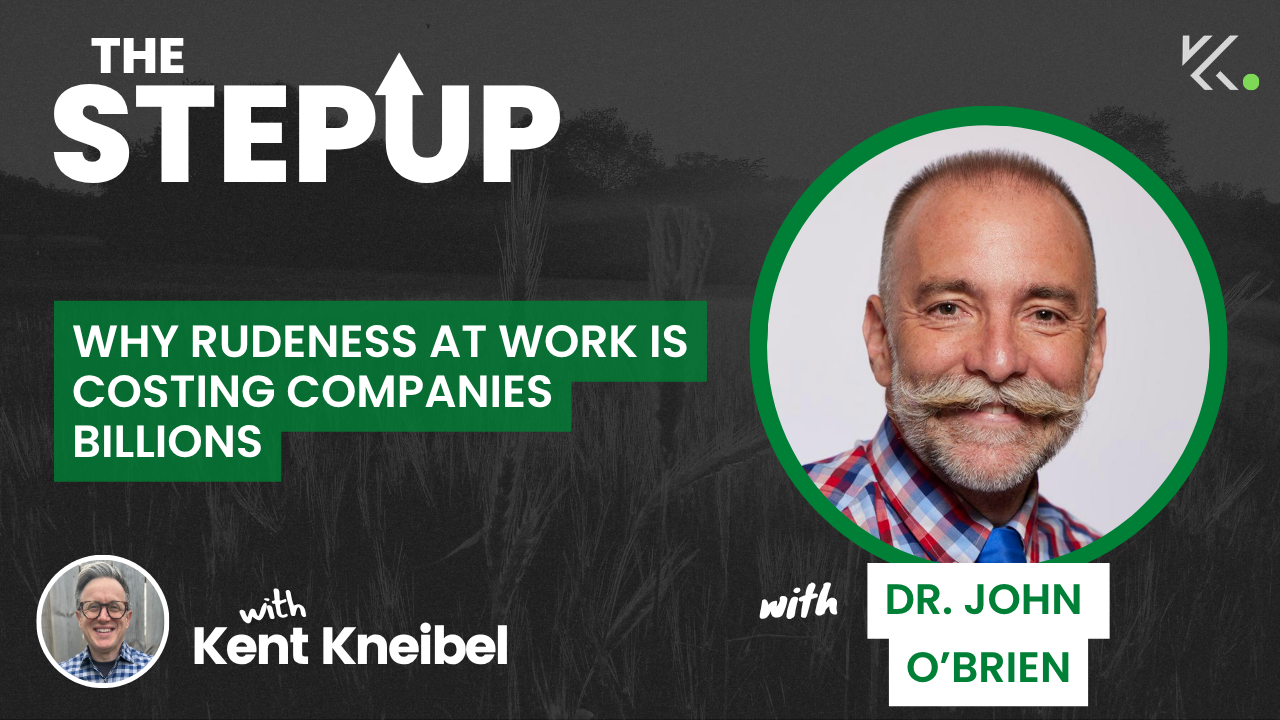
Businesses in the U.S. are losing an estimated $2 billion a day to rudeness and incivility. Not layoffs, not bad strategy, just people being sour, sarcastic, or careless with each other. Dr. John O'Brien has spent 30 years as a psychologist watching what that does to people, and he's spent the last several turning it into a mission: teaching leaders and teams how to catch it before it wrecks a culture.
Guest: Dr. John M. O'Brien is a licensed psychologist, executive coach, and founder of Activate Success, and the author of Rudeness Rehab: Reclaiming Civility in the Workplace and Your Home Space.
In this episode:
- 00:40 — Kent's intro and why 1 in 3 promotions fail
- 01:44 — John's path from psychotherapy to workplace civility
- 05:00 — The billion-dollar cost of incivility
- 08:44 — How social media and digital tools fuel workplace rudeness
- 12:54 — Return-to-office mandates and the narcissism research behind them
- 17:57 — The three types of incivility, and the one John worries about most
- 23:19 — What leaders and HR should actually be doing about it
- 31:50 — The BAM framework for staying calm under pressure
- 39:16 — Advice for leaders stepping into a new role
Resources mentioned:
- SHRM's research on the cost of workplace incivility (shrm.org)
- Dr. Christine Porath's research on civility at work
- Andrew Huberman's physiological sigh research, Huberman Lab (hubermanlab.com)
- Adam Grant, Marissa Shandell, and Courtney Elliott's study linking CEO narcissism to return-to-office mandates (fortune.com)
- Rudeness Rehab: Reclaiming Civility in the Workplace and Your Home Space (rudenessrehab.com)
- Civility Matters, John's podcast - (https://civilitymatters.buzzsprout.com )
Links for today's show:
- John O'Brien on LinkedIn
- John's TEDxTufts Talk: Small Slights, Big Consequences
- Activate Success
- Rudeness Rehab (book)
- Kent Kniebel on LinkedIn
- The Promoted Leader Toolkit
Music for this podcast comes from a live recording of the song Needle & Thread and is provided with permission by Pert' Near Sandstone. Check them out on pertnearsandstone.com and on all major streaming platforms.
Enjoyed the episode? Leave a rating and review wherever you listen, it helps more leaders find the show.
John M O'Brien (guest)
00:00:04.240 - 00:00:38.040
But you know, employers and business leaders sometimes. Yeah, well, that's kind of nice. You know, physical health, mental health, blah, blah, blah.
But when you say, oh, those things actually also translate into impacts on business outcomes, on creativity, on productivity, you know, and ultimately what impact that can have businesses can lose in terms of the amounts of money.
I mean, Sherm's data estimate that businesses in the US are losing 2 billion with a B, that is billion dollars per day due to rudeness and instability in the workplace.
Kent Kniebel (host)
00:00:40.200 - 00:01:42.560
Hi there and welcome to the Step up podcast. I'm your host, Kent Knievel.
Every week I talk to experts who focus on helping leaders step up their leadership game and leaders telling their stories of growing up through the ranks. If you're new to the show, do me a favor and subscribe so you never miss an episode. One last thing.
As a leadership development consultant and executive coach, a focus area of mine is supporting newly promoted leaders.
One in three promotions fail because we never teach newly minted VPs how to stop being a director or a newly promoted director how to stop being a manager. That's you.
Or if you support a leader who has been recently promoted, I encourage you to visit my website at Kent Coach Toolkit and download a free copy of the Promoted Leader Toolkit filled with practical advice and tools to help new leaders stick the landing and truly step up to their new leadership level. All right, dillied and dallied long enough. On with the show. Welcome, everybody. Today we're going to be talking about civility in the workplace.
And with me for this conversation today is Dr. John O'. Brien. John, thanks for coming today. I appreciate having you here, and thanks for having me.
John M O'Brien (guest)
00:01:42.560 - 00:01:44.200
I'm looking forward to this conversation.
Kent Kniebel (host)
00:01:44.920 - 00:01:54.790
All right, before we get into it, for anybody listening who doesn't know who you are, I would love for you to take a little time and introduce yourself to the audience. Tell us a little bit about your career story, wherever you want to go with that.
John M O'Brien (guest)
00:01:54.950 - 00:03:46.640
Okay, well, so I'm a psychologist by training. I've been in the mental health field as a psychologist for about 30 years now, but I started at six. The age of six. That's why I still look so young.
That's what I always tell. Been doing this for many years and enjoyed the work in doing individual psychotherapy with people assessments.
And I've also taught in the University of Maine and Augusta for a little over 25 years, courses in psycho psychology and addiction. But I'd always had an interest in taking my show on the road.
So to speak out into the Workplace because my dad was actually an executive with a firm in the sales and sales leadership department and regional sales. And that position ultimately led to a major heart attack when he was 49. He was never able to work again after that and died very young.
So I've seen kind of firsthand the impact of stress on someone in the workplace. And that really is. It's probably no surprise. You don't have to look too far to link those two things that why did I go into the work that I'm doing?
And so I've also developed in the last several years the getting certified to do coaching specifically.
And then I had a specific interest having heard Dr. Christine Porath speak about the connection between incivility or rudeness and workplace problems, business problems, and also problems in people's personal lives. And that really lit my fire around this topic.
And taking my background in psychotherapy of teaching people coping skills with this interest in instability, that's really what has me jazzed right now. And I wrote a book on this that maybe we'll talk a bit about.
But I also am now going out into the world doing a lot of speaking engagements about the fact that we have a choice over how we treat.
Kent Kniebel (host)
00:03:46.640 - 00:04:21.040
Each other like that. Interesting story too, right. And I think you're right that I don't know what the number is.
Maybe you'll have this at the top of your head, but it's like we spend something like 70% of our waking hours at work, right. In our modern society.
I feel like there's a recent uptick in talking about, I'm just going to use the term well being broadly, but like mental health and what have you in the workplace. One of the, the only way to change a norm is to actually bring it out into the light of day. Right. Because norms are unspoken rules. Right. So the only.
John M O'Brien (guest)
00:04:21.040 - 00:04:21.440
If you.
Kent Kniebel (host)
00:04:21.440 - 00:05:00.060
There's a norm you don't like in the workplace, as a leader, you need to name it, voice it, name it, and that's how you can begin to change it. And I think the thing that was popping in my head as you were talking about rudeness is we all know an asshole or two in the workplace, right?
And, and it's talked about in quiet corners or at home, Right. I don't feel like we talk about rudeness in the workplace very much, to be honest.
And so that's where I think what popped in my head was like, gosh, interesting to just name this out loud and talk. I'm just, I guess I'm wondering if that resonates with you that it's not something we talk about very transparently often.
John M O'Brien (guest)
00:05:00.540 - 00:06:05.400
Absolutely.
I think it's something that certainly has become increasing in its incidence in our culture and it's become normalized and people I think, just assume it's a part of the culture and there's really nothing that they can do about it. And I think there's that piece that it's just, well, it's just part of the way that we're relating to each other now.
And there's also the idea that people underestimate the negative impact that's having on their mental health, on their physical health. But you know, employers and business leaders sometimes. Yeah, well that's kind of nice, you know, physical health, mental health, blah blah, blah.
But when you say oh, those things actually also translate into impacts on business outcomes, on creativity, on productivity, you know, and ultimately what impact that can have businesses can lose in terms of the amounts of money.
I mean, Sherm's data estimate that businesses in the US are losing 2 billion with a B, that is billion dollars per day due to rudeness and instability in the workplace.
Kent Kniebel (host)
00:06:06.200 - 00:06:26.710
And I think it's easy to chalk it up to again, putting it in the well being bucket. It's easy to chalk it up to sick days. Right. The more well days people have, the more well days they're showing up to work. Right.
And that's only one metric. But you're saying there's also some research on productivity for those who are still showing up regardless.
John M O'Brien (guest)
00:06:27.350 - 00:06:49.830
Absolutely, yes. And who really feel like they would rather not be showing up or they have been the recipient of rudeness from someone else.
So they have been spending their waking hours overnight plotting how they're going to get back at that person. And so that's, they sort of figure out how to bring that poison back into the workplace.
Kent Kniebel (host)
00:06:51.760 - 00:07:00.160
Interesting. So how are you bringing this conversation into organizations? And what's the, I guess, let me take it from the top. What's the in?
John M O'Brien (guest)
00:07:01.760 - 00:08:43.600
Well, the in is the idea that when, you know, and I'll just say that when I started to write the book and was working with my editor on it and talking about the fact that like why would people want to change in general? Not, not just why would business leaders want change, but why would people want to change in general?
And saying to people, oh gosh heck, we need to just treat each other better, it's the right thing to do, that that's not enough.
But when you say to people, well, you know, if you don't treat, if you don't Start treating other people better and managing your own stress more effectively. That's going to actually shorten your lifespan.
That's going to create more problems physically while you are alive, going to create more mental health problems. So getting people's attention that way.
And I think, you know the in with businesses, whenever I go out there into the world, which I'm out there all over the place talking to people, most people are in agreement that, that we do have a huge problem in our society with rudeness and instability. And that when you translate that into the fact that that's having outcomes on businesses, that's what attracts, I think businesses.
They want to have me come in to speak and do consulting because people, I think everywhere I go, people can tell me about a fairly recent experience they've had or not so recent experience they've had. That really stands out for them that it was such a toxic work environment they had to leave.
So I think that leaders who are seeing this pattern and recognizing the negative impact and not wanting to reinforce kind of toxic or rude behavior are open to my message.
Kent Kniebel (host)
00:08:44.480 - 00:09:50.430
The thing that keeps popping into my head is almost what I'm hearing you say is the work world is starting to represent the. What we see in our. Which it's all increasingly blended anyway. But our home world, particularly social media. Right.
That I'm curious, what if your research has looked at or touched on any of the negativity bias that social media has that it feeds that this not having to see the person in front of you, how that impacts how people communicate with one another.
That I'm a proponent of the return to work mandates per se in this world of increasingly more online communication, even at work through teams and Slack and all these tools is am I heading in the right direction here of that sort of increase of less face to face, more written communication is playing into an increase in incivility in the workplace?
John M O'Brien (guest)
00:09:51.390 - 00:11:47.420
I think absolutely. And sometimes it's.
You know what I would say to people about social media is that you go on there and you think you're releasing your frustrations when what you're actually doing is rehearsing them.
You're not letting go of them, you're strengthening them by getting in there and talking to just a certain group of people about what's frustrating you. If it's certainly about politics, which many people are posting these days about politics and social media.
But I think people get also desensitized whether through social media or just through less, we'll call it personal forms of communication.
Slack and email and text Message, teams, chat, whatever, that people are much more likely and especially in a fast paced environment to just type whatever they're feeling and hitting send without really thinking about it.
And sometimes it's their frustration coming out, but sometimes it's also they are not aware of how their comment is going to be perceived by the other person. So the problem is not really thinking about how is this going to be received.
And years ago I had students who informed me that I was behind the times.
Oh, what a surprise because at that time there were these new things called emoticons which they said would solve the problem of communicating the emotion in your communication and which I guess are now emoji. But regardless, I don't think that really does it. Still, it's not the same as. As being face to face with someone. And that's the benefit I think of.
Yes.
As you were saying, in at least a day or two a week or having some opportunities to connect in person with your coworkers really makes a huge distance and a difference. Excuse me. And demystifies the. The relationship with the other person.
Kent Kniebel (host)
00:11:47.660 - 00:12:51.420
I. And certainly I think people behave themselves a little bit better when they can see you. Right.
Even if it's even this, it's an audio format that I'm putting out. But you and I can see each other while we're talking here. Yes, like even this. Even zoom meetings and teams meetings.
I think it was 2011 and a boss of mine gave me invaluable advice that I try to remember still to this day. Now keep in mind, I think web technology was at its infancy, maybe even still, arguably, maybe not.
WebEx had been around for quite a while still by 2011, but it was our using it more as the regular way of doing things was at its infancy. And so her advice, it's a little dated, but she would always say hey, if it is neutral to leaning negative, pick up the phone.
Written communication is really great for positive news and positive communication it is just God awful for anything that might even be presumed to be leaning negative.
John M O'Brien (guest)
00:12:51.980 - 00:12:52.460
Yes.
Kent Kniebel (host)
00:12:54.300 - 00:15:04.640
So what's your. All right, let me go here for a minute because I think there was just some news last night or yesterday or so.
I think Adam Grant and some partners had put out a new research paper and I saw a news article about it and it was about what is about what is with the draw to bring people back to the office. Right. And he. I think I saw him.
No numerous posts of his in the lead up to this article coming out where he has been beating the drum of the Research on productivity does not support bringing people back to the office. So what is it? Right. And then their new paper came out and summed it up to leadership narcissism.
In the end, just to keep it totally simple, which is leaders needing to see their people lord over their people, be loved by their people and this, the virtual world doesn't feed them enough. It's probably a little more complicated than that. But that's essentially what he was saying. And I agree with that. Right.
I, you know, no, on the one hand I think I'm a recent convert to. I'm maybe sitting somewhere in the middle of.
I think hybrid makes more sense if you can, but I think there's a lot of companies that are virtual first that are in standing on business around that and doing just fine.
But there are certainly anecdotes of, I think even in the tech space of people being overemployed, meaning developers are holding down two or three jobs because they're working from home and nobody's monitoring them. There's definitely these cases of case by case basis of where work's not getting done virtually.
But it sounds like the research doesn't generally support that overall.
And yet from a civility perspective, there is probably a very good call to support either either bringing people back into the office or how do you mandate more face to face communication unless one sentence chats, I guess. I curious what you're, I don't know, curious what that brings up for you.
John M O'Brien (guest)
00:15:05.600 - 00:17:13.500
Well, I think that I would agree with you sort of leader narcissism or leader desire for lording control over people and being able to see kind of what they're doing is part of what motivates companies or leaders to bring like force people back to the office.
And you know that I think there are, there are many companies that are fully remote but that actually do a good job of, of setting norms around behavior and getting people to be connected so that it works very well. So in part, I don't think it's about in person or remote.
I think it's how it's managed because there are plenty of offices that are forcing people to come back and it's a toxic work environment. But you don't really, I mean it's almost worse in those environments bringing people back.
So it's more about how are the relationships managed than remote.
But I think as a general rule I'm sort of with you on this that I think splitting the difference of having some hybrid capacity, whether it's, you know, once every other week or once a week or twice a week or whatever. The. Whatever works for that company. But I think nothing replaces the in person contact. And so I think that.
And yes, when you are having the opportunity to meet with people in person, that can help to, as I said before, demystify the relationships. People feel more connected and the more goodwill that you have built up in a relationship, then the less reactive you're going to be.
When you see a comment from someone that could be interpreted or misinterpreted, you're going to be more likely to give that person grace to also think maybe they're just having an off day. So I think it's. So I think that, yes, having the opportunity to be in person can help to create a greater foundation for civility.
But it also goes back to what I said before, which is it's. What's the corporate culture like? That's probably more important.
Kent Kniebel (host)
00:17:13.980 - 00:17:28.380
Before we continue, I'm getting a weird echo. Hand me try again. No, no. All right. I think it might have gone away.
John M O'Brien (guest)
00:17:28.380 - 00:17:28.940
Okay.
Kent Kniebel (host)
00:17:29.500 - 00:17:57.650
Okay. All right, I'll clip that out. Yeah. So before we kind of barrel on further, maybe we need to define incivility and rudeness for folks.
So, like when you say this in the workplace, and what are the behaviors that you are with your work and your book that's coming out? What are the behaviors that you're looking at in particular that show up? Well, I think we all know what rude feels like. Right?
But what is it observationally, behaviorally?
John M O'Brien (guest)
00:17:58.690 - 00:18:29.910
Well, first let me just say that there are others in this space around root dispensability who make the distinction that rudeness is intentional, incivility is unintentional. I don't make that distinction because I think people can be perceived as rude without intending to be. And so I use those terms interchangeably.
But you'll hear something. Other things from other people. But that.
Kent Kniebel (host)
00:18:29.910 - 00:18:33.470
That makes some sense to me from a coaching perspective, because the impact is the same.
John M O'Brien (guest)
00:18:33.470 - 00:20:26.340
Absolutely right. Absolutely.
So I think of incivility as rude and inconsiderate behavior that creates stress in the person being targeted by the behavior, but also people who witness it and ultimately boomeranging back to the person who's being uncivil, whether it's their conscience gets the best of them and that creates stress, or that that person that they have targeted ends up plotting overnight about how to get back at them, and that creates stress for them. So incivility is a party that impacts everybody. And there are three major types of incivility that are talked about.
Interpersonal Cyber and victimless.
Interpersonal incivility is what we typically would think of as kind of, you know, people rolling their eyes, making sarcastic comments, sighing, saying sort of mean or hurtful things. That's the interpersonal component. Cyber is what we were talking about earlier.
You know, email, text message, slack, social media, people being just very unfiltered in their comments. The one I am most interested in is this victimless instability that is about leaving a mess behind you for others to clean up. It doesn't target.
Target any specific person, but it's like at the office, leaving a pile of dishes in the sink that people have to either work around or then clean up for you, or leaving the photocopier jammed in the middle of a job and walking away. So someone else who's coming, they have to try to address that first.
It's basically just leaving this message behind you with the hidden message that my time is more valuable than yours, you can clean up after me. So those are the three ways. Interpersonal, cyber and victimless.
Kent Kniebel (host)
00:20:26.900 - 00:20:30.180
So why is victimless of increasing interest to you?
John M O'Brien (guest)
00:20:30.660 - 00:21:14.840
Well, because I think people, I mean, people tend to think about the impact of direct behavior that rolling the rise, making sarcastic comments, posting things.
But this is victimless is kind of more of a passive approach where you, again, you aren't targeting any one person specifically, but also that you may not be aware, going back to intent versus impact, you may be completely oblivious to the impact of your behavior, but meanwhile, you are creating stress in others. So I think it's one area that people are particularly blinded to in terms of thinking about the impact of their behavior.
Kent Kniebel (host)
00:21:15.720 - 00:21:48.900
What I want to keep saying is I feel like this is something my teenage children need to hear, especially the dishes remark. But I think that that's popped into my head a couple of times during this conversation, which is this feels like parenting in a certain way. What is.
What's going on? Like, why is it like, what is happening in our society or our work world where this feels like pretty basic stuff, right? That is clearly.
There's clearly a gap, right?
John M O'Brien (guest)
00:21:48.980 - 00:22:49.160
So we could go down the whole bunny trail of what does this mean about our society? But I don't think we're going to go there. But I think that part of it is also what is being modeled in our society.
And I was talking with someone, I gave a talk last week to a local municipal association and someone came up afterwards and we were talking about the fact that, you know, for kids there are all these, you know, oh, this, don't be a bully and there's all these anti bullying kids and then, you know, and you know, treat each other well and then they turn on the news or they watch a video of their local school board meeting or, or maybe at the dinner table or something, or they get into groups of adults and they hear adults acting in very unfiltered, uncivil ways. So in part it's also about what type of world young people are witnessing and they're getting mixed messages around expectations and a behavior.
Kent Kniebel (host)
00:22:50.040 - 00:23:19.610
I would imagine sometimes it's the leaders that we need to address their behavior, but other times it's also cultural or other people other than the leaders. So let me maybe focus this first on when it's not the leader. Right. But it is leadership's responsibility. Right.
So what are your thoughts on how should leaders be leaning into this? What is their role? What should they be, what should they be doing?
John M O'Brien (guest)
00:23:21.050 - 00:25:26.110
I think first of all, you know, I would invite leaders to do a little bit more exploring on their own of this topic.
They don't have to take what I am saying is gospel truth, but I think it's important to look at the fact there's a lot of data out there to indicate that the type of culture that gets created in a workplace is directly related to productivity and most importantly, profitability. And so for leaders to themselves become convinced of this being an important initiative, then I think being aware of what, what, what are the norms?
Like you were saying before, what are the norms that may not have been verbalized in a work environment, but what are the norms?
And you know, I've had friends who have worked in corporate America where there are certain individual contributors who are seen as so highly valued that they are untouchable and the leader just turns the blind eye to how egregiously they are behaving in the workplace and the negative ways they are treating other people well, because they're such a great individual contributor. So I think that's changing, but unfortunately I think it's still there.
So for leaders to think about, okay, you may be getting a great deal from this individual contributor, but what are you losing in terms of their impact on other people in that workplace? And are people leaving your workplace? Are talented people leaving?
So stepping back and really thinking about the impact of certain people's behavior on a wider scale I think is important.
And again, looking at what types of behaviors are seen as acceptable or the norm in your workplace and actually also get employees in on the conversation, if you're going to try to think about, oh, what's best for My workers and what's best for my employees. How about you actually talk to them to find that out?
Kent Kniebel (host)
00:25:27.230 - 00:25:47.800
Yeah. There's this perception in business that HR needs to learn the business better. All right, I'm getting an echo again. One second here. Okay.
It's your mic picking up your speaker. So I don't know if maybe if you could lean back a little because it might be bouncing off your chest.
John M O'Brien (guest)
00:25:48.040 - 00:25:48.600
Okay.
Kent Kniebel (host)
00:25:48.680 - 00:25:49.640
The audio.
John M O'Brien (guest)
00:25:49.640 - 00:25:50.120
Okay.
Kent Kniebel (host)
00:25:50.120 - 00:25:52.039
We'll just. We'll give it a shot. Okay.
John M O'Brien (guest)
00:25:52.039 - 00:25:54.040
Is that. Is that better? Am I not bouncing anymore?
Kent Kniebel (host)
00:25:54.280 - 00:28:53.750
It has to be me talking, so, yes, I think it's better now. Okay. Sorry about that. I love that you're leaned in, but I think that's what was happening. Is the audio bouncing? Okay, where was I?
I think that I've heard this message probably my entire career, both from when I was a consultant and especially when I was in hr, that. Right. HR needs to learn the business. Right. Because who's the typical voice of culture and problems with the culture.
And if we isolate this very classic example of the rockstar salesperson who leaves dead bodies in their wake, it's usually HR who is trying to raise these issues. People are raising the issues to HR. JR's trying to raise the issues to leadership. I was just.
I've been coaching a chro who is in a much smaller organization now than they were before. Very small.
And what's interesting is as I'm giving her this very same sort of coaching advice, which is the person you are trying to talk to, the leader they're trying to talk to about another leader's behavior. They're not hearing your message of culture. You've been trying for weeks.
You need to figure out how to do the math of what happens when these two or three people leave the company because of this person's behavior going unaddressed. Like, what's the dollars and cents? How does it hit. How does it hit the pocketbook?
Which I think it's been dawning on me recently that when people say that HR needs to learn the business, I think what they truly end up. Yes, they need to understand the work that the people do around them.
And I think even more so is understand the P and L and generally how money flows and what. What's top line and what comes out that ends up dictating the bottom line. Because I've had these mixed feelings for years around.
And when I worked in dni, I was like, I wish we could just have the moral imperative be the reason. Right. Care. Right. And to do something about That I wish the moral imperative of us treating each other well was enough. Right.
But you do have to sometimes look at, again, back to the case of the rock star salesperson who leaves dead bodies in their wake is you need to quantify like if you know it's an issue, you're probably not going to hit their boss on just the cultural problem because they're looking at the top line. You need to look at how their behavior is flowing to the bottom line in terms of other people. Like how are they affecting?
Is turnover higher because of this person? Right. And so I'm resonating with the, your message here of there is a cost, there really is a cost.
And I think that's where perhaps HR needs to step in or leaders themselves. Right. And recognizing it, not turning a blind eye to it.
Kind of going back to what I was saying, which is oftentimes employees are bringing these issues to hr if not their leaders. What should employees be doing? What's the role of just an individual who maybe doesn't feel like they've got a ton of power?
John M O'Brien (guest)
00:28:54.790 - 00:31:34.640
Well, there's a whole variety of choices that someone would have based on a specific situation. So you have to determine, okay, first of all, if someone's been rude or uncivil to you, is this a one off?
Like is this that someone was having a bad day versus is this a pattern of behavior, Was it a state or is it a trait? And if it's the state, is it really, you know, this one instance, is this really worth kind of addressing with, with other people?
Maybe you can address it with the individual who perhaps had a bad day.
And it also speaks to the idea that, you know, if someone's rude to you, do you have a good enough preexisting relationship that you feel like you can address it?
Because a lot of times if you have a good relationship with someone and you, and you address something, you learn, you learn what their actual intent was and they learn about the impact of their behavior.
So whenever possible, I think try to address it with the individual who's, who's done it and again determine if it was a one off, is it really worth addressing? But let's imagine that you feel like you can't address it with that individual. Well, can you actually talk to your boss?
Again, some people have good working relationships with their bosses and they feel like they can sort of get advice about how to handle the situation or maybe going to hr and you know, I think then to figure out what is, you know, what's effective, is it effective to get coaching or guidance from HR or the boss, and then individually to go back to try to address it with that person. Is it to have some sort of a mediated discussion? I see it as levels of things that you can do.
If one level is you just don't think it's possible or it doesn't work to get kind of increasing levels of severity, if you will, for how to address it. I also think, you know, let's imagine you're in a situation, you're working, who you actually don't have a very good relationship with your boss.
Well, I encourage people to try to figure out where else do they have connections in the organization?
Where do they have mentors or colleagues they trust outside their department or even outside their organization to get advice about how to handle someone that's being particularly difficult. So sometimes you can use the system that you're working in, and sometimes you have to go outside of that system.
And it speaks to the idea of the importance of having mentors and supporters and colleagues that you feel like you can trust. Yeah.
Kent Kniebel (host)
00:31:35.120 - 00:31:50.240
And I bet there's a role for us, you know, bystanders, so to speak, to play as well. And maybe this taps into your mission to turn us all into superheroes when it comes to incivility.
John M O'Brien (guest)
00:31:50.480 - 00:31:54.890
Yes, yes. And I'm sorry, what was your question about that?
Kent Kniebel (host)
00:31:56.170 - 00:32:11.650
I guess I'm curious what your mission is to turn us into superheroes. Right.
Because I'm thinking, and maybe I'm not understanding it yet, which you'll enlighten me, which is there's probably also a role that those of us who are on the periphery of rudeness can be playing here too.
John M O'Brien (guest)
00:32:11.650 - 00:34:30.400
Yes, yes, yes.
Well, in terms of turning people into superheroes, which, as you said, I am on a mission, and there are hundreds of them out there already, but it's a growing army. But it's for people to recognize this as a problem.
And then, you know, when in a comic strip when the hero fends off a villain, there's the written sound effect. Bam, bam, bam. And bam stands for, in this case, breathing, active listening and mindfulness.
So I talked to people about the importance of breathing in a very specific kind of breathing called the physiological sigh, which I can talk about. But breathing can help people calm themselves down to be more effective and not just reactive. The A is active listening.
And whether you are the person who's been targeted or whether maybe you're witnessing it, saying things to someone who has said something rude or uncivil, like, what do you mean? Or how so? Or oh, say more. That's holding up a mirror.
And it gets the person to then think about what they've said and they have to rephrase it, which then may get them to realize that they've been rude and uncivil and rephrase.
Or if they double down and continue with that, that gives the person who has been the listener the opportunity to think about how am I going to respond and not react? And then finally, the M is for mindfulness.
Now, I feel like, and I don't know if you think this can, but I feel like mindfulness is something that's been overused. Like, oh, go be mindful and mindful.
And yet so it gets so, so overused, in my opinion, that people can dismiss it, but that there's a lot of power in using skills of self awareness when you know whether it's, you know that this person at work just somehow pushes your buttons whether they intend to or not.
So anytime you're interacting with that person, or maybe it's certain types of interactions or when you feel a certain way, a behavior, you can get very argumentative. So it's about skills of awareness that can help you then determine how to once again respond skillfully and not simply react.
So that's my quick acronym of bam. And I'm teaching people those skills all around the country.
Kent Kniebel (host)
00:34:31.360 - 00:34:36.110
I think we have a minute I'd love to hear about. Hang on. Can you back up again?
John M O'Brien (guest)
00:34:36.990 - 00:34:40.670
Yep. Oh, back up.
Kent Kniebel (host)
00:34:41.070 - 00:34:54.510
Zix the backup again. Yeah, sorry. Yeah, there it go. Now I don't know what's going on. Hang on. It seems to go away after I complain about it for a minute. Let's see.
John M O'Brien (guest)
00:34:55.310 - 00:35:00.790
That was hilarious. I was like, oh, back up in my. What? I just said women. No, John, back up. Back off.
Kent Kniebel (host)
00:35:00.790 - 00:35:09.940
Physically, back up. Yeah, I don't know what's going on. Yeah, it's back. Hang on. Let me just toggle everything again.
John M O'Brien (guest)
00:35:10.020 - 00:35:10.580
Okay.
Kent Kniebel (host)
00:35:12.020 - 00:35:12.580
Okay.
John M O'Brien (guest)
00:35:13.540 - 00:35:14.180
How's that?
Kent Kniebel (host)
00:35:14.180 - 00:35:26.340
That seems to work. I think we're better. Okay, while we have a minute, you said you could talk about this breathing technique that you're recommending. I would.
Maybe it's just a personal indulgence for me, but I would love to hear what this is.
John M O'Brien (guest)
00:35:26.660 - 00:36:33.560
Okay. Well, it's the physiological psi comes from the work of Andrew Huberman of Huberman Lab. So I can't take credit for creating this.
I'm just a big promoter and fan of his.
But its physiological sigh is actually a biologically hardwired breathing reflex in mammals that they do when they're stressed to help Them calm down.
And so it basically builds on the skill of abdominal breathing where we're taking a deep breath in to inhale and expand our lungs fully so our stomach goes out, but then we're breathing in through your nose, exhaling through your mouth, but then taking a second sniff in the process to almost overfill your lungs to do a long exhale. So it's like that's a quick version.
But the idea is you actually get an additional boost of oxygen by doing that and it actually helps to center you more directly.
And so he's done that with research participants and found that it lowers stress and lowers negative emotions, increases sense of calm, and if done over time, it can actually increase positive emotions.
Kent Kniebel (host)
00:36:34.040 - 00:36:46.520
Nice. I know, I know. I, when I hear mindfulness, I do think a little bit about either breath work or meditation too.
So when you're talking about mindfulness in.
John M O'Brien (guest)
00:36:46.520 - 00:36:46.840
The.
Kent Kniebel (host)
00:36:48.930 - 00:36:57.490
Sphere of the your BAM framework, can you, I just would love to hear just a teensy bit more about what your thoughts are or recommendations are around mindfulness.
John M O'Brien (guest)
00:36:58.130 - 00:38:39.120
Well, I, I talk to people about the four step mindfulness. So there's a Texas two step, which is on a dance floor. There's the mindfulness four step which could or could not be done on the dance floor.
But basically it's getting people through self awareness to know and as I was saying before, whether there's an individual, you know, who just aggravates you, but just by breathing, they're like around you and they're breathing and they get you aggravated or it's a certain situation that you get in, a certain team that you're with or you know, when I get aggravated, I'm more likely to engage in this stress related negative behavior.
So it's, it's understanding your own patterns and when you recognize, oh, I'm getting that that person's coming or I'm in a situation where I'm being aggravated, stop. That's what breathe, take a few deep breaths and then that reflect. What's my old pattern? What am I likely to do? It's going to cause problems.
What's this new behavior I'm trying to do and how can I choose that? And then finally choosing stop, breathe, reflect and choose.
Now I will review that with clients and they will often burst out laughing at me because they're saying, oh yeah, sure, when I'm in this, that you're meeting with the CEO or whatever. Yeah, I'm going to say like, hey, I'll be right back, I got to go do my four step mindfulness it's like that's just not reality all the time.
But the more you get in the habit of doing that, you can do it at lightning speed and you can do it on the fly. But just like anything, it's a skill you have to practice.
So I get people to think about that, to stop themselves, breathe, reflect on what they want to do differently and then try to implement that choice.
Kent Kniebel (host)
00:38:39.990 - 00:39:16.390
I also say just take a minute. You don't have to fill every moment of airtime with more words like pause, breathe. Yes, we're winding down here. I'm looking at the time.
A lot of my focus in my writing is about leaders who are have just been promoted and that we don't often teach directors how to stop being managers or VPs, how to stop being directors and to learn how to be a director or a vp. And I focus a fair amount of my attention on the day after the promotion. I ask everybody to come with two pieces of advice.
The first one was what's your advice for those leaders who are seeking their next promotion?
John M O'Brien (guest)
00:39:17.190 - 00:39:54.840
I would suggest that people be aware that your behavior matters more than your words and your behavior throughout anything that you do, both in the organization but really also outside the organization.
Because if what you and that includes social media presence, people sometimes I think forget that and that your behavior is going not necessarily what you achieve in business is going to be, I think a big decider about whether an organization is willing to promote you. So don't underestimate the power of your own behavior as something that's going to be important in seeking.
Kent Kniebel (host)
00:39:56.200 - 00:40:04.500
And so for those who just landed right, they were just promoted, they're in their first weak on the new job. What's your best advice for them to step into that new role?
John M O'Brien (guest)
00:40:04.980 - 00:41:10.920
Well, what I always say and recognizing I am not an economist, nor do I Play 1 on TV, but even though I'm only somewhat informed, I'm not a big believer in trickle down economics, but I am a big believer in trickle down dynamics. Leaders fail to recognize it's just like parenting, the power they have as a role model.
And once again going back to behavior, their behavior is going to set the norm for what is and isn't acceptable on their teams. And so it's important that they are aware of their own behavior, but also that they start to be aware of their direct reports behavior.
Because as we were saying before that sometimes you can have someone who's an exceptionally productive individual contributor and they are wreaking havoc and sometimes as a new leader you inherit those people and then you have to figure out how you're going to be able to deal with that person.
So I would suggest be aware of your own behavior as a new leader, but also figure out how are you going to get the skills to be able to address some of the maybe difficult direct reports you've inherited.
Kent Kniebel (host)
00:41:11.960 - 00:41:23.930
Nice. So for those who want a little more John o' Brien in their life, I would love to hear just a bit about it.
Sounds like you have a book coming out soon and how else can people find you? Get a hold of you? Sure.
John M O'Brien (guest)
00:41:23.930 - 00:42:06.740
Well, so my book came out in 2025. It's called rudeness Rehab Reclaiming civility in the workplace and your home space.
And people can find that@rudenessrehab.com My business in coaching and consulting and professional speaking is@ activatesuccess.org, activatesuccess.org I also following in your footsteps here, Kent, I've also got my own podcast going. Title of that is Civility Matters and it's conversations about civility in the workplace and in our society.
So people can find that Civility Matters podcast on Spotify, Apple Podcast and all the other great podcast sites.
Kent Kniebel (host)
00:42:07.860 - 00:42:14.900
I'll make sure to include links to all this in the show notes. John, it's been great to have you on the podcast today. It's been a fun conversation.
John M O'Brien (guest)
00:42:14.980 - 00:42:17.000
Thanks for having me. I really enjoyed it too. Kentucky.
Kent Kniebel (host)
00:42:17.630 - 00:42:30.230
Yeah, awesome. Appreciate it. And so Rudeness Rehab.
I just scrolled down here and a really fun book cover so I would encourage people to check that out and check out the podcast. What's your podcast title? One more time.
John M O'Brien (guest)
00:42:30.230 - 00:42:31.230
Civility Matters.
Kent Kniebel (host)
00:42:31.550 - 00:43:00.400
Civility Matters. All right, John, thanks so much for being here today. Yes. All right, take it easy. That brings us to the end of our episode. Thank you for listening.
I'd encourage you to head on over to my website Kent Coach and start a conversation with me there. Or check out my promoted leader Toolkit at Kent Co Toolkit. Before you go on with your day, please take a moment to leave a rating and a review.
Wherever you listen to podcasts, click the five stars. That helps put this podcast in front of more ears. Till next time, take it easy.


