
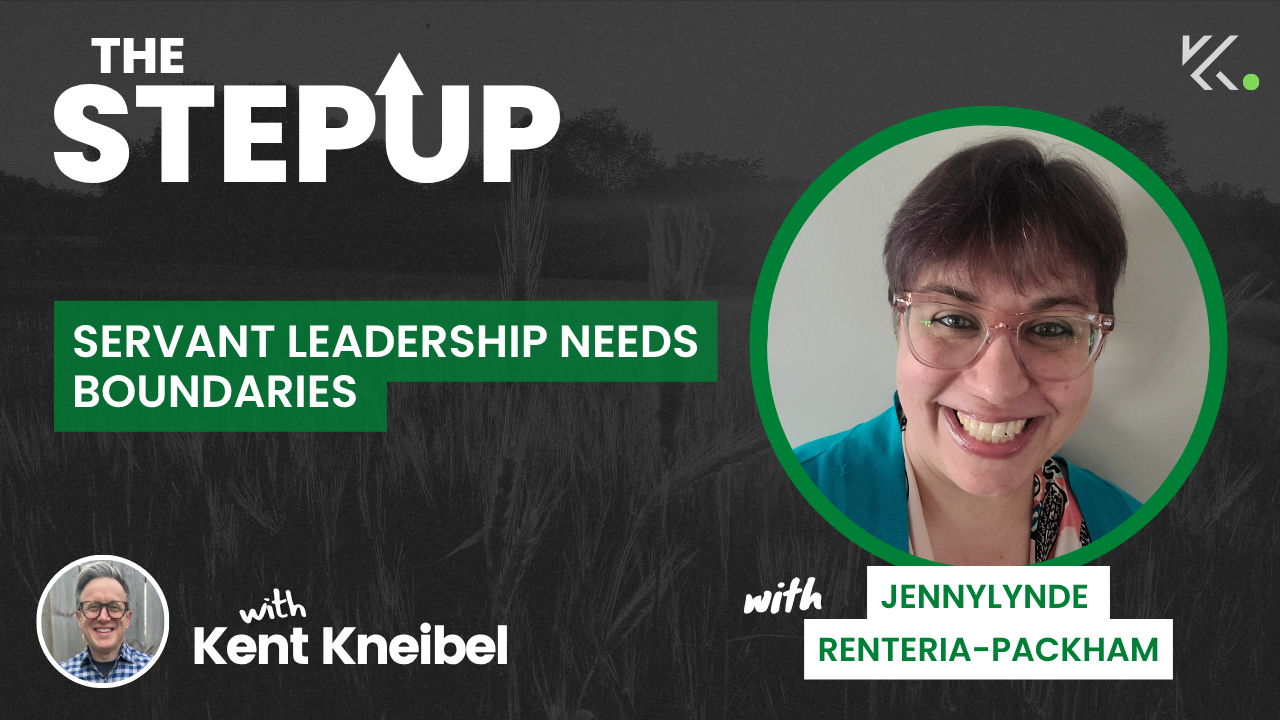
Newly promoted leaders keep their calendars private and their doors closed, then wonder why their team assumes they've stopped doing real work. Jennylynde Renteria-Packham spent two decades leading in long-term care and rehab hospitals before becoming an executive coach, and she joins Kent to talk about servant leadership, boundaries, and why transparency might be the most underused leadership tool there is.
Guest: Jennylynde Renteria-Packham spent over two decades leading in long-term care and rehab hospital settings, from director of nursing to director of quality, before founding Courage Coaching, where she now coaches leaders at every level from new manager to CEO.
In this episode:
- [00:50] — Meet Jennylynde: from nursing assistant to director of nursing, quality, and executive coach
- [07:49] — The mindset shift nobody warns you about when you're promoted off the front line
- [11:11] — Why healthcare leadership isn't as unique as it looks, and where it actually is
- [20:06] — The day two of her own staff called her in over an attendance policy
- [22:50] — Her working definition of servant leadership: humility, decisive ownership, and never throwing a team member under the bus in public
- [35:20] — "Make your calendar public": transparency, boundaries, and avoiding burnout
- [45:12] — Leader standard work: documenting your job so your successor doesn't inherit a mess
- [50:00] — Her advice for leaders chasing the next promotion, and leaders who just got one
Resources mentioned:
- Radical Candor by Kim Scott
- Leader standard work (Toyota Production System concept)
- Transforming Health Care: Virginia Mason Medical Center's Pursuit of the Perfect Patient Experience by Charles Kenney
Links for today's show:
- Jennylynde Renteria-Packham on LinkedIn
- https://couragecoaching.us/
- Kent Kniebel on LinkedIn
- The Promoted Leader Toolkit
Music for this podcast comes from a live recording of the song Needle & Thread and is provided with permission by Pert' Near Sandstone. Check them out on pertnearsandstone.com and on all major streaming platforms.
Enjoyed the episode? Leave a rating and review wherever you listen — it helps more leaders find the show.
Jennylynde Renteria-Packham (guest)
00:00:03.600 - 00:00:47.710
Make your calendar public.
You know how to make something private.
We all know how to use Outlook.
This is the year of our Lord 2026.
You can do this.
Make your calendar public.
Because people need to see your blocks of work for working on budget for four weeks every fall.
They need to see that every single day.
You have to spend an hour on the schedule.
They need to see how what you're doing outside of what you used to do next to them.
Because just like you didn't know until you got the role, they don't know that you're actually working.
So it's things like, open door policy is great and what does it mean when you shut your door?
Do people come in anyway?
Because you need a sign that says, please check my calendar before knocking on this door.
Kent Kniebel (host)
00:00:50.350 - 00:01:54.980
Hi there and welcome to the Step up podcast.
I'm your host, Kent Knievel.
Every week I talk to experts who focus on helping leaders step up their leadership game and leaders telling their stories of growing up through the ranks.
If you're new to the show, do me a favor and subscribe so you never miss an episode.
One last thing.
As a leadership development consultant and executive coach, focus area of mine is supporting newly promoted leaders.
One in three promotions fail because we never teach newly minted VPs how to stop being a director, or a newly promoted director how to stop being a manager, or that's you.
Or if you support a leader who has been recently promoted, I encourage you to visit my website at Kent Coach Toolkit and download a free copy of the Promoted Leader Toolkit filled with practical advice and tools to help new leaders stick the landing and truly step up to their new leadership level.
All right, I've dillied and dallied long enough.
On with the show.
Welcome, everybody.
Today we're going to be talking about serving servant leadership.
And with me for this conversation today is Jenny Lind Renterira Pakman.
Jenny, welcome to the podcast.
Or Jenny Lind.
Sorry, I should say the whole word.
Jennylynde Renteria-Packham (guest)
00:01:55.460 - 00:01:59.300
Hi, there is Jennifer, because I think you're talking about somebody else.
I'm definitely Jenny Lind.
Kent Kniebel (host)
00:02:00.260 - 00:02:14.070
There's a song by a artist that I love.
He was the lead singer of Soul Coffee, and his name is Mike Doty.
He's a solo artist now, but he had a song he put up maybe 10 years ago called 27 Jennifers about his high school experience.
Jennylynde Renteria-Packham (guest)
00:02:14.470 - 00:02:16.590
Yeah, so I was going to say that sounds like my graduate.
Kent Kniebel (host)
00:02:16.590 - 00:02:33.750
Yeah, yeah.
Clearly a Gen X guy.
Anywho, well, that's not what our episode's about today, but well, thank you for being here.
And before we get into the topic, for the audience who does not know you, would love for you to walk us through whatever of your background and career that you'd like to walk us through.
Jennylynde Renteria-Packham (guest)
00:02:34.550 - 00:06:28.350
Sure.
Thank you, Kent.
And thank you again for having me on your podcast.
I feel like I'm joining an illustrious group of other leaders and leader trainers who really have a feeling for wanting to help others be great leaders.
And that's what I am passionate about as well.
And that probably comes from my lengthy experiences having both amazing leaders and not so amazing leaders, trying to follow them through.
And my experience is healthcare.
I very early on became passionate about care of the elderly and started out as a nursing assistant in long term care.
Went to college the first time pre med, thought I was gonna be a doctor, had grown up thinking I was gonna be a doctor, and then graduated and had a realization that it was very cure focused and not holistic enough for what resonated with my soul.
So went back into long term care, had a friend who was in nursing school who said, oh my gosh, you should be a nurse.
And I went, oh my, who wants to be a nurse?
Because I had worked for so long in long term care and watched those nurses work so hard, it was really not where I thought my path was.
But she convinced me to reach out and those were given away my age because I reached out in June and there was still a spot for that August class for me to join in.
So joined in, went to nursing school through that time, of course had experiences in other kinds of care, but really loved long term care and giving our elders the best they could have at the end of their life.
So went back to lunchtrum care, quickly became a director of nursing and from there stayed in leadership roles.
Now, as we talked about with the servant leadership, my idea of a leader is I'm going to do whatever it takes, right?
I'm going to get out there and help folks and to be there with them.
So director of nursing and long term care was a nursing home, a whole that moves up to a whole campus eventually, right?
So we've got everything from independent living through those memory cares.
Then I had a colleague who was working part time for me come and say I have a job for you.
And I said we're out of J, we shouldn't be talking about this year.
But she sent me an email and it turns out that her boss at her other job, which was a director of quality in a different large complex in our area, was leaving and I It really again resonated with me and I thought this is a great way to help even more people.
So again, as a leader, I was really thinking about how do I affect the most lives in long term care as possible?
Teaching, teaching in the nursing assistant program so that other nursing assistants did a great job and then leading others and making sure they had what they need to do a good job.
So then director of quality was a really nice transition for me.
And then I was again invited by a colleague to think about director quality in a rehab hospital, which was a whole other side of medicine.
Frankly, I didn't even know about.
Right.
Rehab and long term care.
People are already frail elders, they get injured in some way or have a health crisis, they end up in long term care and more often than not they end up staying, at least in the time period we're talking about.
And I've been out of that well for 10 years now.
So it may have changed, but that's how it was when I was there.
And so rehab hospital was this amazing experience because just three weeks of rehab and we had people come in with spinal cord injuries and walk out or wheel themselves out, but get to be in the fancy exoskeletons or all these different cool things.
And so it was really amazing to get to be a leader in that different setting and again, helping grow people up and getting some other folks into leadership positions because I could see that they would thrive in that.
So I that's part of what I've been so passionate about my career.
And then that led as the COVID burnout got so many of us who were at the bedside in long term care and even as a director of quality at the bedside as often as not into that coaching realm and really thinking again about how can I help others get the best service of whatever healthcare in particular, but whatever kind of service.
And it's helping their leaders be the best they could be, which is what led me into the coaching realm.
And here I am now doing executive leadership coaching for every level, from a new manager to a CEO.
Kent Kniebel (host)
00:06:29.070 - 00:07:49.600
Nice.
I find that.
Okay, there's a few things that you said here that I think are just sort of interesting to point out.
Right.
It sounds like you went from one helping profession to another, which I think is, you know, interesting.
And yet if you think about it, you know, I definitely had these times in my career when I was working, you know, in the consultancy in particular and we're doing these big programs for big companies.
And you know, there sometimes there was this conversation of I wish we could do more, you know, for more people.
Right.
And, you know, we're, we're dealing with the cream of the crop, the top 100 in the company or whatever.
And part of the conversation that we would end up having is the how the work you're doing to help build leaders, how that diffuses, so to speak, or disseminates, so to speak, into, you know, if they become a better leader, they lead better.
The people under them have a better experience.
You know, work is what, 70% or so of our waking lives.
So that's important.
And then the other thing.
So I mean, interesting that you went from like one helping profession kind of into another, which sounded like a pretty smooth transition because you had kind of risen in the leadership ranks anyway.
So you were already building leaders under you.
Jennylynde Renteria-Packham (guest)
00:07:49.600 - 00:08:30.670
And mindset change, though, to.
And sometimes newer leaders really have to come to terms with that.
Right.
When you take someone because they're great at their frontline job and so you promote them to a manager job, they may be great as a manager, there's caveats there and some training needed.
But if they succeed in that role, they are still a huge mindset change of.
I'm not working anymore.
Right.
I'm not helping someone get up, get dressed, go to the bathroom, take a shower.
I'm overseeing the people who are.
How does that matter?
Right.
And so you really need to do that mindset change of I, I can actually have a more broad spread.
Broad spread effect.
Kent Kniebel (host)
00:08:31.150 - 00:08:31.710
Yeah.
Jennylynde Renteria-Packham (guest)
00:08:31.710 - 00:09:06.879
By supervising these people well and making sure that they have the skills and the knowledge and the actual materials to do their job the best they can, as well as.
Here's that other ugly caveat.
When you're in a new leadership.
Right.
Helping people realize if this is not the right role for them, if they're not going to succeed here.
That is also, I think, a sign of a great leader.
If you can help when you're recognizing that people are not thriving in their role, to be able to coach and guide them into the right role or into a different industry, sometimes it's inviting.
You want to invite them to consider it before you have to invite them to work someplace else.
Kent Kniebel (host)
00:09:06.879 - 00:11:11.160
Right.
Invite them to leave.
Yeah, that's a great point.
And I think it's.
It's so common across the board.
Right.
That the best.
Yeah.
And that the best team member gets tapped to become, you know, the team leader when, when there's an opening.
And I feel like the medical industry gets picked on perhaps a little unfairly and some of it is perhaps on both sides of the fence.
Like I think folks within the medical industry can have their blinders on and think we're very unique.
Terminal uniqueness, as we might want to say in, in this.
Like, I have trained my life to be a world class cardiac surgeon and suddenly the administrator of the hospital taps me on my shoulder and says, guess what?
Now you're the chief of cardiac surgery or whatever, or whatever those titles are.
And so I know from a consulting perspective, for years I've even probably parroted this.
Like, gosh, it's so unique in the medical industry that these people who train their entire lives.
I think now that I'm talking out loud because I'm an extrovert.
I think what might be unique about it is sometimes the tenure at which you get tapped sometimes can be much later in career than perhaps in the corporate side.
I'd be curious what your, what your take on that is.
But before I go there, the reality is that it's like that everywhere, right?
The react like I don't know, I don't know what the numbers are.
I'd have to look into the research.
Like how many people go to school to be a manager, right?
No, I don't know that many people.
Do you go to school to become an accountant or.
Let's just go with that for a minute.
You go to school to become an accountant and maybe you show some leadership skills, maybe not.
But you're the best accountant or maybe you're just the best accountant and there's a team lead role open and you get tapped for it.
So there's part of this, like what makes that, you know, and perhaps what makes that so unique in the medical industry though is the sort of direct hands on, at least on the, on the provider side.
I don't know, I threw a lot out there.
What's your thoughts on that?
Jennylynde Renteria-Packham (guest)
00:11:11.720 - 00:11:52.510
Yeah, I think that it does happen everywhere.
I think you're absolutely right.
And I have coached folks.
I've come across folks or folks who come across me wanting coaching from all kinds of different industries, which is I love because then I get to learn like I didn't know about grocery stores, so I was coaching a regional manager.
That was fascinating.
I didn't even know about some different aspects of healthcare until got to coach some of those leaders in those areas and learn about that.
So even as a coach you get to learn so much more about others and it's so exciting to me.
It's part of the passion of it in healthcare.
There is the extra layer of licensure and this is the conversation I've had sometimes because, yes, there's hospital administration.
Kent Kniebel (host)
00:11:52.660 - 00:11:52.860
Right.
Jennylynde Renteria-Packham (guest)
00:11:52.860 - 00:13:26.430
Hospital admin, technically, there's a manager, supervisor, director, VP who oversees that frontline worker.
And in almost every frontline worker role, there's also that medical overlay piece.
And so the conversation I've had with providers is it doesn't matter that you don't sign their paycheck.
When you're in the room and you have the highest licensure, people automatically you're the kind of de facto leader.
And so you don't get to throw things in the OR unless you want that to be the normal way that we act in the or.
You don't get to have a fit in the hallway in front of a family member of a patient because you're angry at something that went wrong or because the pharmacy didn't have the meds or because somebody couldn't read your order properly.
You have to model behavior.
We want regardless of whether or not we actually sign the paycheck.
And that, I think, applies to leadership teams in any industry.
Right?
The leadership teams that quickly turn toxic because they have one person that they get away with some really unprofessional behavior is similar.
That's the mirror to providers who say, I, but I don't want.
I didn't get into this to be a leader.
Sorry, Charlie.
Yeah, Maybe you should have been a nurse then, because I don't.
You could stay in the background and not always have to be the leader as much when you have a lower licensure title.
But when that's the person who decides how the care of an individual patient's gonna happen, we are all gonna default look to you to have the final say because you have to write the order.
Right?
Kent Kniebel (host)
00:13:26.510 - 00:13:26.910
Yeah.
Jennylynde Renteria-Packham (guest)
00:13:26.910 - 00:14:26.950
Ma' am or sir, you are the one writing the order that says how this person gets.
So you are a leader even if you didn't sign up to be one.
But I think you're onto something else, which is in a lot of places, especially hospitals are teaching healthcare systems.
They don't have a lot of choice about whether or not they get.
So it's one thing if you're that great accountant and there's six of you and somebody comes and says, we think you'd be great for this job, you could probably go, no, thank you.
I'm a great accountant.
I want to stay here and I'm happy with what I do and I want to go home.
At the end of the day, they don't necessarily have the ability to do that and keep their jobs.
And some of these larger medical systems, especially the teaching systems, it's more like they not tap you on the shoulder and say you are going to.
And that's where your point about whether you're a younger provider or a closer to retirement provider, either way, when they say, nope, this is actually your job now, a lot of times they don't cost you.
Kent Kniebel (host)
00:14:27.110 - 00:14:27.910
Yeah, yeah.
Jennylynde Renteria-Packham (guest)
00:14:27.990 - 00:14:30.550
It's not really an offer.
Right.
It's like being found.
Kent Kniebel (host)
00:14:31.110 - 00:15:27.060
Yeah.
Interesting.
Well, I guess I hadn't really thought about, you know, how a, a care team is assembled around a patient.
Right.
And which also changes every, what, six to 12 hours throughout the day as well.
But yes, I mean, I guess I hadn't quite thought about the fact that like you might not have a manager title as a doctor, but you are the one who is legally responsible for the care of patient A.
And there's about anywhere from three to 10 other people within, you know, the hospital who are going to be interacting with and providing some level of care to this person.
And like good, bad or otherwise, or like it or not, you're.
You become kind of a de facto manager of this at least the care.
Right.
The care for that team.
Jennylynde Renteria-Packham (guest)
00:15:27.060 - 00:16:23.230
Yeah, the care which, which is supervisor.
The phlebotomist has a supervisor, the therapist has a supervisor.
And all of those people play a part in the team.
But yes, they're acting on the orders, literally written computer, written orders of that primary provider and whatever the setting is.
And it, it adds an extra layer of fun because we all like to be thought of as equals.
And there are things like phlebotomists are amazing people and they can get sometimes, even though I've been trained, cross trained to do some of that work as a nurse.
Wow, the things that those therapists can do to get folks literally back on their feet.
A stunning, amazing work.
That's not something that the nurse or the phlebotomist or the doctor can do.
Right.
So we all do play a part and we still, for the craziness that is the healthcare system, have to be acting on a lot of times position orders.
So.
Kent Kniebel (host)
00:16:23.230 - 00:18:27.560
Yeah, well, and so, you know, here I'm, I'm thinking out loud about like, I'm trying to challenge my, trying to challenge the assumption of how unique it really is.
But then I keep coming back to another, another layer as to why it's unique.
So let me, for example, in consulting, sometimes design agencies, ad agencies, still consulting, I guess you could call those even in my background, you know, when I worked for a consultancy, you know, project was Sold.
And so you've got, you know, perhaps the key salesperson and then maybe they put a key consultant on it.
They are now the engagement manager.
And then a team kind of comes together from kind of different specialties to come and sort of deliver upon that client project.
So there's this part of me that's like, I don't know, maybe it's not that unique because, like, here's how consulting works.
But then I kind of come back to the statement I made earlier, which is, yes, but in consulting, those teams usually are pretty static still, like for that project, right.
These six people are going to be working on this project, period.
You don't have them, you're not working on it 24 7.
And you're not trading out team members every 12 hours.
And maybe someone's sick and a float nurse from a different department or temp comes in and now they're on your team.
Right.
Like, that doesn't happen in sort of the consulting space the way it happens in the medical industry.
So they're also.
My guess is, and I'd be curious what your, what your take on this is.
There's a certain level of trust you must have to have.
Like, and you have to have trust in the corporate environment too, right?
You do.
But like, there's gotta, there's, there must be a certain level of trust you have to have that people are trained and know what they're doing, even if today's the first day you've met them or you don't have the luxury of two years of experience with this person.
Right.
Because people probably rotate out pretty fast too.
Jennylynde Renteria-Packham (guest)
00:18:27.560 - 00:19:52.290
In the medical industry sometimes there are absolutely places and teams where a portion of the team has been there for decades and there are other places or other parts of even that team where you'll have those three or four positions that are rotating because it's the person who just got out of college, they're getting their experience and then they know they have another specialty in mind or they're going back to school for their advanced degree or so there's some rollover.
But yes, there is.
It's so fascinating that you bring that up because I think there is this absolute.
It's blind trust.
I think it's a choice we make when we're in healthcare.
We are choosing to trust everyone until they prove to us they cannot be trusted.
Which fascinatingly enough, as I said, that alone, I think.
Oh, yeah.
That's why sometimes leaders have a problem, because regardless if you're the physician leader or the manager, Supervisor, senior vp.
We got into healthcare because we want to help people.
And so we decided, or got taught somewhere along the way that we have to trust the others.
We can't be there 247 caring for the people in our care.
So we are going to trust other people to fill those gaps when we're gone.
And therefore, when we've done this blind, blanket trust until proven otherwise kind of attitude about our work.
And then you're in leadership and you're watching someone who's proving themselves to not be trustworthy.
Yeah.
Kent Kniebel (host)
00:19:52.290 - 00:20:04.800
And you can cover for one another, you know, on the corporate side, a little easier.
Right.
Because we're not necessarily dealing with life and death and.
Or life and limb, you know, put it that way.
Jennylynde Renteria-Packham (guest)
00:20:05.520 - 00:20:06.000
Yeah.
Kent Kniebel (host)
00:20:06.000 - 00:20:06.800
Yeah.
Interesting.
Jennylynde Renteria-Packham (guest)
00:20:06.800 - 00:22:50.410
Yeah, I. I think that.
Yeah.
No, I'm having this whole epiphany on your podcast because now I'm gonna.
When folks are struggling.
Cause I did that.
I had these amazing staff when I was the director of the entire campus.
I was trying to be really nice.
And so I was super lackadaisical about our attendance policy.
Right.
I didn't want to fire people over tenants.
I had a lot of single moms.
I had a lot of people of color and other minority groups.
And I really wanted to be that supportive boss.
And I had two of my leads one day, ask to see me in my office.
And I thought, oh, wonder what's happening.
So naive.
And I go and I sit down, and they said, we love you.
We love working for you, but if you don't knock it off, we're going to quit.
And I said, what are you talking about?
I'm trying to be.
I'm supportive.
And they said, you are letting people walk all over you.
And you have a policy.
You wrote the policy.
You published policy.
You made us all sign the policy.
Jenny Lind, stick to your policy or we're leaving.
And I was.
It was shocking.
It was so shocking to me to have them call me out, call me in.
We call it calling.
Call me, ask me to lean in now and say, there is a balance between wanting to be nice and understanding and supportive of your team and allowing yourself to be walked all over.
And I wasn't doing it well.
And so I've always looked back so fondly on those women who really helped me.
And they reported to me.
Right.
This wasn't even like a mentor relationship, and I've had some great ones of those, too.
But this was frontline staff who came to me and said, you can do a better job.
And that speaks to two things.
One, I could do a better job, and two, that I had built a culture that they could come and correct me.
Because I think that's the other thing which maybe is part of servant leadership, but maybe it's just part of what I chose for how I wanted to be a leader, is that I used to be frontline staff.
Right.
I know what it's like to have good ideas or to see problems or to see solutions and not have anybody listen to you.
And I never wanted to be that kind of leader.
So one of the things for me as I was formulating what sort of leadership I wanted to present the servant leader of I'm not too good to do a work or to help do work.
So I can wash a dish, pass a tray, sweep a floor, empty a garbage, help a resident go to the toilet, or help transfer a resident.
I actually used to be really good at that and pretty strong.
So I could move a resident in a bed with another team member so that nobody got hurt.
I could do all of that and still do my leadership jobs of scheduling and supply ordering and medications and all the other pieces.
Communication with our regulatory agencies.
Right.
As a director of quality, you're like the face that the direct commission gets to see when they come into your rehab hospital.
Those were fun times.
Kent Kniebel (host)
00:22:50.490 - 00:23:26.020
Yeah.
So let me.
Let me.
Let's take a quick step back because, you know, one of the things we wanted to talk about today was servant leadership.
So I appreciate you kind of bringing us full circle back to that because I could wax philosophical and on, you know, medical versus corporate kind of leadership for even longer, I'm sure.
But I know, you know, this is something you talk about, think about, work with, you know, so how do you.
What would be your.
You know, and this doesn't have to be polished by any means.
Like, what's your definition of servant leadership?
Like, how do you define it?
Jennylynde Renteria-Packham (guest)
00:23:27.220 - 00:23:30.620
That is a great question.
Now I feel like I'm in the hot seat.
Kent Kniebel (host)
00:23:30.620 - 00:23:32.980
Ah, sorry, I didn't mean to wait.
Jennylynde Renteria-Packham (guest)
00:23:32.980 - 00:27:53.980
No, it's a fantastic question, and I love the challenge of defining it in words.
I think for me, one of the biggest pieces of a servant leader is remaining humble.
I too, stumbled into my leadership positions.
They, the universe, whichever God we're believing in, whatever unsci, scientific, uncaring universe put in front of me, the next step in my path every time, and I had to choose to take it or not.
So it wasn't that I was, like, hungry and striving for leadership roles.
It was never my goal was to be a CEO.
Right.
Because I left that particular path before I became a CEO because it really wasn't my goal.
My goal was to make sure that our client, whatever client looks like, gets the best possible service and product from us.
To do that as a leader, it means that I'm helping the frontline staff be as both effective and efficient and happy in their role as possible.
Because when staff want to come to work and they want to do a good job, everything else is smoother.
So I absolutely has always thought about and smoothing the road for everybody and making sure that the physical materials to do the job were there, but also that all that other support was there for folks because While we spend 70% of our awake hours at work, it isn't actually our whole life.
And so for me, as a servant leader as well, it's helping people figure out what is your work life balance?
What does that look like for you?
How does that manifest in the workplace?
So sometimes that's saying no, I don't think you can actually have that over time.
I'm watching you.
You've been in my office four times this week complaining about struggles at home that aren't about you need more money, they're about you.
You need the time and the presence of mind to deal with those things at home.
So I'm going to ask you not to volunteer for that shift that just came open because yeah, sure, it's great.
Who doesn't love having a little overtime money?
Right?
And that's in every industry.
And so really encouraging folks to increase their self awareness has been part of my servant leadership.
So not only is it never, I'm never too good to do whatever task needs to be done, I don't know everything.
And I really want to hear from the people who know their job what can be better.
And yeah, I think the other, oh, the other piece would be but I'm not afraid to make a decision.
Right?
So as a leader, the leader side of servant leader is somebody has to be in charge, somebody has to make a decision and I'm never going to be the person who's going to hem and haw and not make a decision.
In fact, I would say to folks, okay, I'm making the decision and if it's God awful mess, you're going to tell me, we're going to clean it up.
But we have to move forward.
We cannot stay in this room chewing the fat on this issue for any longer.
We've heard all the different sides.
We could.
I think this is the right direction to Go based on everything you've shared with me.
And so I'm gonna make the decision.
I'm responsible for the decision.
And so if it's a mess, you get to tell me, and I take responsibility for the decision, and we'll move forward together.
And if it's not good, we clean it up.
And if it's good, you get to celebrate.
Cause you enacted this decision.
So I don't.
I'm not a fan of taking credit for stuff other people do.
And frankly, as a leader, there's a lot of stuff that I could take credit for.
But it's not me.
Right.
It's the people who work on my team who are willing to commit to making things work for our clients.
And so that's the piece there where I am very passionate about.
I pass the kudos on.
But the buck stops here on the responsibility for things that didn't go well.
And that means in public, too.
Right.
I don't have to agree.
I don't have to agree with what somebody on my team did.
But in public, I'm going to say, I hear you, Kent, and I'm so sorry that your loved one got the treatment that you are unsatisfied with.
And that is my responsibility.
And I take full responsibility for the fact that you feel there was a negative outcome.
So thank you for bringing it to my attention so that I can fix it and then I can resolve it with you.
Now, I might have to go to a nurse and say, I need you to never do that again.
Kent Kniebel (host)
00:27:54.220 - 00:27:55.460
Yeah, Right.
Jennylynde Renteria-Packham (guest)
00:27:55.460 - 00:28:23.310
But I am never, in a client going to throw a staff member under the bus.
The problem is mine, because I'm the leader.
And I will have that corrective conversation in private later, and we'll talk about.
To get a hold of me or how to make a better decision so that kind of negative outcome doesn't happen again.
But we never throw staff members, team members under the bus.
So that's the other side, I think, of servant leadership.
For me, that's really important because I've watched too many leaders do that.
Right.
Kent Kniebel (host)
00:28:23.470 - 00:28:24.150
Yeah.
Yeah.
Jennylynde Renteria-Packham (guest)
00:28:24.150 - 00:28:32.190
That are trying to make you feel better.
And they say, oh, my gosh, Kate was Lisa.
It was her fault.
I can't.
My best friend Lisa is going to listen to this and be like, come on, she's in her soup.
Kent Kniebel (host)
00:28:32.190 - 00:28:32.590
Yeah.
Jennylynde Renteria-Packham (guest)
00:28:33.640 - 00:28:40.520
One of my best friends is a nurse, too.
So I'll use Lisa and be like, oh, Lisa did it.
But I'll go talk to her.
Right.
I've seen leaders do that.
Kent Kniebel (host)
00:28:40.920 - 00:28:44.200
And that's.
That's not.
That is not isolated to the medical.
Jennylynde Renteria-Packham (guest)
00:28:44.280 - 00:28:44.920
Not at all.
Kent Kniebel (host)
00:28:45.000 - 00:30:26.090
At all.
Right.
I think I've had, definitely had some opportunities to lean in on.
And this is one thing I was going to say earlier too, which is, you know, the informal leadership that shows up.
Right.
In the medical industry too, because we look to the nurse who has the most experience on the floor, whether or not she's the manager or not, to provide guidance or we look to the senior doctor, you know, for guidance, even if they don't have a manager title.
Same thing happens in the work in the corporate sphere.
Two and I, you know, I have certainly had these, these experiences of, you know, having to call.
I was encouraged by my boss to call a senior consultant who was probably 25 years older than me after he had said some unsavory.
Is making it sound worse than it was, but unsavory things about a product that we had in front of, you know, hundred plus salespeople across the nation.
And I had to call this person and say, you know, I just want to give you some feedback here that everybody listens to you.
You are a, you know, whether or not you're elite, like an official leader in this company, you are a, you are looked at as a general around here.
Right.
And so when you say something, people listen.
So when you, when you said this thing about this product, you've now given a hundred people the disincentive to sell it.
Right.
And does it need things to be fixed?
Sure, yeah.
Jennylynde Renteria-Packham (guest)
00:30:26.650 - 00:30:27.370
Doesn't everything.
Kent Kniebel (host)
00:30:27.530 - 00:31:19.180
Doesn't everything?
Right, right.
And I've kind of had these other experiences too, you know, and most companies I've worked for have had this because HR is very, is a very diffused function.
For example, right.
You have corporate, corporate center roles.
You've got roles that are sitting in the business units or whatnot.
And there can be tension across them, you know, and certainly there's been this like one HR mantra, right.
In some companies.
And you know, I know.
And so kind of coming back to what you were talking about, like some people are better than others at saying that is really good feedback.
This is a real challenge, you know, we will work on it.
And, and versus saying I hear you, learning and development sucks, they never get this stuff right.
Or, you know, yes, comp and benefits, they are really rigid, you know, and, and, and yeah, okay, so I want to.
Jennylynde Renteria-Packham (guest)
00:31:19.900 - 00:32:26.860
They're passing the buck.
And I think the other place where leadership could really use some better and leadership in every, every industry, in every department is some of that psychological training.
And because so my other best friend, Margo, is a therapist.
And I have to tell you the things I have picked up just in our friendly conversations that I can turn around and apply in a.
When I'm in a leadership role or in a coaching role, watching another leader struggle.
And I say, hey, did you.
Because one of the things is that I often use with all my clients is I need you to listen to how you talk about yourself.
That like right off the gate.
One of the very first things that almost all of my clients, we have to have that conversation because they talk so negatively about themselves.
And I think, and I've said to them, would you ever let anyone talk about your spouse or your best friend or your team?
Like, because I just heard you say some really terrible things about yourself and I have some bad news for you.
Your brain can hear you.
Kent Kniebel (host)
00:32:27.020 - 00:32:29.100
Yeah.
Oh, yes.
Yeah, yeah.
Jennylynde Renteria-Packham (guest)
00:32:29.180 - 00:33:09.060
And so knowing that there's, there is a whole scientific theory about how we can help ourselves, change ourselves, but also help others.
And you know, when you've experienced a leader who has some of that knowledge versus the ones that don't, right?
When they don't have any idea of self awareness of how what they say is affecting both themselves or others, and then you watch the team not thrive.
And as a coach, I don't know, you also probably had the experience where like, okay, how do I say that in the way that they can hear it?
Because they really need to hear it because they're taking their own team.
It's not about the team, it's about them.
Kent Kniebel (host)
00:33:09.060 - 00:35:19.340
Yeah, well, so let me.
Right, so there's elements of servant leadership that, you know, in my sort of thinking, it is an external focus, right.
Servant leadership is a focus on my people.
How do I get the best out of them?
How do I do the best for them?
Right, that, that it, you know, at its core, servant leadership is about, you know, serving my team so that they can serve the mission or whatever as best as possible.
And, but there's, there's an, there's an element here I would like your take on though, right?
Because I think even in your own example is the, you know, the unafraid to pitch in, you know, rolling up one sleeve when one needs to as well.
And something I talk about in leadership quite a bit.
And so I don't know if this is a challenge, but I want to, There's.
I think there's a nuance here that I'd like to get your take on.
Because, because let me, let me give you the flip side of this, which Is the flip side of the pitching in part not the servant leadership part.
New leaders and particularly not just brand new leaders but, but leaders who are just promoted in particular, doesn't matter what level, have to learn to leave the old role behind.
And, and the unlearning that needs to happen is, is regular through your career every time you, you know, are promoted, you got to unlearn, right?
What you know, I'm now a direct, you know, I'm now a director.
I need.
How do I stop behaving like a manager and start behaving like a director.
And so there's this element of when that unlearning isn't happening, you tend to see leaders pitching in a lot.
Right.
You see them rolling up their sleeves all too readily making sure their name is attached to high visibility projects, not just their team.
So what's the nuance for you in terms of how you think about that in terms of pitching in in service of the team versus pitching in in service of one's own ego?
Ego.
Definition of success, definition of productivity.
Jennylynde Renteria-Packham (guest)
00:35:20.540 - 00:37:43.280
Two parts to that.
One is that idea of transparency.
So I'm a big.
Because I think what happens in a lot of those roles and you also, this is where if you don't have that carefulness about self awareness, where you end up badmouthing your new role to your old peers is the transparency of this.
I didn't know the role included this.
Right.
So I need to be super.
I've had so many clients like making the hair in the back of my neck stand up who are, I'm like, just make your calendar public.
You know how to make something private.
We all know how to use Outlook.
This is the year of our Lord 2026.
You can do this.
Make your calendar public.
Because people need to see your blocks of work for working on budget for four weeks every fall.
They need to see that every single day.
You have to spend an hour on the schedule.
They need to see how what you're doing outside of what you used to do next to them.
Because just like you didn't know until you got the role, they don't know that you're actually working.
So it's things like open door policy is great.
And what does it mean when you shut your door, do people come in anyway?
Because you need a sign that says please check my calendar before knocking on this door.
Because if you can see that I'm in a meeting with the CEO, don't knock on my door unless the building's on fire.
Right?
So it's the Other piece.
One piece is transparency.
The other piece is boundaries is.
And they go together.
Right.
I have to be able to set a boundary that says when I'm working on something else, I'm not going to come help.
You do need to figure it out and I'm going to share from experience here.
If you don't set that boundary, you will burn out and have to leave a role.
Been there, done that, got the T shirt.
Because you can't not have boundaries for years and then try to set em up.
Right.
It doesn't.
That doesn't.
I shouldn't say you can't.
Some people can and they are able to recover that.
I was in a role where I was simply too immersed in trying to be helpful to everyone else because things were so difficult in that particular workplace and were crumbling around us that I thought I needed to be on the front lines and helping everybody.
And so that meant that I also had to do all of my leadership work at different times.
And then I was a complete burnout.
Kent Kniebel (host)
00:37:43.360 - 00:37:44.240
Yeah.
Yeah.
Jennylynde Renteria-Packham (guest)
00:37:44.320 - 00:37:44.600
Well.
Kent Kniebel (host)
00:37:44.600 - 00:39:28.710
And yet.
Right.
You know, if there was one thing I could wave a magic wand to change in kind of leadership in general, it's the, the establishment of the player coach model.
Right.
That most leadership roles, particularly director level and below.
Maybe not always directors, but certainly director level and below.
I have not necessarily seen a lot of VPs or above with this, but the, the expectation is that the leader is spending, I don't know what it is, 20 to 50% of their time doing work alongside the team, too.
And there's a couple companies out there which I need to try to follow better, who are trying this model of.
Nope, leaders are going to lead and coach and they're not going to do the work anymore.
But interestingly, I think there's like this dual expectation too though, that the employees are.
Have this like, expectation that their manager can do their job too.
And there's, you know, this expectation from managers who used to be employees that are like, I need to prove that I can also do the work.
Right.
But you don't see a CEO, Right.
Diving into.
I mean, they've got to know a little bit about a lot of things, but they're not rolling up their sleeves to, you know, balance the books.
Right.
Their CFO and their team is doing that.
Right.
They're not crafting marketing copy.
Right.
The marketing team is doing that.
Right.
And so there's this.
Jennylynde Renteria-Packham (guest)
00:39:28.710 - 00:39:29.230
Yeah.
I don't know.
Kent Kniebel (host)
00:39:29.230 - 00:39:56.770
There's this, this.
This whole player coach thing kind of gets at me sometimes because what ends up happening is, let's say the intent was 20% of your time is going to, you know, let's put it in the nursing world, like 20% of your time is going to be direct patient care and 80% of your time is going to be management duties.
But what ends up happening is drift.
Drift ends up happening.
And now you're doing 50, 60, 70.
Yeah, you're flipped entirely.
Exactly.
Yeah.
Jennylynde Renteria-Packham (guest)
00:39:56.770 - 00:42:37.349
So I think you talked us back into that trust, though.
Just proving that you do have to trust your team in every industry, not just healthcare.
It may feel more prickly in healthcare because we are dealing with life and limb, as you point out.
However, every industry has that.
I have to trust that marketing is doing the best that they can with what they have, that it is doing the best that they can, that accounting is doing that.
Everybody's doing the best job they can and that if it's not good enough, the CEO will then, or whoever their boss is, will then correct the course on that.
So there's that piece, I think the other piece.
I worked in a health system that used Toyota production, so Toyota production system.
And then Virginia Mason took it out in the west coast, in Seattle, Portland, sorry, I get the west coast state.
It was one of the northern west coast states.
Virginia Mason took it, put it into healthcare because they had some really tragic outcomes.
There's a book about it called Transforming Healthcare they wrote out using Toyota production.
And so working in that idea and the idea of a go and see.
So do I need to know what frontline work looks like?
Absolutely.
You absolutely should.
And everybody up to a CEO can go and see what frontline work looks like.
Does that mean I need to roll up my sleeves and do it?
It shouldn't.
Unless again, there's some really strange outstanding incident where everybody's coming down because we all have to get this knocked out in an hour maybe then the CO is going to actually roll up their sleeves.
But most of the time, the go and see is literally, we used to joke, little mo, big ears like that, like those crazy foxes with the huge eyes and ears.
That idea of, I'm just watching what happens, I might take some notes, I might have some questions, I'm just watching.
And then if I'm seeing from way out here, my leadership perspective that there's a gap after the go and see, I can follow up with some questions, I can maybe offer some solutions, I can ask them for solutions.
Right.
But I just need to know what that work looks like.
I don't need to do it.
And again, I think that's part of that boundaries piece where when you're comfortable with transparency and you know where the boundary is, it's easier to stick to it.
Because then hopefully you're also bringing up the culture and of the team to understand why and where that boundary is.
Because it's a lot easier than when everybody understands that they have boundaries.
Right.
And the same way that, that I'm not gonna come do that work.
I'm not asking you to come do my work.
Right.
And you can see what my work is.
Cause you can see my calendar because I'm not hiding work from anybody.
Kent Kniebel (host)
00:42:37.349 - 00:43:28.070
Yeah, that's.
So I think that's probably one of the most practical pieces of advice that's come out on this podcast yet.
And it's so simple.
And I'll tell you from my own experience, when I worked in the consultancy we had, and this was prior to Korn Ferry buying us, even we had, we had the default setup on Microsoft Outlook at the company was open, was open calendar, but we were also, it was all team project, client, project work that somebody else was scheduling onto your calendar.
And so, you know, they had to know what was on your calendar and if something, you know, if you did have a personal thing or a personal appointment, you know, you were encouraged to market private.
But that didn't mean someone wasn't going to reach out and say, hey, that private appointment you have at one o' clock on Tuesday, is it.
Jennylynde Renteria-Packham (guest)
00:43:28.070 - 00:43:28.750
Are we moving?
Kent Kniebel (host)
00:43:28.830 - 00:44:24.130
Yeah.
Is it movable or what's going on?
And it was actually sort of like, you know, reverse culture shock, I guess, in that way.
Because, you know, even Korn Ferry found that to be odd when they bought us.
Like, what do you mean?
You have open calendars?
And every company that I've worked at since the default is, is private, you know, and I, to your point, the idea of like the, the transparency.
Right, because now I'm gonna, I'm gonna give you the other side of it too, though, which on the one hand, it's like, you know, if your employees are wondering, what does this person do all day?
Well, having an open calendar would certainly show that, which does mean you probably would have to bring a little bit of diligence to filling white space with even a free appointment.
Right.
That indicates.
Here's what I'm doing at this time, if, if you don't interrupt me.
But.
Jennylynde Renteria-Packham (guest)
00:44:24.210 - 00:44:24.850
Right, right.
Kent Kniebel (host)
00:44:24.850 - 00:45:11.190
Because I think for me, like the default would be, I've got all this open time, I know how I'm going to fill it if nobody books Me.
But you'd have to, you know, be pretty diligent about filling in, like desk work, you know, in such a way that's also transparent, but also the flip side of this.
So not only would that be transparent to the employees, but I also think leaders, especially new leaders and especially the leaders who were sort of just promoted, who need to unlearn the old role, have to sort of relearn what plus what plus what equals a productive day at their level two.
Right.
So I wonder, I wonder if part of, you know, a transparent calendar might also help a leader with that to say, write down what you're working on.
Oh, okay.
Jennylynde Renteria-Packham (guest)
00:45:12.200 - 00:48:47.100
Because not only does that help me if I'm a new leader, because I'm gonna say, oh, I need to do the schedule Every day at 3 o'.
Clock.
Once PM shift has come in, I need to figure out, are we good for the next 24 hours?
Cause I've made it through the day.
I know that PM shift is good.
So every day from 3 to 4, I need time on my calendar.
Put the time on my calendar for the schedule.
I need time on my calendar for whatever those weekly meetings and then prep for the weekly meetings and prep for the quarterly meetings.
Oh, shoot.
That's right.
There's a board report due and I'm gonna have to prep for that to make sure that when my Senior VP asks for information on the quarter, I have it ready.
So I think it really helps you get that flow of what that's supposed to the rhythm of the new job down.
I think the transparency would help you feel more accountable to it because everybody can see it.
Right.
Even if nobody ever says anything to you about it.
The idea is that they could if they wanted to, because they can see it.
Yeah.
And I think you could get to a point as a CEO, are you going to put that on your calendar?
No, you're not.
But realistically, is everybody looking at your calendar all the time?
No.
And if they are, when you do a go and see, you bring your handy dandy notebook that's full of three pages of what you're working on when you're not at a meeting.
And you can show, again, transparency is.
Hey, what I do is really important.
I used to say, as the Director of Quality, I'm the one who makes sure you get a job.
Because if Joint Commission comes in here and closes us down, none of us work anymore.
Yeah.
So.
Well, I don't necessarily like the tasks involved with Director of Quality, like policy review.
It's not an option.
I have to be doing ongoing policy review.
There has to be time on my calendar for it so that when the joint Commission comes in here, we can just show them what a great job we do.
And we don't have to be worried that we're gonna get shut down because the records aren't right.
So don't get me wrong.
I would much rather be out there with you helping a patient learn how to walk again.
That's not an option right now for us all to have a job.
This is what my job is.
And I've literally had that conversation with people.
You only have to have me have a couple people, and then everybody goes out and talks, and then out on the floor, everybody's talking about, oh, my God, I'm so glad I don't have done anyone's job, because who would want to do that poster?
Did you see those binders on her desk?
And then, like, the culture begins to accept and respect what the leader is doing, because it's.
There are certainly places and industries and different levels that probably don't need to exist.
Right.
I can't say that it's so efficient in every level, but I can say I've worked for places that don't have the luxury of fluff.
And so there is no fluff.
Every single leadership position is there with a set of tasks they have to accomplish for the organization to continue to exist.
So knowing that if I know that I have the set of duties but nobody else does, am I really doing a good job as their leader?
No.
I need to go ahead and tell them.
And does it matter that for part of the time I went on my director roles, I was overseeing other departments like case management or dietary?
Does the cook need to know?
No.
But does it help so that they know why I'm not down there helping them clean up dirty dishes after lunch when they've been swamped and wear short because somebody's out with COVID Yes.
Actually, it does help them understand that.
In fact, it's not because I don't want to help them.
It's because this task has to get done for this organization to continue.
And so that's where that transparency piece becomes a real mover of culture in a good way.
Kent Kniebel (host)
00:48:47.100 - 00:49:22.520
I'm smiling because I'm like, I think I need to explore this more.
Not necessarily on this call today, but, you know, I'm thinking about, you know, how does one get their successor ready?
Right.
For their role?
If they have a successor, they know this person is going to take over their role, but that that person Has a job to do.
Transparency.
Right.
If you can show this, show your successor, here's how I spend each of my days, here's what I do.
They also then have an opportunity to say, I have no idea what that thing is.
Do I need to know prior to taking your job?
And, and if so, like, how do.
Jennylynde Renteria-Packham (guest)
00:49:22.520 - 00:49:28.880
We start the terminology leader standard work.
This is a Toyota terminology leader standard work, right?
Kent Kniebel (host)
00:49:28.880 - 00:49:29.320
Yep.
Jennylynde Renteria-Packham (guest)
00:49:29.320 - 00:49:51.750
That every industry can do leader standard work.
And there's a million and one different spreadsheets or pretty flowery whatevers to get your leaders standard work.
To say, this is what I do every day, this is what I do every week, this is what I do every month, this is what I do every quarter.
These are things that only happen annually.
And oh my gosh, do I need to train that successor because it hasn't happened and I'm going to be gone before it happens again.
Right.
Kent Kniebel (host)
00:49:51.830 - 00:49:52.350
Love it.
Jennylynde Renteria-Packham (guest)
00:49:52.350 - 00:49:53.350
So, yeah, I love it.
Kent Kniebel (host)
00:49:53.430 - 00:50:00.990
All right, I'm going to bring this plane in for a landing.
This has been, all right, a very fun nation.
So, and I think I've, I've alluded to this a bit.
Jennylynde Renteria-Packham (guest)
00:50:00.990 - 00:50:01.150
Right.
Kent Kniebel (host)
00:50:01.150 - 00:50:49.960
A lot of what I.
A big area that I think about and focus on and it's from both kind of my time on the outside and on the inside of HR and watching leaders who, you know, kind of going back to this idea of successors, watching leaders who we felt were ready and promoting.
And there's a pretty big flame out rate with promotions in general because we don't tend to do a lot to help people the day after they've been promoted.
Understand how to unlearn the old role, learn the new role.
So I, you know, try to kind of end every episode with this, which is, you know, what's one?
And I'm going to throw both questions out for time and you can either try to answer both or just one know.
What's one piece of advice you have for leaders who are seeking that next leadership promotion?
And one piece of advice you have for leaders who were just promoted.
Jennylynde Renteria-Packham (guest)
00:50:50.280 - 00:52:07.290
Okay.
If you're seeking it, start by trying to know yourself.
Because knowing yourself, having that idea of self awareness and what your leadership style, what you feel like resonates with you, will help you immensely as you get into a new role.
If you're in a new role, find your safety net.
Find the folks who support you, who can teach you, who have your back and are willing to give you a little grace as you stumble, because we all stumble in new roles and give yourself a little grace and maybe Part of finding that safety net of folks is finding somebody like you or I, Kent, who's going to be able to help coach you up, share other leaders experiences, both good and bad, to help you learn from them.
But don't be afraid.
Don't be afraid to try things and be wrong.
Right.
As a new leader, I think that's the other thing that can be really immobilizing as we get terrified of making a mistake.
Yeah, I think it's okay to make a mess as long as we own that we made the mess.
I think it's okay to try some things that didn't work.
And one, it keeps us humble.
Right.
Keeps our ego from being too big.
But two, we might stumble onto the right new thing to try or it might lead us to the person who does have the right answer for how things should go.
So I'm all about it's okay to make mistakes.
Give some grace.
Get some grace.
Kent Kniebel (host)
00:52:07.610 - 00:52:35.470
Yeah, yeah, I like that.
Because, you know, when we bring in someone from the outside, the expectation is that they've done the job.
It's more of a lateral move.
When we promote someone from the inside, we know that they weren't in this job before.
And I think one too many leaders try to kind of white knuckle it through and pretend that they have it all figured out too early.
When you probably would have some grace from those around you to say, I don't know, or please help with this or that.
Okay?
Jennylynde Renteria-Packham (guest)
00:52:35.790 - 00:52:51.150
That's the culture you want out of your team.
You want them to come to you and say, I don't know how to do this.
You need to model that behavior by saying, gosh, this is new to me.
I don't know how to do it.
I'm going to find someone to help me.
And then again, the culture push of you being the example, you want to see your team so powerful.
Kent Kniebel (host)
00:52:51.950 - 00:53:27.780
So I have to say this, and then I'm going to turn one more question back to you, which is one of my favorite parts in Kim Scott's book Radical Candor is way at the end, after she's gone through all of her whole model and everything she talks about, how do you build a feedback culture?
It's not by boldly leaning in and radically providing feedback left and right.
It's actually leaning in and asking for feedback.
Right, Right.
That's how you kind of build an actual feedback culture.
So it just resonates with exactly what you were saying.
All right, so for those out there who would like a little more Jenny Lind in their lives?
Where do they find you who should be reaching out to you?
What do you want them to know as we close out here?
Jennylynde Renteria-Packham (guest)
00:53:28.340 - 00:54:05.710
Thank you, Kent.
Yeah, any, frankly, new leaders, established leaders?
I've grown the gamut of folks that I've coached and I've enjoyed all of them.
The best way to reach me is book couragecoaching Us.
And it's us because there is a courage coaching in the uk.
But yeah.
So book couragecoaching Us.
I do.
I say complimentary because it's not free.
It's work.
A complimentary coaching session for folks right out the gate just to get a feel for how I work and to see if it's a good fit and then we can talk about if you want to continue.
So if you book something there, come ready to work on something because we'll figure it out.
And otherwise, my website is couragecoaching Us.
And thank you again for having me.
This has been so much fun.
Kent Kniebel (host)
00:54:06.190 - 00:54:07.790
It was a lot of fun.
Thanks for being on.
Jennylynde Renteria-Packham (guest)
00:54:08.830 - 00:54:09.390
You bet.
Kent Kniebel (host)
00:54:09.630 - 00:54:10.670
All right, take it easy.
Jennylynde Renteria-Packham (guest)
00:54:11.550 - 00:54:12.030
Thanks.
Kent Kniebel (host)
00:54:14.830 - 00:54:36.790
That brings us to the end of our episode.
Thank you for listening.
I'd encourage you to head on over to my website, Kent Coach, and start a conversation with me there.
Or check out my promoted leader Toolkit at Kent Co Toolkit.
Before you go on with your day, please take a moment to leave a rating and a review.
Wherever you listen to podcasts, click the five stars.
That helps put this podcast in front of more ears.
Till next time, take it easy.


