
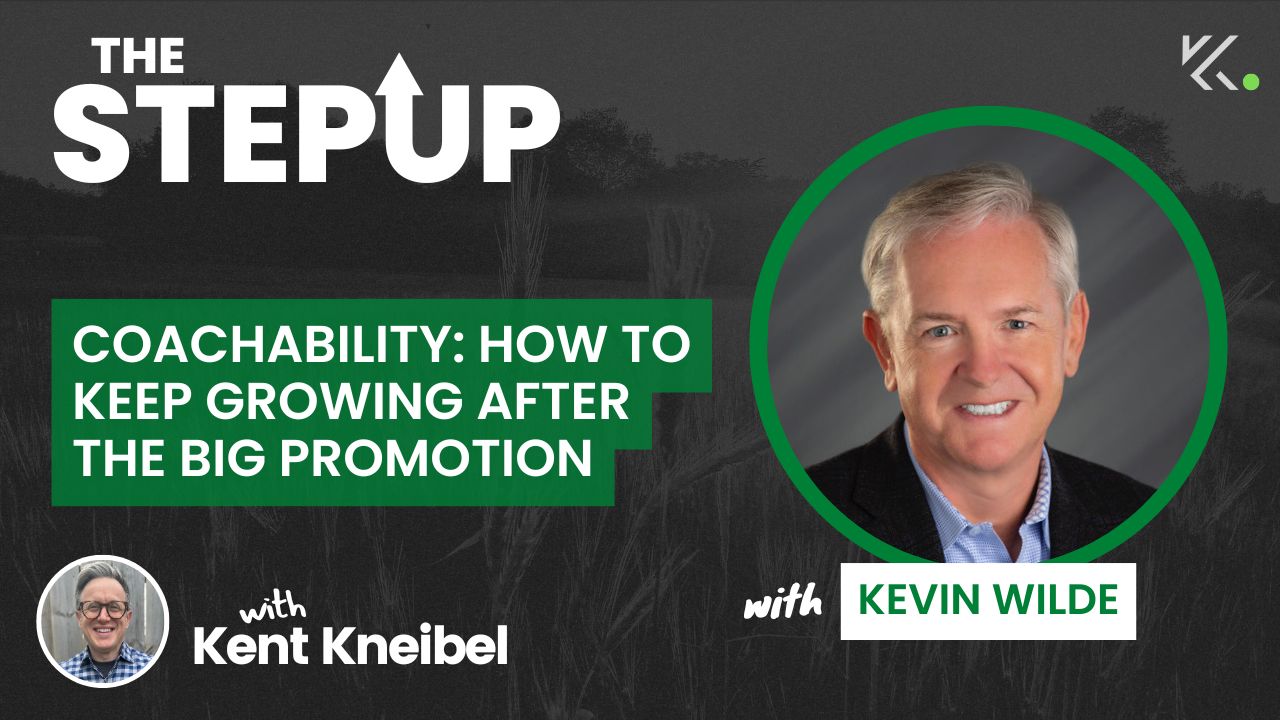
Today’s guest is someone who’s made a career out of helping leaders not just level up—but stay coachable while they do it.
Kevin Wilde is an executive leadership fellow at the University of Minnesota and a lifelong student of what makes leadership stick. He brings over three decades of experience from the front lines of leadership development, including senior roles at General Electric and as the Chief Learning Officer at General Mills. He is also author of the award winning book, “Coachability: The Leadership Superpower”.
These days, Kevin splits his time between teaching Executive MBA students, advising top companies on talent strategy, and researching one of the most overlooked leadership superpowers: coachability.
He’s been recognized with awards like Chief Learning Officer of the Year and named #1 in global leadership development by multiple publications—but what really sets Kevin apart is his curiosity, humility, and ability to make leadership learning both practical and human.
__
Let’s dive into the juicy bits of this chat about the importance of coachability for leaders, especially those who have just snagged a promotion. We kick things off by tackling that oh-so-common mindset that creeps in once you get a shiny new title: “I’ve arrived.” Spoiler alert: that kind of thinking can seriously hold you back. We explore why leaders often hesitate to ask for feedback and how that can lead to a downward spiral in their growth. Our guest, Kevin Wilde, shares some gems on how being open to input is not just a “nice-to-have” but a total game changer for engagement and performance. Plus, we dish out practical tips to help you stay in that learning zone and keep your leadership game strong. So grab a comfy seat and get ready for some insightful banter that could just change the way you lead!
Climbing the corporate ladder is like trying to juggle flaming torches—exciting, but one wrong move and it can all come crashing down! In our latest chat with Kevin Wilde, we unpack the critical concept of coachability for leaders. He’s got some serious street cred, with years at companies like General Electric and General Mills, and he’s here to remind us that just because you’ve got a title, it doesn’t mean you’ve got it all figured out. The conversation kicks off with Kevin’s take on the common misconception that comes with promotions—‘I’ve arrived!’ But, as he points out, that’s often when the learning should ramp up, not slow down.
We explore the research behind why many leaders stop seeking feedback and how this can lead to a disconnect with their teams. It turns out that being coachable isn’t just a nice-to-have; it’s essential for maintaining engagement and building solid relationships. Kevin shares his insights on how leaders can stay in their ‘learning zone’ by actively seeking feedback and reflecting on their growth. Plus, he offers up actionable tips for fostering a culture that encourages curiosity and openness. So, if you’re looking to elevate your leadership game, this episode is packed with practical advice and a few laughs along the way. Tune in for a refreshing take on what it means to be a leader who’s not just in it for the title, but genuinely invested in growth!
Takeaways:
- Stepping up in leadership doesn't mean you've arrived; it's a continuous learning journey, dude.
- Promotions can lead to a lack of curiosity; don't let confidence blind you from feedback.
- Coachability is a superpower for leaders; it enhances performance and engagement across teams.
- Asking for feedback is crucial, but it requires a mindset shift to be open and humble.
- Engaging in after-action reviews can help foster a learning culture in teams, boosting everyone's growth.
- To build your coachability, seek input actively and practice reflective habits consistently, my friend.
Links referenced in this episode:
- Kevin Wilde on Linked In
- thecoachableleader.com
- Coachability: The Leadership Superpower - Book
- Kent Kniebel on Linked In
- kniebelleadershipadvisory.com
**Music for this podcast comes from the song Needle & Thread and is provided with permission by Pert' Near Sandstone. Check them out on PertNeaerSandstone.com and on all major streaming platforms.**
Kevin Wilde (guest)
00:00:04.160 - 00:00:33.700
One thing that happens is this mental attitude of once you're promoted, I've arrived. I've arrived, right? Why would I ask people for input? I had one coach, that coachee that I was working with said, got to a big job, I deserve it.
Promotion, we got to change this place. I got to drive ahead. Why in the world would I ask someone how am I doing or what could be better?
And while I think there's some truth in to some degree, we should be change agents and confident in our skills. Confident doesn't mean the lack of humility or confident doesn't mean the lack of curiosity.
Kent Kniebel (host)
00:00:35.560 - 00:01:59.330
Welcome to the Step Up Expert Voices for leadership Growth. I'm your host, Kent Knievel, and each week I interview experts who focus on supporting leaders and stepping up their leadership game.
One of the areas of interest for me in my own consulting and coaching business is leaders who have been recently promoted.
If that's you or a leader that you support, I do encourage you to go to Kent Coach Playbook to Download my free 90 day success blueprint with practical suggestions on how to hit the ground running. Also, before we really get rolling here on whatever platform you're on, I do encourage you to subscribe so that you never miss an episode.
So don't forget to also, like, comment and subscribe. Appreciate that.
One of the things I wanted to talk about is a topic I keep kind of talking about is that as leaders step up one level to the next, you need to continue to learn what is now required at this role.
And coachability is a topic that has continued to come up as a, as my guest is going to tell you, as a superpower for leaders, especially the higher up in an organization you get. So without further ado, I want to introduce Kevin Wilde, who's here to talk to us today about coachability.
I think you can see behind him if on the video format on YouTube, his book in the back corner there, Coachability. Welcome, Kevin.
Kevin Wilde (guest)
00:02:00.230 - 00:02:12.094
Yes. And that's not the true size. It's bigger than that. But thank you.
Yeah, Ken, looking forward to the discussion and a great topic for both leaders stepping into new roles as well as leaders that just want to up their game in whatever they're doing.
Kent Kniebel (host)
00:02:12.182 - 00:02:22.424
Yeah, no doubt, no doubt.
Well, before we kind of get into the topic of coachability, I would love for people to hear a bit more about your background and how did you end up on the other side of this interview today?
Kevin Wilde (guest)
00:02:22.622 - 00:03:21.750
Yeah. Thank you. Well, a friend of Kent, let's start there and appreciate being part of your series.
And I'M always kind of curious to learn your view on the topic as well and then something of value to people watching or listening.
But my short story is 34 year corporate career, General Electric, General Mills, variety of roles in talent, quality manufacturing, but essentially fell in love with learning and development. Ran some of the executive development programs for General electric and then 17 years at General Mills as a chief loaning officer.
Talent guy retired some time ago but kept up the fascination with the field of leadership and talent development for a dozen years now.
I've taught the executive MBA course on leadership at the University of Minnesota, Carlson School of Business and one other program, supply chain same thing and advise the industry.
And part of my darn curious on leadership turned into this book and a mission of mine about hey, I don't think we're spending as much time as we could on this whole topic of coachability, so delighted to share that with you and your group.
Kent Kniebel (host)
00:03:21.870 - 00:03:31.930
Nice. Well, so let's go there right now. Where did the topic of coachability really come up for you and kind of what caused you to dive deeper?
Kevin Wilde (guest)
00:03:32.350 - 00:05:29.720
Yeah, started with terminations. So there's the upside and the downside of the story. Start with the dark side.
So I was doing talent reviews with the CEO and the senior team in my old place and I noticed every once in a while among our top 500 officers and directors worldwide, there were a few that just messed up and got over their heads.
And these were people that were talented, hard working, great degrees, we love them, we supported them and something went wrong and started doing a postmortem on why is it that that happens everywhere at derailment. And to me, what was just stunning was in my research I looked at their last 360 degree of record last time.
Other people rated them on their leadership attributes and how they're impacting things. And one question kept coming up time and time again. 30 points lower than my average officer director population.
And the question was does this leader seek and respond to feedback? And as I started gathering other information, in many cases it was they shut down their curiosity to learn.
They were just in a doing I know better mode or I'm denying the signals. And that got them into trouble. And of course in that role we wanted to avoid that. So I started digging to okay, what causes it, how to avoid it.
Came up with five or six things that's in my book that can get in the way.
But then part of my academic world, I started doing the research and the two things I picked up is one, in addition to the downside there's an upside that there's a series of studies that show that if you are seen as a coachable leader at all levels, you're seen as a much better leader. You've got better levels of engagement to two and a half times better levels of engagement, performance, promotability, your own strategic.
And on and on and on. I've got it on my website, which we'll share later. The case for coachability. But you just don't hear about it as much.
Nor do this is my second finding. Do.
Do you see a kind of concise view of this is what it is and this is what leaders practically can do about it to avoid being on Kevin's bad list and instead being on the good list.
Kent Kniebel (host)
00:05:29.840 - 00:06:18.622
That's awesome.
Well, before we get into all the benefits that come with coachability, now, I suppose I couldn't say this for every case, but I feel like with great intention, leaders are focused on getting things done, putting up big numbers, closing gaps, meeting goals, things like that. And suddenly they look around and they're just not getting as much feedback as they once did. Right.
So what is it that leads, in your research, experience, opinion, what leads leaders to kind of fall into this void? Because I would say there's probably some grouping of them that it's unintentional. Right. I've just kind of fallen into.
I'm no longer getting feedback.
Kevin Wilde (guest)
00:06:18.806 - 00:07:51.040
There are some factors, if we can go through a few of them, and I've seen them personally that I have to work on.
And I think all of us can think back on the days when we were probably were more curious and more open to learn and curious on tips and techniques, on getting better. But Kent, you're right. We just get really busy. We get very confident in our skills or a lot of pressure.
And the last thing we want to do is have to deal with some input that has us think about how do I change my game in a way that we hadn't expected. So I think coachability can naturally decline, which by the way, is one of the other studies. I went to the firm that did the 360s for us.
They had at the time a database of over 50,000 leaders worldwide, all levels. And we looked at an index of how coachable they're seen against level. And what we found is frontline supervisor, 72% positive. Yes.
You're senior coachable, you're growing, you're beginning your career, you're a sponge, all that. By time we looked at the senior levels again, this is not Terrell leaders. These are all leaders.
The senior level is well under 50%, which is kind of signaling that we're not seen as being coachable. As we move ahead now, we can unbundle some of the things going on there.
But again, the good news is we did go back and we found highly coachable rated leaders at all levels. CEOs, senior leaders. So it's there. But the question is, are we as coachable as used to be?
Are we doing anything that's getting in the way, or is the world treating us differently? So I'll go through my little inventory, and again, I've got some of it in the book.
But one thing that happens is this mental attitude of, well, once you're promoted, I've arrived.
Kent Kniebel (host)
00:07:51.200 - 00:07:51.952
Right?
Kevin Wilde (guest)
00:07:52.136 - 00:10:04.758
Right. Why would I ask people for input? I had one coach, that coachee that I was working with said, got to a big job, I deserve it, promotion.
We got to change this place. I got to drive ahead. Why in the world would I ask someone, how am I doing or what could be better?
And while I think there's some truth in, to some degree, we should be change agents and confident in our skills. Confident doesn't mean the lack of humility or confident doesn't mean the lack of curiosity. And I think that gets in the way.
So I think, no, no one's ever arrived. Or as one leader said, you know, I know what's going on. I've got my set. Okay. If the world doesn't change, you're as good as you need to be.
Now the question is, then, so the mindset shifts and how you do it. I did hear a variation on that once I was coaching a senior director. She moved up in the R and D world.
And she said to me, you know, I love this notion of, you know, getting coaching and feedback, and I want to grow, but I will not ask, will not ask for input. And she had what I call the superhuman stance, which I don't know if that's the imposter syndrome going on or something.
That's that notion about as much as you want coach, good coaching from others, you're hesitant because you're going to feel it's going to come across as something's wrong or it's going to come across as I'm affirming weakness. I'd rather not know. And we had a. And I said, no, I don't think that's true in your environment.
No, Kent, there are some places that are highly toxic, overly competitive. You got to be very careful. But we're going to keep growing.
We need to get truth tellers, and we got to pick up signals and finding some ways of doing that. And I found some other things.
So those are some reasons there's the boss bubble, if I may, that notion about, you know, once you're the boss, people start filtering what they tell you, and they want to tell you good news to make you happy. Now, most of us know, okay, there's two sides of the story here, but we can lose track of that.
And then the last one I'll mention is this, what I call the empty gym. So picture your local gymnasium a few days after January 1st. Place is empty. Why is it empty?
Well, for January 1st, we're in there, we're working out, we're lifting weight that we've never listed before. The next day, we could hardly get out of bed. And I think the same thing's true of getting coaching and feedback from others.
If we're not in the rhythm of doing can feel very awkward.
Kent Kniebel (host)
00:10:04.934 - 00:10:05.318
Right.
Kevin Wilde (guest)
00:10:05.374 - 00:10:34.562
And so getting back to. I did a little Google search. This is Google Trends, where you can put in two different trend terms and see the difference. And I put in, how do I Dr.
Google? How do I give feedback? And then I put in, okay, how do I receive feedback?
It was a 10 to 1 ratio for every 10 searches on tell Me how to give it, there was only one on how to get it. So I think we have to equal that, balance out a bit more. And I think as leaders growing and developing, we can up our game.
Kent Kniebel (host)
00:10:34.746 - 00:12:07.430
That's so, that's super interesting. And I, while I hope to have her on the podcast someday, I'm going to credit Kim Scott, who wrote the book Radical Candor.
And she said something, who knows, I'm potentially butchering it. But she said something in her book that I've kind of taken with me every. Ever since.
And it essentially, towards the end of the book, she was talking about how do you create a feedback culture. Right. And the misconception is you create a feedback culture by getting better at giving feedback, going out and giving more feedback more boldly.
And what she says is it's actually the opposite is what creates a feedback culture is asking for more feedback more boldly. So it just connects with what you're saying here, which is you have to build that. That muscle and repetition of. Of seeking feedback. Right.
And one thing you said earlier, which is, you know, seems sounds like folks who are kind of earlier in their leadership career tend to have more coachability. Right. And I wonder what the correlation to humility, you know, might be earlier in career in terms of.
I know I've just been promoted to my first leadership role. I know I need to ask for more feedback. I need to learn how to do this thing. That's leadership.
But as you, as you get higher and higher, the desire to prove that they made the right choice in promoting you, you know, and how much that stops you from seeking feedback, it.
Kevin Wilde (guest)
00:12:07.470 - 00:12:21.946
It absolutely do.
With that point of view about if you want to build a more of a positive, let's call it a growth culture that, you know, doing it yourself, supporting others that do it is the right way to start, by the way. And I'll just, I'll just get this out of the way. I do not like the word feedback.
Kent Kniebel (host)
00:12:22.058 - 00:12:23.034
Ah, okay.
Kevin Wilde (guest)
00:12:23.162 - 00:13:33.030
It's got too much baggage. I use it in my book. Okay. And we can still use it. But I was just on, off a call.
Someone that took my coachability assessment, scored low in one or two categories, had a conversation with their boss about it, and he said, you know, the boss doesn't give me much feedback. So we kind of went through the, well, how do you, how do you get to a place where you're getting what you need to grow?
And we can talk about that too.
But I said, by the way, don't use that word, you know, and there's been studies that show that if you say, hey, give me some input, give me some thoughts. What are your observations that you're almost unloading the gun, if you will, of the relationship.
Okay, let's just make it a more of a natural thing as opposed to some heavy duty and even candidate. Sometimes I, I hesitate on the word radical candor.
Like, I don't know if I want to be radical all the time in my culture, but this notion about, hey, you know, think about, let's go to a different world for a second. Let's talk about your hobbies. Let's talk about the world that you are. You are truly an amateur again, whether it's golfing or it's gardening, we're.
We're in an interesting spot there because. Yeah, you're always looking for tips. Yeah. What's a better way of doing this? What are the experts doing here?
I know I'm not perfect, but I'm good enough to want to get better. And I think that's the mindset leaders can take as well.
Kent Kniebel (host)
00:13:33.570 - 00:16:05.900
Let's talk about sports and feedback and adults for a second here. So. Because what you said just so. I'm endlessly fascinated by this topic. So I've been curling for. I Don't know, seven, eight years off and on.
I took a big gap between my first year and had babies, and, you know, it was harder to get out of the house. And so now I've been curling maybe maybe five or six years in a row now. And I. I moved into being the skipper of my team this last year.
And it's interesting, too, because I wonder how much is it the comfort in others giving feedback, even when it comes separate from me as a leader asking or even being open to feedback as well? Because I noticed, because I'm just learning how to be a skipper. You have to read the ice. You're calling the shots.
You've got to get comfortable yelling in this large ice rink. And that's not my go to. I even. I noticed in my. Our former. He's basically our team captain, whether or not he's the skipper anymore.
You know, I noticed sometimes he's just like, hey, I'll stop giving you advice. I'm like, no, don't stop giving me advice. Right?
And then sometimes we'd have substitutes with some really awesome seasoned curlers come and play with us. And I know I would notice them huddling and talking, you know, at the other end of the ice rink, at the sheet.
And every now and then, I just was like, all right, I need to show them that I'm open to feedback, to keep getting it, because I'm just learning. And if people don't tell me what to do or how to do it or how to be more clear or give me some pointers, I don't see them naturally wanting to do it.
Right. There seems to be this hesitance.
I don't know if it's an age immaturity thing where it's like, well, there's this assumption that nobody wants feedback and nobody wants advice and pointers. So I would have to intentionally pull these people aside and just say, I'm open to any thoughts or advice you have tonight. Like, I am.
I'm just learning. So I guess I'm wondering, you know, what are your. Because I think that it's very clear what the call to action is for leaders here around.
Hey, especially the higher you get, it gets lonely people, as you were just saying, people are kind of telling you only the good stuff, telling you what they think you want to hear, and they're not readily providing you with feedback. Right. So there is this. You need to be asking for feedback. What. What? Stop. What is it that stops others as well? Like.
Kevin Wilde (guest)
00:16:06.020 - 00:18:51.316
Yeah, well, I think our little story about, you know, Takes you from the professional world about, I get paid for this, so I better be darn good at it. And last thing I want to do is be seen as someone who's weak. To, hey, this is just, I'm a new skipper of curling or I'm the new.
And you think about that puts you in what I call the learning zone.
One of the fun pieces of research that really anchors the book on coachability for me is we looked at 200 leaders and we created the coachability index as rated by others, you're coachable, high to low. But we also had a personality assessment of all these leaders and we looked at the dimension of confidence.
So the question is, if you go from low confidence to high confidence, what happens to your coachability in seeing the eyes of others? And it's not linear. It's not linear. It's a curve. So essentially think of it this way. Low confidence, low coachability. And I've been there.
It's like, you know, I just can't handle feedback. I'm not ready for it, or it's the wrong time, or I'm just too threatened.
And whether it's the relationship with the coach giver or it's the environment, like, okay, not good.
On the other hand, and where I think, Kent, you and I spent the latter half of our corporate careers taking someone who's too confident back to, let's gotta get back to that middle. And I call that middle a learning zone. And one of the questions that we need to ask ourselves is think back.
When you're in your learning zone, when you're in the flow of being curious, you being the, hey, I'm a new skipper. I want to learn things. I'm going to reach out to others and do that. I'm going to see what others do.
I'm going to just reinforce that notion about, yeah, I'm curious. That's being in the learning zone. It can be different for other people.
But I did a study, 800 leaders over time, what puts you into their learning zone? And among the top items included curiosity. I'm just, okay, I want to be the best skipper. Yeah, I'm curious about that.
So I think getting back to, where am I curious versus I'm just in a doing mode. I'm in a pushing mode. So, yeah, I want to get work done, but is there a better way of doing it? How am I coming across? How are other people seeing me?
Where. Where could things be better or even reinforcing? This is working well. I got to keep doing it. So Getting back to that curiosity is one thing.
Interesting enough, I've had some people that say if it's a problem, and I think it's a problem solving mindset about, oh, this is a problem and I want to solve this problem and that's going to put me in the learning zone, not in a defensive way, but in a confident way, like, okay, I got to figure this out. I see that a lot with engineers, scientists, people that have a very data analytic point of view. They get in their learning zone.
If you frame it as a problem to be solved, that's another way to look at it. And there's others.
But just that mindset of whether it's the growth mindset approach or just that notion about, you know what, I still have to have the mindset of a beginner if I'm ever going to pick up how to get better.
Kent Kniebel (host)
00:18:51.388 - 00:19:52.132
Yeah, yeah. Well. And I think to your point, right, you say to someone, I have feedback for you. Right.
And I think to the last time that was said to you, I'm sure, like, you know, your pity, your stomach kind of falls a little bit like, okay, what's coming my way? Right.
And I think given everybody has that has probably had a mix of experiences of receiving feedback that probably impacts others willingness to proactively give you feedback. Right. You, you the leader we're kind of talking about here today.
So that, that leads me to, you know, the call to action for moving yourself, being curious, trying doing what you can to put yourself in the learning zone as you're talking about here. So I kind of pushed us to the negative at first. So let's talk more about. So what's the benefit?
Why should people, why should leaders be leaning in getting more curious and either building their coachability or demonstrating their coachability more?
Kevin Wilde (guest)
00:19:52.316 - 00:22:48.490
Well, I'll put in a couple of ways. One, there's probably something out there that if you heard it could make even better.
Either to achieve what you need to achieve or stronger relationships or just being more capable. There's something out there. And the other way I put it is, you know, you can't solve a problem you don't know about.
I would say you can't build a strength that you haven't heard.
And one thing I'm doing with one of my classes right now is they're getting a kind of a 360 called the reflected Best Self, that it's not a scale of ratings on behaviors, it's storytelling.
So you ask 10 to 20 people, write down a little story of when you saw Me at my best, and that's my concluding exercise of this class, to say you need to get a firm grasp not just on what's the gap, what's the thing you're trying to get better at, but where you have talents and abilities that the world needs more of. And how do you go from being good to great? Where are your signature strengths?
Where are the things that would propel you in your career or for a new leader going into a new role? Where is their relevance to what I'm great at?
And how do I make that connection as I'm trying to catch up on the other things that the new role requires? So, one, it's a way to know yourself better, to see what's coming across, because that's the other thing about as you advance.
As you advance, you lose in many cases, that sense of how you're really coming across to others and rare. Again, there's that upside, but again, there's evidence that shows that people are more engaged with you.
I always ask people on the negative side, have you ever worked for an uncoachable leader? How'd that go? How engaged were you? And I said, the flip of it is true, too.
If someone that's great as a coachable leader, again, confident, what they're doing, capable, you respect them for what they know and what they can do, but at the same time, they're open for your thoughts and ideas and what could be better? There's a straight. There's a better relationship there. So I think you've got that as a connection point.
And the final thing is, if you believe there's no such thing as standing still, either you're working on something to get better and there's good momentum, or you start drifting.
And I think no matter whether you're new in role or whether you've been there for a while, that notion about, do I have something intentional that's pulling me ahead? So back to my storytelling of when are you at the best? My concluding point with the class is going to be both.
It's a mirror that you can use to grow, but it's also the how did you feel when people told you?
And in many cases, what's really surprising, Ken, is a lot of people say, boy, people told me about the time I did whatever, I forgot completely about that, or I didn't realize it was a big deal. It was very affirming. And I think the notion about sometimes we miss. We miss how we're having a great impact on others.
And I think it's good to hear that. And I also say, by the way, you should do that as well. Right.
So back to the build the environment, you go first, but you're building the environment of then complimenting others when they're at their best. So that's the beginning of this. But again, we'll go through at the end.
But my website, Coachable Leader, the CoachableLeader.com I've got a whole page on the research on the evidence for coachable leader.
Kent Kniebel (host)
00:22:48.610 - 00:23:27.300
Brilliant.
Well, and I don't mean to have you keep giving away all the secrets here, but I feel like from my memory having read your book some time ago, so I'm not gonna be able to like pair it at all word for word.
But you had talked some about the evidence of, you know, how more highly coachable leaders are more likely to even have a more highly engaged team, lower turnover.
I'm just wondering, you know, what are some of the key benefits that you'd want our listeners to hear about in terms of, you know, what are some of those benefits when you do have a highly coachable leader in place?
Kevin Wilde (guest)
00:23:27.420 - 00:25:08.868
Yeah, Evidence would suggest this is my professorial role. Evidence would suggest that leaders that are rated as highly coachable also have people reporting. I'm more engaged in my work.
And I think the correlation there again talks about the quality of the relationship and again the excitement of, hey, I'm working for someone that I've got a great partnering with. So I think you've got engagement that as you know, there's just a huge body of evidence that the more engagement got a team, the better results.
You're going to have lower Turnover, he's got, etc. So good things come from that engagement thing from that performance tends to be higher.
So I've got studies that show that your performance ratings are higher. I saw a study that looked at angel investors and entrepreneurs. Fascinating.
It's like, okay, angel investors, why would you give someone money for a crazy new idea? And they had their list, you know, untapped market, creative approach, capable team that could pull it off, et cetera.
But coachability was one of the elements. And I think it's the angel investor saying, I just don't want to give you my money. I want to be able to give you some input.
Now there's an interesting contradiction there which, by the way, I think would be fun for you and I to go into. And that is to some degree, by definition, an entrepreneur is bringing something new to the world that doesn't exist.
And you need to have this strong enough ego and Vision and confidence that you're not being taken down by the world as well. Here's the 10 reasons why that doesn't work.
So question is, why would you want coachability if you're an entrepreneur and in the same way if you're promoted to a new job, you've been hired based on all the good things you said in your interview. Why would you want input when you know you're in there to be a change agent and put runs on the board, et cetera.
And I think it's an interesting balance of again, confidence enough to ask and humble enough to know I can get better.
Kent Kniebel (host)
00:25:09.004 - 00:25:09.364
Yeah.
Kevin Wilde (guest)
00:25:09.412 - 00:25:34.730
And I think whether it's an entrepreneur, et cetera. So those are snippets.
There was interesting final study I'll mention four consulting firms had looked at had rated their performers or consultants and those that were seen as coachable had high correlations with how those people were rated as performers, as problem solvers, as strategic. And I think the fourth thing was quality relationships. All those things were better for the people that were seen as coachable.
Kent Kniebel (host)
00:25:35.230 - 00:26:00.442
Awesome. Well, and so. And you were just talking about so getting better. Right.
So I want to talk a little bit about your assessment if you are willing to go there with me and I know I had a chance to take it. We can talk about my results if you want or just the assessment in general.
But I would love to hear more about how did the assessment come about, how have you been using it and how have you been finding it useful.
Kevin Wilde (guest)
00:26:00.586 - 00:30:09.680
Yeah, whatever is helpful. Here's you so to start with back to the I had done interview 50 executive coaches on what is coachability when you see it, when you don't.
Worked with a professor at the university as well as a grad assistant, did a big literature review and everything from emotional intelligence to self efficacy to feedback seeking behaviors. All of that and two things I found is one, the industry is fragmented.
There's not a good point of view on this and there's really not a good working model that both spans the academic definition of something and then the pragmatic give me something I can work with right at my job. And so from that I formed my model which given again the studies I had done said high coachable leaders do five things. Number one, mindset.
The mindset is one of I want to get better, I'm curious to get better so that I value being in my learning zone. The growth mindset. Right. I'm not a finished product then. Therefore behaviors that I found consistently keep coachable leaders in their learning zone.
And while it varied by position and personal style, it fell into four buckets of behaviors. One was habits of seeking. I'm asking, I'm checking in.
I've got either a good coach or I've got a way of doing an after action review that they consistently are seeing as seeks, ideas and input on how they're doing and what could be better seek. And then when it shows up, either because you asked for it or not, they respond openly and constructively, which is a muscle memory.
We talk about that when we get to the pragmatic parts. Third thing then is they take enough time to reflect. They don't quickly dismiss, they don't quickly get into action.
They pull back to think, okay, what does this mean for me? And then finally, if they decide this is worth taking action on, the fourth thing is they do follow.
Three follow through, they take action because I'm not going to coach you if I don't ever see something that shows you've processed this and you're doing something. So highly cultural leaders model is value self improvement mindset. And then fourth practices consistently seeking, responding, reflecting and acting.
That became an instrument I created with a professor. We had 100 some items went out or validated, got some other input, et cetera.
And I realized, okay, that was good for my research, good for the book, but the world does not need another hundred item instrument. From a learning perspective. We regressed it down to the 30 quick items that, okay, this is again, it's valid, it's reliable.
I've done two validation studies on the thing, but it's a learning input and I'm having coaches use it as onboarding to coaches to talk about. Okay, so what are your tendencies and how can we leverage that? I love that in our coaching process.
I'm also interesting enough, I'm brought in at the beginning of either leadership classes or programs to get people more aware of their coach abilities are going through the program. And I think that, yeah, that's what's missing. And I don't.
It doesn't have to be Kevin's book or Kevin's assessment, but I'd say, you know, we don't talk about this enough. Where are you at on your curiosity on those different dimensions? So again, what you experienced was my short version.
I've had thousands of people take it. It' great in a number of ways. But more than anything else, it gets you into conversation. Okay, to what degree am I seeing it?
Okay, this is valuable for me. To what degree do I see myself actively going out and seeking coaching and input consistently. To what degree am I responding openly to that?
Am I thinking about enough? And then I'm taking action. And you know, there's a lot of variation there on people that tend to score high on some items and lower on others.
And my questions are always, okay, where you're scoring high, what does that look like? How do you now leverage that more? And then of the lower scores, what has your attention? That maybe a little habit or a practice could help?
And the book is full of, you know, I went back, I did look at a number of leaders on each of those dimensions, and there's like seven or eight techniques and tips. And you know, on my website I've got blogs and new ideas on worksheets and whatnot. And then how do you even practically distill it?
So long story to say, yep, Kevin studied it. Here's my model. And the model is reflected in the little instrument which can give people like you a thought.
Okay, where would this tell me I'm doing on this dimension and what has my attention? So I guess the question, Paul, for you is what had your attention?
Kent Kniebel (host)
00:30:11.220 - 00:32:11.210
So when I took the assessment, so a couple things I'll say about it. One is it was fast, right? So I think that's really important for people. You know, assessments can be a huge drain on resources.
You know, of all kind, 360s are probably the most outstanding example of that. In terms of you're asking for sometimes an hour of 10 people's time for just one liter to get their 360 results.
And I'm not saying we shouldn't do three 60s. I'm just being, you know, honest about kind of the, oh, yeah, what needs to be metabolized here, Right?
So I thought it was, it was fast, which I really liked. So I was able to get through it. I got my results immediately. So I love that. You know, I'm not necessarily waiting on a coach to give me the results.
So I think you've done some really good work there of making it accessible and kind of a do no harm, right? Assessment. So I like this about it. I think you were like, hey, here's the dimension I'm measuring and here's my question.
So there was sort of this like, oh, I can see what the questions are asking and trying to get at. Which for me personally, it encouraged me to be more honest too.
I was like, you know, hey, I'm not, I'm not trying to get, you know, fill this out for Kevin to give me, you know, a thumbs up or a high Five, I'm trying to learn something about myself here, so let me be as honest as I can. And I thought the assessment nailed me, you know, pretty well. Right.
I think it, you know, I had some real bright spots and a couple of things to work on. Right. And, you know, I thought it was pretty accurate. And I could see.
So from my own coaching practice, I could see how this would be a great tool for a coach or a leadership development program, even if the leadership development program is not going to focus on coachability specifically. But. Right. If we're going to talk about, hey, how do you go from insight to action?
We might need to have a conversation about coachability, your willingness to learn, your willingness to put yourself in the learning zone.
Kevin Wilde (guest)
00:32:11.370 - 00:35:51.716
Yeah, absolutely. And back to the.
Whether it's a coaching engagement or a leadership development program of some kind, that notion about, as a leader is going through it, as a participant or clients going through it is, at the end of the day, if you're putting the program together or you're the coach, you don't make the decision. The decision on getting the value, the decision on following through is always on the other side of the table.
So that notion about, well, let's equal a playing field. Back to the giving, receiving, feedback. Okay, so what do you want going to this? How can I help you?
The other thing, I've become kind of a, I gotta write this up. Some point.
I just got back from a meeting where someone just had this company, did this, you know, five star leadership development program, all the key dimensions, great methodology, great, you know, feedback, start at the top, brought it down. And they're sitting there, we're talking about like, you know, but now they've got the really hard question being asked, what do I do now?
What are people? And I said, you know, I've done those programs too, and it's great to do it.
It's kind of a, you know, it upsets the pattern and you want people to think differently and all of that. And we go out of our way to make that happen. But sometimes we miss the bigger point.
And the bigger point back to who makes the decision on, did this change my behavior? Am I applying? It is, did this help me build a new habit? Small point, but classically, leadership development.
One thing you're doing, you're putting peers together for an action learning project or peer coaching, et cetera, that don't naturally get together, right. And then programs end and these people never realize, I could meet with these people. I don't need someone to put this together. But It's a habit.
How do I continue to ask for my truth tellers? How do I hang with a new gang? How do I check in with my peers differently?
That puts both of us in a learning mode as opposed to always doing change mode. And so one thing I'm doing in my classes and leadership program. Classic Ace. So my last class, I said, I don't want an action plan.
This is your final plan. I don't want an action plan. I want your habit plan. What are the habits you're going to reinforce based on what we did?
Or what's that new habit you're going to start doing? Case in point, someone that you know maybe scored lower on. Okay, how do I follow through in a stronger way?
And the notion there is, well, maybe you should. A couple things to think about is every week think about, okay, where do I need to follow through on something?
What's the small experiment I could start doing? And where can someone hold me accountable on? Hey, how'd you do on that?
One of the things that I've gotten into, speaking of not acting well, is for many years back to you being the curling skipper, I've been a runner. Not fast, not well, but man, I can go out there and crank out the miles. And I completely ignored strength training.
And then finally last year with a friend, I said, I'm starting going to trainer with him.
And I now go a number of times a week and trust me, you know, I've got weights sitting at home, I could have a gym membership, but that appointment keeps me accountable to act because tomorrow it's 3:00 and JT is going to lead me through some exercises and that just keeps me going. I'll do some things on my own, but I just know myself and my tendencies that that's something I'm not going to act on, right?
I don't have a little more structure. And the one thing interesting that JT does, my trainers.
I mean, this guy knows, he knows a lot about exercise and he just gives me enough, you know, put your elbow in here, move that out there. Here's a new exercise for you. He doesn't give me too much. He gives me enough so I don't hurt myself.
But there's enough there that keeps momentum going.
And I think that's probably the thing I'm hoping out of the assessment is can you use it not to put you in a box, you know, you're a red, you're a green, you're a L or whatever the, you know, what are the habits and what's that one little habit that would really make a difference to you and those around you?
Kent Kniebel (host)
00:35:51.868 - 00:37:11.198
Yeah. Two things that you said there.
One is, and I've been talking about this more in the podcast as well as my own coaching conversations, is this idea of just experiment, like what's the one thing you're going to try one time and check in and how did that go? Right. You know, we don't have to make everything into a sea change. Right. Like just try one thing and see how that goes.
And then the other thing you said was, I'm going to equate it to sometimes a peer or a coach is the thing that can help hold you accountable to that reflection. Right. And that's what I found with coaching in particular is coaching is a permission structure to stop the daily grind and pause and reflect.
Now, I think we probably could continue this for another 45 minutes easily, because I think we're, we're clearly both nerds on the topic of coachability. But I'm trying to keep this podcast to a single way commute length.
So what I want to move us into is Kevin would love to leave our listeners today with a few things that they can give do immediately with this. So I would love to know what you prepared for that today.
Kevin Wilde (guest)
00:37:11.334 - 00:40:07.982
Yeah, and again, there's more on my website, more on my book, and you can go to that for that because back to the. Yeah, I'm just, I'm at the point in my career I'm trying to give it away. Right.
We don't spend enough time on this topic, either role modeling it for ourselves or building into our coaching practice or building. It's like a little more on coachability I think would go a long ways.
So I'll just put five things out there quickly and you tell me where you want to go with this. Number one, let's talk about this notion about valuing, valuing self improvement, getting yourself in the learning zone.
One of the things we did in our second validation of my little coachability assessment is the psychometrician said, hey, Kevin, what's interesting, you need all 30 items to give you the model and to put people in the right place. But what's interesting was the highest coachable people, highest rated had two chunks of questions they answered very differently.
One was feedback is mission critical. Feedback is critical for me to achieve my goals. So a tip would be, okay, so look at what you have to get done in the next year.
Where would input or feedback or coaching from others help you get better? Something important to either achieve it or the other question was for my growth.
So even just brainstorming for a few minutes on what would be most useful, again, not nice to get, would make people happy if I asked. I listened to Ken's podcast. I'm gonna do it like, no, mission critical. I can't get there.
You look at professional athletes, you look at professional musicians, they're getting input, they're getting coaching. I've got my book. My friend Scott Eck, a professional actor, talked about taking a note after a rehearsal.
The director gives all the actors notes and you learn how to take a note. Where would a note that you're not getting could be helpful? So that means part one. The other thing is relationships.
They also scored very highly on questions about empathy, gratitude and diversity. And I think on the diversity one, the question there was, I don't see the world quite the same way other people do.
I can't really do what I want to be the great leader, to have great things happen, to have engagement, etc. If I don't understand more about their points of view and I get so busy or I get so blind spotted, I don't see that.
I don't know if that's a verb or not. Blindsided verb. Make it up. Blind spotted. But this notion about, you know, I'm just curious. And again, back to the learning zone.
So what could get you in your learning zone? Mission, achieving a mission, strengthening relationships.
On the seek thing, I'm a big fan of after action reviews as a way of getting started, back to the. You're in the gym, you're trying to lift a muscle. Don't. Don't lift 200 pounds. Start with 20. My trainers, Kevin. Or start with 20.
No need to impress anyone. And I think the notion about the end of a project at the end of an effort, say, you know what, either one on one or group.
You know, I want to just do a debrief here before we move on busily. What did we learn, what went well and what could we do differently? And then say, you know what, I want some coaching too.
What's the one thing I did well in this project I should do again? And what's one thing I could do differently next time that would be even better.
I've done that now, by the way, on podcasts, and I'd love to do it once we stop the recording button. Give me, give me some coaching. One thing I did well in the podcast and one thing I did could do better. One thing I learned from a podcast. Kevin.
Don't, don't keep banging the mic.
Kent Kniebel (host)
00:40:08.046 - 00:40:10.638
Not good. You haven't done that once.
Kevin Wilde (guest)
00:40:10.774 - 00:40:42.196
I had no idea. Right. So I was like, kevin, hands down. So. So that helped me. So find your questions. I love that. You know, one thing that went well. Do again.
One thing differently. I think on respond, I think you've got to have a trigger phrase that puts you in a curious as opposed to a defensive mode.
We're all going to be defensive. Come on. There's some feedback you just don't want to hear. Or.
Yeah, like, we all want love and appreciation, and that's getting you into the learning zone of confidence. But then, okay, once I'm there, I can listen. So I think having my favorite one is either I'm taking. This is just a note. You know, it's.
It's not about me, but it's for me. Right?
Kent Kniebel (host)
00:40:42.268 - 00:40:42.500
Right.
Kevin Wilde (guest)
00:40:42.540 - 00:41:49.750
If they didn't believe in me, they wouldn't take the trouble to tell me something like, all right, so assume positive intent. But I'm taking a note. I can decide what to do with it. But the moment I want to listen, I want to reinforce that openness.
So that would be on the respond. Well, have a trigger phrase around the house. My trigger phrase is when someone says, kevin, come here. It's like, here comes my tip of the day.
And I just say that. It makes me smile, but I'm curious. Okay, okay, now I'm there. So what's your tip of the day phrase?
You can ask to put you in that mode and then have time to reflect. And that's either you gotta write things down, what did I hear today, or it's the start of the day.
I tell all of my coaching clients and leadership participants. Friday, 15 minutes. Come on, put it on your calendar. Every Friday, 15 minutes, you have a meeting with yourself. Get out of email, get out of slack.
15 minutes. Do a little reflection. What did I learn this week? What did I hear this week? What's one thing I could be doing differently?
What's one thing that's working for me, I'm grateful for, but just 15 minutes. Just 15 minutes. And again, some people, they can't do it without a friend.
Kent Kniebel (host)
00:41:49.870 - 00:41:50.150
Right?
Kevin Wilde (guest)
00:41:50.190 - 00:43:00.788
It's like my JT at the Zim at the gym. I'm gonna have a meeting every two weeks with a colleague, with someone either in the company or someone that's just a friend.
We're gonna have coffee, and we're just gonna chat. And I love when I. When I tell my students is when you meet with a learning buddy. Tell them, here's the question you should ask me.
Here's the question you should ask me. And trust me, if you try that, that's going to make a big difference.
And then finally, to your point about asking or acting, I think there's two things there.
One, you've mentioned it, which is what's a small first step I could take here now, sometimes you need to have the bigger map to say, here's the first step of the bigger map. What's one thing I could do a little differently and then build them from there.
If it was a call the gym, find a trainer, that's all I need to do today. And then you move on from there. The other one is if you really want to grow, if you think about it, it's not a solo effort, right?
You've got to have an ally, you got to have a friend, you've got to have a companion on that.
And so this notion about I want to get better, I better have a learning relationship with someone again, either a coach, a friend, a loved one, et cetera, that helps you along the way. We all need encouragement, we all need some tips every once in a while. So that's a quick inventory.
Kent Kniebel (host)
00:43:00.884 - 00:44:00.398
Love it. Perfect. Thank you, Kevin. Wonderful. Well, I will certainly direct folks to your site and your book through our show notes.
So I appreciate all the practical advice. So that brings us to the end of the episode.
So I just want to thank our listener, listener first and foremost or listeners hopefully for your time and attention. My couple calls to action for you as well here is on whatever platform you are consuming, this podcast would love a five star rating and a comment.
This just helps put the podcast in front of more eyes and ears. Again, if you're interested in leaders who have just been promoted internally, I would encourage you to go to coach.
I encourage you to head on over to my website, start a conversation with recently promoted. Check out my promotion playbook at. Thank you so much for your day. I ask you, please take a moment. Very fun conversation as well as podcasts.
Kevin Wilde (guest)
00:44:00.574 - 00:44:14.350
Fun being on this again. I'll refer to you as Skipper Ken. Great.
Great to hear about the curling thing and I think for anyone listening in, yeah, just pick one thing out of this podcast and try a little something and trust me, it's going to be helpful.
Kent Kniebel (host)
00:44:14.430 - 00:44:14.830
Love it.
Kevin Wilde (guest)
00:44:14.870 - 00:44:15.428
Thank you.
Kent Kniebel (host)
00:44:15.534 - 00:44:43.330
Awesome. Thank you and thanks again to our listeners. Until next time, take it easy. That brings us to the end of our episode. Thanks for listening.
I'd encourage you to head on over to my website, Kent Coach and start a conversation with me there or check out my promotion playbook at Kent Coates Playbook. Before you go on with your day, I ask that you please take a moment to leave a rating and a review wherever you listen to podcasts. Five stars.
That helps put this podcast in front of more eyes and ears. Until next time, take it easy.


