
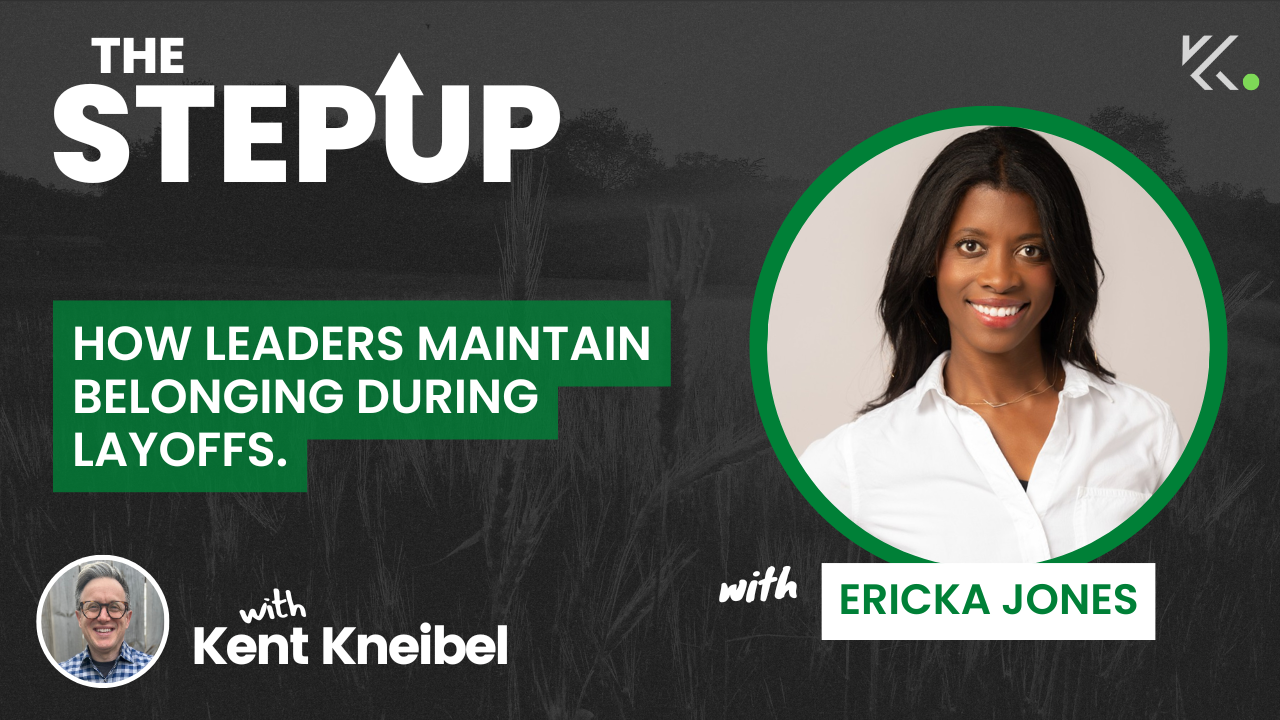
Ericka Jones is here to create a spark. A spark for change. A spark of inspiration for transformation. She utilizes her expertise in innovative and strategic leadership to embed programs throughout organizations. She has a deep background in Operations, HR, Learning and Development and DEI. We met while we were both working at Cargill.
In today's episode, we're diving into some heavy but super relevant territory: the whole deal with belonging during layoffs. The big takeaway? You can't control the outcome of layoffs, but you can totally control how honest and transparent you are with your team during these turbulent times. We chat about how crucial it is for leaders to foster a sense of belonging, even when making tough decisions. After all, when folks feel seen and valued, it builds trust and engagement, which is like the secret sauce for keeping morale up. So, if you’re a leader, whether you’re dealing with layoffs or just navigating the workplace vibes, we’ve got some solid advice on how to keep those connections strong and help everyone feel like they belong, no matter the chaos around them. Grab your headphones and let’s get into it!
Ericka Jones, our insightful guest, brings her wealth of experience in leadership development and DEI to the table, shedding light on how layoffs can shake the very foundation of team dynamics. We discuss the psychological impacts on both those who are let go and those who remain, often referred to as 'survivors.' Erica emphasizes that even when hard decisions must be made, leaders have the power to foster an atmosphere of belonging through honesty, empathy, and open communication. We dive into the concept of ‘psychological safety’ and how allowing team members to express their feelings can lead to a stronger, united front. Listeners will walk away with actionable strategies to implement in their own teams, ensuring that the values of trust and belonging are not just buzzwords, but lived realities, especially in challenging times.
Takeaways:
- In times of uncertainty, leaders must prioritize creating a sense of belonging among their teams, especially during layoffs.
- Transparency is key; leaders should openly communicate the reasons behind tough business decisions to alleviate employee fears.
- High trust teams see greater engagement, so fostering trust through honest communication is essential for any workplace.
- Recognizing and appreciating team members' contributions is crucial, as it reinforces their value and helps maintain morale during difficult times.
- When layoffs occur, it’s vital to support both the departing and remaining employees to ensure everyone feels valued and not isolated.
- Leaders should frame challenging situations as opportunities for growth, encouraging employees to see transitions as new chapters, not just endings.
Links for today's show:
**Music for this podcast comes from the song Needle & Thread and is provided with permission by Pert' Near Sandstone. Check them out on PertNeaerSandstone.com and on all major streaming platforms.**
*Editing by Fynn Gentle / www.fynngentle.com
Ericka Jones (guest)
00:00:04.000 - 00:00:45.870
You can't control the outcome, but you can control the honesty of it. Right. And so you can control that. And I think when employees know that they.
To your point, I love that you feel like you're an adult and you're being treated like adults. So there. That naturally creates trust. Right?
And we know that high trust teams, they, they once again, that creates higher engagement, like more belonging.
And I think that that's really important for leaders to reflect on is what is the state of belonging, you know, and how would we measure that and what's our role in creating that true sense of belonging when we have to make hard business decisions?
Kent Kniebel (host)
00:00:48.030 - 00:01:53.800
Hi there and welcome to the Step Up Expert Voices for Leadership Growth. I'm your host, Kent Knievel. Every week I talk to experts who focus on helping leaders step up their leadership game.
If you're new to the show, then on whatever platform you're using, I encourage you to subscribe so you never miss an episode. One last thing.
As a leadership development consultant and executive coach, I have a particular interest in supporting recent internally promoted leaders.
If that's you, or if you support a leader who has been recently promoted, I encourage you to visit my website at Kent Coates Playbook and download a free copy of my 90 day blueprint filled with practical advice for you or the leader you support in hitting the ground running and truly stepping up to their new leadership level. Without further ado, on with the show. Welcome, everybody. Today we are talking about belonging in the time of mass layoffs, if you will.
With me today is Erica Jones, former colleague of mine from my Cargill days. She's gone on to do other things since then and has kindly agreed to come on my podcast today. Erica, welcome. Hi.
Ericka Jones (guest)
00:01:54.200 - 00:01:57.240
I'm so glad that we're back together on a video call.
Kent Kniebel (host)
00:01:57.240 - 00:01:59.120
Getting the band back together. I love it.
Ericka Jones (guest)
00:01:59.120 - 00:02:01.000
Getting the band back together. I love it.
Kent Kniebel (host)
00:02:01.080 - 00:02:11.640
Yes. Well, so as. So for those of the audience who don't know you, I always start with you telling a little bit about your career story.
So tell us a little bit about your. Your career adventure.
Ericka Jones (guest)
00:02:12.280 - 00:07:19.500
Yeah, you know, there's so many different chapters in my career. You know, I've been working professionally for, you know, a couple decades and I would say that my career is not linear.
It's definitely the chapters have been written based on saying yes and just being open to whatever, you know, like where, where what is presented next.
And I would say that that's not like I let it steer me, but I think that, you know, I've always been a yes and Open to where that led, which has led to a really dynamic book. I started my career off in working in leadership on the store side, so really focused on customer facing and leading management teams.
Then that led me into talent acquisition, which I would have never thought, and leading a team of recruiters in the US and recruiting and hiring for early career talent and opening up a couple of international stores for the retailer that I was working for at the time.
And in addition to that, what I really loved about talent acquisition, especially for early careers, is that, you know, at the time, no one wants to take their career and work in a mall, right? So really what it was is that's where I really learned about connection and human centered connection.
When you're really working with early career talent perspectives and they're making choices on their career and you are getting them to work in your organization, they're coming because of you and because of who you are and what in your way of being and how you're able to be delivered versus I'm going to go work in a mall, right? Like no one that's not like a sexy appeal after you're finishing college or whatever pathway that is.
And so leading that and leading partnerships and building out a career, a talent acquisition team from the ground up, you know, was we were using Excel documents. There was nothing sophisticated about the programs that we were using.
So being able to learn and build and scale that segment of the organization was really wonderful. And what I learned in that is that I loved billing solution focused programs and scaling them nice. And that's my sweet spot.
And so, you know, any leader that I've worked with, they're like, you're excellent with Tangletown, able to identify the problem, have a white page and then build a program and a strategy with that.
So that led me into the diversity, equity and inclusion space where I led our at the same organization, our DEI program for our stores, organization that side of the house and developed programs to scale that globally. And then that really the space of diversity, equity and inclusion is really where I found my sweet spot.
When you're talking about culture, behaviors, a sense of belonging and behind every great organization is our people. And it's because people feel seen and valued where they want to put their best work forward.
And that's how you're able to increase productivity, enhance business because you're also the employees are reflective of the customers. Right.
And so that intersectionality of tapping into the behavior aspect and leveraging differences for employees really was like a light bulb for me in my career and how we can correlate that and translate that into business outcomes. So I've been in the DEI space, specialized in it for over 17 years and I've did various.
Yeah, I would say, I would say it's always, it's always been there before me, you know, ever since in high school when I there wasn't language around it. And so I've always been in the work of how do we make people feel included and belong, you know, like that sense of belonging.
And so yeah, I've worked at some notable organizations throughout the time.
One of the stints where you and I came into contact as well and worked on a learning, a learning and development program where we were embedding inclusive behaviors into leadership development programs and. Yeah. And then in just like my last role at an automotive. In the automotive industry, I was also in the, you know, public sector.
So I've been in a lot of different sectors. And this work is translates within any industry. Everyone's trying to find the solutions for the same problem with talent if there is a problem. Right.
And yeah, so that's a little bit. And then I teach yoga and meditation.
So a lot of mindfulness and holistic approach of leadership when it comes to well being really is the foundation of bedrock as who I am as a leader.
Kent Kniebel (host)
00:07:19.740 - 00:07:27.080
Are your photos still up in a will be unnamed very popular yoga clothing store?
Ericka Jones (guest)
00:07:27.080 - 00:07:29.440
They're not. They're not. So my contract.
Kent Kniebel (host)
00:07:30.640 - 00:07:31.120
Okay.
Ericka Jones (guest)
00:07:31.120 - 00:08:02.880
Yeah, yeah. The contract with that ended. You're talking. So I was an ambassador with Lululemon, a yoga ambassador and here in the Twin Cities and that ended.
So really as well, when you think of again the intersectionality of that, of the heart of well being and well being and community and connection and people want to feel like they're a part of something and they want to be a part of something that matters. Right. And make it an impact and that is ultimately leadership in an organization as well.
Kent Kniebel (host)
00:08:02.880 - 00:09:10.930
Nice.
I want to come back to, you know, one thing you were saying about working in the malls and you know, how do you make, you know, working in a retail environment for probably like a younger generation of employees. Right. Like probably just over or not too far over the age restrictions for working. Right. And making it a place that people want to be very.
You know, I've had some similar experience when I worked in the restaurant industry, which is retail and hospitality are very closely resemble one another in certain ways. And I remember the data coming through that and very clear data on stores that had higher engagement, had higher sales. Right.
And higher obviously higher retention and you know, that, that nothing in that environment sort of makes or breaks the. Not just the store's performance, but the employee experience.
Ericka Jones (guest)
00:09:11.410 - 00:09:11.730
Right.
Kent Kniebel (host)
00:09:11.730 - 00:10:00.560
The way that managers do. Right. And I think there's this whole thing where, you know what, and I remember this being a.
When one of my first jobs is working in a restaurant as a host. And so I would be there just before servers would be kind of like checking in and turning over for the day.
And the very first question I would get asked standing at the front of the store was A, which managers are on tonight? B, who's close, who's closing? Right.
Because everybody wanted to know if they were stuck with the good or the bad managers, you know, and so it's the, the power, it's so clear at those frontline, you know, retail jobs, like the power that managers hold, especially when you can walk out the door and go to another store or another restaurant if you don't like the one you're in. Right.
Ericka Jones (guest)
00:10:01.040 - 00:10:24.200
Yeah. I mean, they're, you know, Gallup in Deloitte, they've done a lot of studies on employee engagement. Right.
Where those who are highly engaged have less absent, absenteeism.
When you think about, you know, a retailer or the hospitality industry and you're working with non exempt employees, you know, like people calling out, not showing up.
Kent Kniebel (host)
00:10:24.200 - 00:10:24.600
Yeah.
Ericka Jones (guest)
00:10:24.600 - 00:11:01.920
Also safety, you know, when you think about safety incidents, you know, reducing in turnover and also like productivity and profitability, you know, and customers really feel that, you know, and so. And then also when we think about like in retail, like shrink in like theft rates, you know, that happen.
So overall, when employees are engaged, they know that they make an impact to the organization that really contributes to the value, the culture, the mission, and they're willing to put their best work forward.
Kent Kniebel (host)
00:11:02.000 - 00:12:33.160
Yeah, yeah. And while engagement surveys measure all kinds of things, one key place that they measure is inclusion and belonging.
Like, do I feel like I belong here? And so this is my very practiced segue into our topic for today. Right.
So we're in this odd time, you know, we're recording in mid November 2025 right now. And I know this year alone just with recognizable brands, right? Brands that are big enough with numbers big enough to remark upon.
You know, there's been at least a couple hundred thousand layoffs since June, I want to say. And it's, it's a rough time for people. It's a rough time for obviously, first and foremost, people who've been laid off.
It's a rough time for those who weren't but were present for layoffs. Right. At a company that had layoffs, those who were left behind or left, you know, still made it through. Right. The layoffs. Right.
And even in some cases where I've heard right, there's companies who have really declared. We are in an ongoing review of our business model. And so there's sort of this looming. There could be more to come. Right. And so, you know, I think we.
One of the things we wanted to talk about today was the sense of, like, how this period of time at companies that are facing these kinds of layoffs, how that can sort of ramp up, rock the foundation of belonging in an organization. So I'd love to hear, you know, some of your.
Ericka Jones (guest)
00:12:33.160 - 00:17:17.150
Yeah, like what? I think that, you know, if I had to umbrella at all, I would say it's uncertainty. Right.
Because we've experienced it even since COVID There's been these different levels of uncertainty. And I think layoffs. We've seen it a lot this year and how it's done. Right. You know, I've heard stories and how it's done. It's a robot, robot call.
People are all brought on and there. There feels like there's like this lack of humanization and really great leaders.
I think in times of uncertainty, especially during layoffs is it's important to really double down on the element of belonging. Because number one, for the employee that was laid off, unfortunately, the want to know that they mattered.
They want to know that their work, that they did mattered.
They want to know, like, have that reinforcement because it could potentially chip away confidence that you're the now bringing into another organization. Right. So it's kind of like passing the buck. Like you want to leave them in a.
In a state of wholeness so that when they're going to the next organization, if I'm a firm believer, if one door closes, there's another one that's opening. So your other chapters getting ready to get written. I don't think it's always a bad thing.
People that I've heard that have laid off are like, well, if it didn't happen, I would have never left. Right. So it was time for them to have done that. But so you really want them to feel valued when they leave. Right.
So that they can for their contributions and really honor that because they're now a customer. The second part too is the employees that are left behind, you know, like those quote unquote survivor employees.
You know, like, there's probably survivor's guilt a little bit and you want to like, also share, like show the care and the remaining of the bat because there is a level of uncertainty and fear that I could be next that's there. And really in those times of belonging, what I, I see in that is re emphasizing what it means to, to cultivate belonging.
You feel seen so and you feel heard and being heard in that which we talk so much about in organizations is psychological safety and allowing people to be able to name the emotion and express the emotion and what they're feeling. Right. And of fear, of guilt, of a sense of grief, uncertainty of the direction of the organization and leaders allowing space for that.
And when I've seen leaders allow space for that, I honestly have applauded their leadership more than anything versus let's just move on.
You know, like yes, we still need to move on but there's this moment of empathetic leadership and it's being courageous and bold to say I'm going to allow space to name this emotion and then how do we want to come together as a team to ensure that our well being is that we're good, you know, and, and that we, that you feel seen that here is my commitment as a leader in order to ensure that we are heading on the, on the straight path. Like because we still do need to continue to keep moving forward. Right. And so I think there's optimism in the leader.
There's, they're able to hold the capacity of the duality of both knowing that the teams can feel this and knowing that we need to like move forward.
But you have to like take them through the river to the other side because we're working in this multi generational organization, you know, so if you think of like an employee who is a gen Z, they've never experienced this before. Right.
So that can feel like a shock and like probably have a deeper loss than someone like you or I where we're like oh yeah, we've seen this like just keep, you know, keep it moving. Right. And this really, this, this is hard and this is tough.
And leaders during that by building that belonging they're able to build resiliency for their leaders and their team. And so I think that it's an important, I think it's important for leaders to really think about how belonging is a through line of all things.
It's not just to increase the engagement of employees but it's also during the times of uncertainty.
Kent Kniebel (host)
00:17:17.230 - 00:18:03.650
Yeah. So let's, I want to take a step back for a second and because you've defined belonging, right.
So you know, feeling seen, heard, valued during the best of times, right. During an average quarter or year. Maybe that's not the definition of the best of times, but during. During the average times. Right.
So I think some people, for some people feeling valued, seen, heard, can. Can feel like kind of an esoteric thing. So break it down, Help us break it down.
For leaders out there, what is their role, practically speaking, right. In helping people on their team feel valued, seen, heard?
Ericka Jones (guest)
00:18:04.690 - 00:20:11.920
Yeah, I think one. It's like having. It's really knowing. I think it's being transparent, honestly.
You know, when you think about, like, organizations, especially those who are for profit, and there's external headwinds, you know, and you. Depending on the market that you're. Or the industry that you're in, and just being really real, you know, I, I work in the DEI space, so I.
It's been very challenging right now, you know, and so we've seen teams where they've lived off individuals.
And what I've heard are some of those leaders that have been really transparent about what the external environments are and where the company needs to go and how your function is aligning to where the company needs to go given, like, external environments, the marketplace or whatever is happening, then an individual is able to connect the dots, right. And they're able to see that and land it on something.
But if we're not being transparent and then there's not clarity and there's ambiguity around business and how your role aligns to the business, it's hard for what I've seen, it's hard for employees to land the plane on why something like that would happen. So I, you know, I, I think that it's. It's, you know, and I'll speak and be very honest, I was recently laid off, and it was no shock or surprise.
And I think that the leader that I had did, like, the best that they could have done with it. I, like, we've, you know, it was all the dots connected as to why, where the company was going, where the headwinds were.
And so that made it very easy to understand. Like, on the other side of that is a leader that has to do that, that doesn't want to. Right. And that is tough.
And so, yeah, so I think, like, the number one thing is transparency from the beginning. Right.
Kent Kniebel (host)
00:20:11.920 - 00:22:05.520
And I think that helps drive people feeling sort of valued and respected and. Right. Treated. Treated like an adult, right?
Yeah, 100%, because I've been in, you know, one organization I was in had to, you know, we went through like a summer furlough, right. We. It was 09. There was a downturn in the economy. And, you know, they were just very transparent with us.
They said, listen, we had two choices to make, right? We could miss payroll, shutter a few choices, right. Miss payroll, shutter the doors, and we could all look for a new job.
We could do a mass layoff, you know, at the company and hope, you know, we have, we can make it through and we have enough people to do the work our clients have for us. Or, you know, see, we.
We've sort of made this decision that, you know, if we can everyone top, top to bottom in the company, you know, take an X percent pay cut, we think it should be temporary for just the summer, and if we can make it to, you know, one. Whatever that was, you know, that that will be on a stronger footing and be able to get back to full pay and come out the other end even stronger.
And being treated like adults sort of helped us. I would say it almost helped everybody.
Now, that didn't mean it made it easy, but I think everybody felt treated well, treated like an adult, trusted, you know, so feeling valued is not just the I appreciate your work, which is also extremely important. Right. How are you actually showing appreciation for people and that they are valued, that their contribution is valued too. Right.
So I think being trusted, transparent, treated like an adult, but also don't forget, and it's probably the easier one to do, but it's like, don't forget to also, like, take the time to show genuine appreciation for the contribution of your employees. Right?
Ericka Jones (guest)
00:22:05.840 - 00:23:37.960
Yeah. Like, you can't control the outcome, but you can control the honesty of it. Yeah. Right. And so you can control that.
And I think when employees know that they. To your point, I love that you feel like you're an adult and you're being treated like adults. So there. That naturally creates trust. Right.
And we know that high trust teams are, you know, like they, they once again, that creates higher engagement, like more belonging. And I think that that's really important for leaders to reflect on is what is the state of belonging, you know, and how would we measure that?
And what's our role in creating that true sense of belonging when we have to make hard business decisions? You know, as leaders, people are bringing in so many different facets and dimensions of who they are.
You know, they're bringing in, you know, all parts of themselves in work.
Long are the days, you know, with our grandparents generation, the boomers, the traditionalists, where it was like, you keep that separate, you know, everyone's coming in, you know, thanks to technology, with all of this here. And it's easy to create stories, like, for an employee to create stories. So a really keen leader will understand the.
The temperature, you know, like, and the environment of their team, and they will know how to turn that dial in order to maintain, like, a steady room temperature.
Kent Kniebel (host)
00:23:38.200 - 00:25:32.290
Yeah. And so that. That kind of gets to the, you know, see, you know, helping employees feel seen and heard, too. Right. Which is, again, I think they can be.
Take it from the conceptual, which is especially.
So let's bring it to the, you know, the current environment we're in, where perhaps you're on a team, you're a leader, you're on a team where you had to lay off 10, 20% of your team practically in an environment like this, pretending it didn't happen and trying to move forward the next day, reallocating work and just plowing forward your next team meeting, trying to treat that exactly like you did last week's team meeting. Not only is it, to your point, like, lacking in transparency, but people are going to feel probably not very seen or heard. Right.
Whereas, like, again, practically speaking, what should you do in your very next meeting, leader? Perhaps we call out what happened and say, right, this is what just happened. And how's everybody doing right now?
I think where leaders get tripped up is feeling like they need to know how to respond to anything and everything people might say. Right. And I think that's. But I. I believe. And I'd be curious what your perspective is.
Like, I believe that's a bit of a fallacy, like, that you actually need to know what to do or say for whatever might happen after you throw that question out, like, how is everybody doing? You know, this is really hard. I know work's gonna be piling up for people in the near term. You know, how's everybody doing with what just happened?
Right. And I. I'm probably going to repeat myself, but I.
And I think where some leaders freeze is the fear of what they might say and whether or not I'll have the right response to that.
Ericka Jones (guest)
00:25:32.450 - 00:27:56.500
Yeah, yeah. You know, I love that you bring that up, because what I really think is, in the sense of. It's like the pink elephant. Could you imagine.
Could you imagine if we were driving down the street and there was a pink elephant, like, in the middle of the highway, what would you do?
You'd probably call your wife or call a friend and say, oh, my gosh, I was driving down this highway and I saw this pink, like, pink elephant, you know, or a stampede of them. So it's odd that you wouldn't say Something, you know, it doesn't make sense.
So I think, you know, so it's important to name the thing and really set the conversation up of. Yeah, like just allowing that to be in the room. I think it's really important. And doing it in a way that's respectful.
That's where you build psychological safety. I think there's a borderline.
Leaders aren't going to get it right, you know, and it's just like for me, when I think of teaching a yoga class, I can go in with this perfectly scripted class, yet the environment is completely different, right? So it is being that thermostat and really knowing when, like just being okay, not getting it right.
And that is the humility, like, that's the confident humility I think of leaders too, is knowing you have the confidence to have this conversation and to be the thermostat where it needs to go and really set the temperature and regulate the environment of that. But at the same time, you don't need to know. Like that is like needing to get it right, needing it to be perfect. I think that is ego.
And ego is driven so much, you know, in leadership. And really what we want is human centric leadership where the best thing to say is like, I don't know. And I can, I can assure you of this, right?
I can, I can assure you of this that our work matters, that it's aligned to this. You reaffirm like your objectives, your mission, what, like the goals and priorities of.
Are of the team and really like temper that and, and really give positive reward to it. But needing to know the answer, I think can be a detriment for not saying anything at all.
Kent Kniebel (host)
00:27:56.840 - 00:30:28.440
Yeah. Yes. Yes.
And when I have given any amount of advice or counsel for leaders who are in a position like that, it's always been, well, if you're not sure what to say, maybe that's what you say, right? When someone says something that maybe felt uncomfortable to you as a team, as the leader, and not knowing what to say in the meeting at that moment.
Because to take a quick step back, this makes me think of the. There's a change management model that we call the Sarah model. Shock, anger, rejection, acceptance.
And the idea is that everybody goes through this change curve when things change, or you may even go through the change curve, so to speak, when you're given tough feedback.
Everybody, the person laid off, the person not laid off, the leader who had to do the layoff, right, are going through this change curve of shock, anger, rejection, acceptance. They might go through it in Two minutes, two weeks, two years. They might go through it silently, they might go through it, you know, out loud, right?
And so recognizing that, you know, it's a natural phenomenon that people kind of go through. And so if you're in a meeting, how's everybody doing and something is said that you're not sure exactly how to respond to it.
You know, my advice and counsel to folks throughout the years has just been, we'll say that, like, I'm not sure how to respond to that, but I do know that this is a very hard, you know, this is a really hard time. It's going to be hard on a lot of us. You know, what was just shared sounds really hard, right?
Like that's all you really need to say, you know, and that's part of, you know, helping people feel heard and seen is letting people say out loud on the team, like, this sucks, right? Our close team member is no longer here. I'm worried about them. I'm worried about me. I'm worried about, you know, future layoffs, so to speak.
And you don't have to have an answer to that, but you have a, you have the choice of whether or not you give any space to that in meetings at all.
And probably, you know, the, the leaders who open up that conversation even imperfectly and even without knowing exactly how to respond probably drive a bit more sort of belonging, so to speak, than the leaders who are trying to, you know, just put their heads down and white knuckle it and, and move forward without acknowledging it at all.
Ericka Jones (guest)
00:30:28.440 - 00:33:01.220
Yeah, yeah, yeah. Because like, what you're, you're, you're so right. Where I think of it is like layoffs really shake the humanity or shake the structure.
And what you're saying is it doesn't have to shake the humanity. Like at the end of the day, like there's like, there's a humanity.
And although leaders are leaders, they're leading teams and they're leading organization, there's an element of humanity. And that's where, where I've really shifted my language and who I am as a leader is a holistic, human centric leader.
And you know, like when I think of, you know, we've heard different models, like inclusive leader and all of that, and that just started to seem like, like kitschy and just like a catchphrase. But when I really think about holistic and hu.
Human centric leadership, just like organizations put the customer at the center of their business model, it forces me to pause and put the human being at the center of how I'M leading how I'm communicating and really like, expressing real emotion in a way that is respectful and still like an executive, like a leader.
You know, it was at the time, the organization that you and I were at during COVID And I remember the CEO at the time, like, doing an incredible job of, you know, there were two things happening that were really tense at once that caught, you know, this. The organization was in the windfires of both.
And then just being able to say, I don't know if I'm getting it right, but I'm going to do my best to try the heart my hardest. And I just remember, wow, exactly like you said, like, I don't need to get it right.
I don't know if I'm going to get it right, but I'm going to do my darndest to try to get it right. And Brene Brown says that too. We don't have to do it right, but it's our job to, like, work to get it right.
And the only reason, the only way that we get it right is putting ourselves on the court, you know, is like really testing that with employees. And, um, that's what I. I feel employees really want when they feel valued.
Otherwise, it feels like these buzzwords that we're just throwing in value statements and culture statements, but we're. We're not really getting to the heart of it.
Kent Kniebel (host)
00:33:01.300 - 00:33:01.780
Yeah.
Ericka Jones (guest)
00:33:01.940 - 00:33:02.219
Well.
Kent Kniebel (host)
00:33:02.219 - 00:35:15.530
And so I want to turn our attention briefly. Cause I'm just watching the time here to those who were laid off. Right.
And I think now, while we're usually talking to leaders and about the teams that currently report to them, and there are usually probably some pretty hard and fast rules for leaders who just had to lay someone off about whether or not and how they can be in contact with the person who was just laid off.
But I want to talk about that person for a moment too, which is, you know, the day before you had a job and worked for a company, you had a place to either virtually log in or physically go to for work. And at least in the U.S. i would say over the last few decades, a lot of where we get community is at work. Right.
I think certainly people have other places where they get community. But I would say en masse, right. As a broad generalization, you know, the bulk of people get their community from work. Right.
And I think even Covid kind of highlighted for us the importance of community. Time with, you know, time with people, you enjoy, time with friends, things like that.
But, you know, you relate off and now this commute, this Big commute, a big part of your life. Right.
You know, what is it probably like 40% or more of your waking hours, you know, that when you're not asleep are spent at work and then someone will. May or may not, correct me on the math there, but it's somewhere and it's a big chunk. Right. And now. And it's. It's like. Well, it's a.
It's like a flip of a light switch. One day it's there, the next day it's not. And there's a lot going on for someone who's going through that.
And I'd say one thing that I wanted to talk a bit about today on this topic is what's, you know, the role that those of us who maybe were colleagues, maybe we were colleagues very recently at the place where you were laid off, or maybe it was a couple of companies ago, you know, the role that we can play, the opportunity that everybody has to play in helping provide a sense of sort of community belonging to people who were just laid off. Right?
Ericka Jones (guest)
00:35:15.530 - 00:35:15.970
Yeah.
Kent Kniebel (host)
00:35:15.970 - 00:35:29.850
Sometimes you don't know, but I would say we're.
We're in this moment of like, layoffs are so pervasive at the moment that I would say I'm seeing more LinkedIn posts than ever of people, you know, saying, you know, they were invited to leave their company and are now on the market.
Ericka Jones (guest)
00:35:29.850 - 00:39:01.290
Yeah, I love that, that invitation to leave your company.
You know, I love that part of it because honestly, I feel so, so incredibly grateful and blessed to have such a great community, you included in that. Where one. It's like, what can I do? You know, who can I reach out to? And we're.
Even though we may not be a leader in an organization, we're all leaders in our lives. And, you know, it's. When there's natural disasters and things that happen, like, what do people do?
They just like, come together that just drop at a hat. And. And I think that same thing, you know, part of me was like, oh, my gosh, I. I haven't talked to this person in years.
And so here I am reaching out and it's like, no, they want to help. They want to, you know, they want to support. And it's.
It's such a learning for me on who am I during that time when I see that, because, like, I look at it as a giver and a taker. And like, the giver is. That is an act of kindness and belonging. They want a person, they know what it feels like. Right.
And so reaching out, extending networks and doing that because, you know, I've. I've worked in talent acquisition, and I've seen both sides of it.
It can be like a black hole when you're out there trying to, like, find the right thing, but people willing to take a call, review your resume, and explain what's happening in the marketplace. That is. That is the biggest transition of confidence sustainment that I think we can give people. Because, you know, I was talking with somebody.
I was teaching a class, a yoga class, and it was after I was laid off, and I found out that they were. And I just went over and I asked, like, how are you doing? And I just ask them, and they're like, you know, I feel really embarrassed. I.
It's like, it's. I'm taking it personally. And I was. And I. And I just feel alone in it. And I was like, well, you're not alone, because I did, too.
And there's so many other people around. And, you know, there was, like, a little bit of levity in the moment. And afterwards I found out that that individual, they were like, wow, they.
They shared with somebody. I just felt so seen.
And it gave me the confidence to go on LinkedIn in and start reaching out to people, you know, and that one little spark, that one conversation to ask someone how they're doing is, you know, my motto in life is, like, just show up. Like, you show up with a text, with a phone call, with a connection, and you do that for people. And you're.
You're able to maintain, like, where a person could dip down into that low confidence, like, this is happening to me.
You're able to remind them who they are, you know, and remind them of their gifts that they bring and, like, empowering them to know, like, this is not over. Your. Your book is not done. Like, the book's not done. You're just writing a new chapter. Right.
And I think we take those leadership skills away from, like, leading teams to. To our personal networks and our personal contacts, too. Just like whatever you practice on the mat is happening off the mat. Like, whatever.
We are practicing in leadership in an organization where we're getting paid. We also do that in our private lives, too.
Kent Kniebel (host)
00:39:01.690 - 00:39:07.610
I've never heard that yoga quote before, and I love that. I'm assuming perhaps it's a wrestling quote, but I think it's a yoga quote.
Ericka Jones (guest)
00:39:07.610 - 00:39:10.120
Yeah, it's kind of the same. Yeah. Yeah.
Kent Kniebel (host)
00:39:10.120 - 00:40:11.900
I would say I make it a pretty regular practice when I know someone's been laid off. When I see someone who I know that's posted something online to reach out and, you know, and just say, hey, that sucks. Been there, there's.
Maybe there's not, but if there is anything I can do, you know, let me know. Would love, you know, if you want to chat, would love to chat, right?
And I saw someone I know who's recently been laid off who had a pretty upbeat post about it.
But he actually, you know, the selfless person he is, he sort of took the platform opportunity to say, hey, like, reach out to those people that, you know, have been laid off. Because you never know. The.
Like reminding, even if it's two companies ago that you worked with them, like reminding them that you remember who they are, their work matter. It had an impact on you enough to reach out and just check in, you know, can make the difference during what can be a pretty isolating time.
Ericka Jones (guest)
00:40:12.780 - 00:42:55.060
I love that because I just had a. A colleague of mine, you know, from the organization that I just left, and she's. And this is a part two.
You know, we talk so much about recognition and organizations, and there's a lot of recognition systems that you could give. And she said, you know what? I didn't give you your flowers enough. Like, I want to give you your flowers, right? And. And I didn't expect that.
And what she said was, so. It still touches me to this day. And this, it just happened two weeks ago.
And I'm like, yeah, let's give people our flowers, their flowers, you know, on who they were and the value and impact that they had on us. Because I think when uncertainty happens like this, you as the individual also has to be the leader of self, right? So there's a leader.
What the leaders can do for the employees. But then who are you as a leader of self in order to continue to move forward?
So that lead of self is like going back and remembering, like reading those notes, looking at the impact that you've made and really saying, okay, what is this here to show me, you know, that. That maybe I was sitting in my comfort zone for so long and it's time for me to grow. I never really thought about it.
My story of being laid off, like, okay, yeah, I was. I am an expert and specialize in dei, but yet when I lensed out, I'm like, no, I am also a solution focused, like scaling strategy and programs.
And that is very widespread, you know, and so sometimes we're in a tunnel, you know, like ourselves, and then leading ourselves is saying, okay, what is this here for? And for me, within a short two weeks, it helped me Reshape my, you know, script of who I am as a leader.
And I'm also like an engineer and an architect of people.
I would have never thought I would have said that, but maybe it was like the industries that I was in with like engineers, like I'm not the engineer to put something together. Do not ask me to put something together. It will fall apart, but I will like meaning like that you had to like drive or utilize as a tool.
But I am an architect when it comes to sustainable programs and teams that will really impact the culture of an organization. And I think I would have never, I would have never thought of that, you know, had I this happened.
Kent Kniebel (host)
00:42:55.300 - 00:43:00.260
It's a good zoom out, right. That pulled out of your day to day.
Ericka Jones (guest)
00:43:00.980 - 00:43:03.580
Yeah, well, looking at, looking at the time.
Kent Kniebel (host)
00:43:03.580 - 00:43:04.980
I'm sorry, I'm going to move us.
Ericka Jones (guest)
00:43:05.300 - 00:43:05.660
Yeah.
Kent Kniebel (host)
00:43:05.660 - 00:43:09.420
I'm going to give us sort of a violent shove into our advice column here. So.
Ericka Jones (guest)
00:43:09.420 - 00:43:09.740
Yeah.
Kent Kniebel (host)
00:43:09.740 - 00:43:17.750
Erica, what's one piece of advice you have for leaders out there? You know, what's one thing that they can do today?
Ericka Jones (guest)
00:43:19.110 - 00:44:32.420
I think it's reground people and their purpose. You know, reground people in the purpose of the organization. Restate the mission. I think it's.
There's a lot of noise that's out there and getting back to the basics of the mission, the direction we're going. It's end of year so that's always a really good time to do the reflection of what we've accomplished at the end of the year and where we're going.
So it's a really, really great time to restate the mission, clarify priorities and then really have that moment where, you know, it's a call or it's like a team building where you're really giving deep compliments, compliments and sharing the contributions of each person on the team and the work that they're going to contribute forward, go forward. And I think just building intentional time out for that is. Is really, really important. Like the business will be there, it will still keep happening.
But as a leader, like pause, slow down, reground people and their why and their purpose and. Yeah, nice.
Kent Kniebel (host)
00:44:32.420 - 00:44:43.870
And so what's your advice for, for. I'm trying to get better at how I ask this for senior leaders or even HR partners. What's your advice for them on how to better support leaders?
Ericka Jones (guest)
00:44:46.110 - 00:45:34.810
I think it's really asking leaders how are their teams doing?
Because you're kind of removed and wanting to hear some of those verbatims and, and listening and hearing that and then bringing that in to culture and honestly seeing it happen in action.
I think that if we want to see people shift and change, like, leaders need to be able to demonstrate that, but they need to also, like, there's a willingness to also hear the hard feedback, which might be that our employees are scared and our employees are fearful and our employees don't believe X, Y and Z. And it's. It's hearing that hard feedback or whatever feedback it is in order to support the leaders.
Kent Kniebel (host)
00:45:35.130 - 00:45:55.620
Yeah, well, and I would add a second thing to that, which is the brilliance of where, like, we overcomplicate accountability at times and simply a senior leader asking their leadership team, how are your teams doing? Might actually be the prompting that a couple leaders around that table might need to actually go ask that question.
Ericka Jones (guest)
00:45:56.020 - 00:45:56.500
Yeah.
Kent Kniebel (host)
00:45:56.580 - 00:46:14.100
On top of all the information you might get. Right. Coming out of that. Well, Erica, I hear a puppy in the background getting squirrely and telling us it's time to wrap it up. So this was great.
And I feel like I'll have to have you back on another topic in the near future here, but thank you very much for coming.
Ericka Jones (guest)
00:46:14.100 - 00:46:21.790
Yeah, talk about belonging. The puppies. Like, I needed attention. Right? So, like, give me attention. Yeah, I'm bored.
Kent Kniebel (host)
00:46:22.270 - 00:46:25.710
Well, thank you so much for coming on. I. I can't wait to do it again.
Ericka Jones (guest)
00:46:26.110 - 00:46:27.510
Oh, well, thank you so much.
Kent Kniebel (host)
00:46:27.510 - 00:46:52.200
All right, see ya. That brings us to the end of our episode. Thanks for listening.
I'd encourage you to head on over to my website, Kent Coach, and start a conversation with me there. Or check out my promotion playbook at Kent Coach Playbook.
Before you go on with your day, I ask you please take a moment to leave a rating and a review wherever you listen to podcasts. Five stars. That helps put this podcast in front of more eyes and ears. Until next time, take it easy.


