
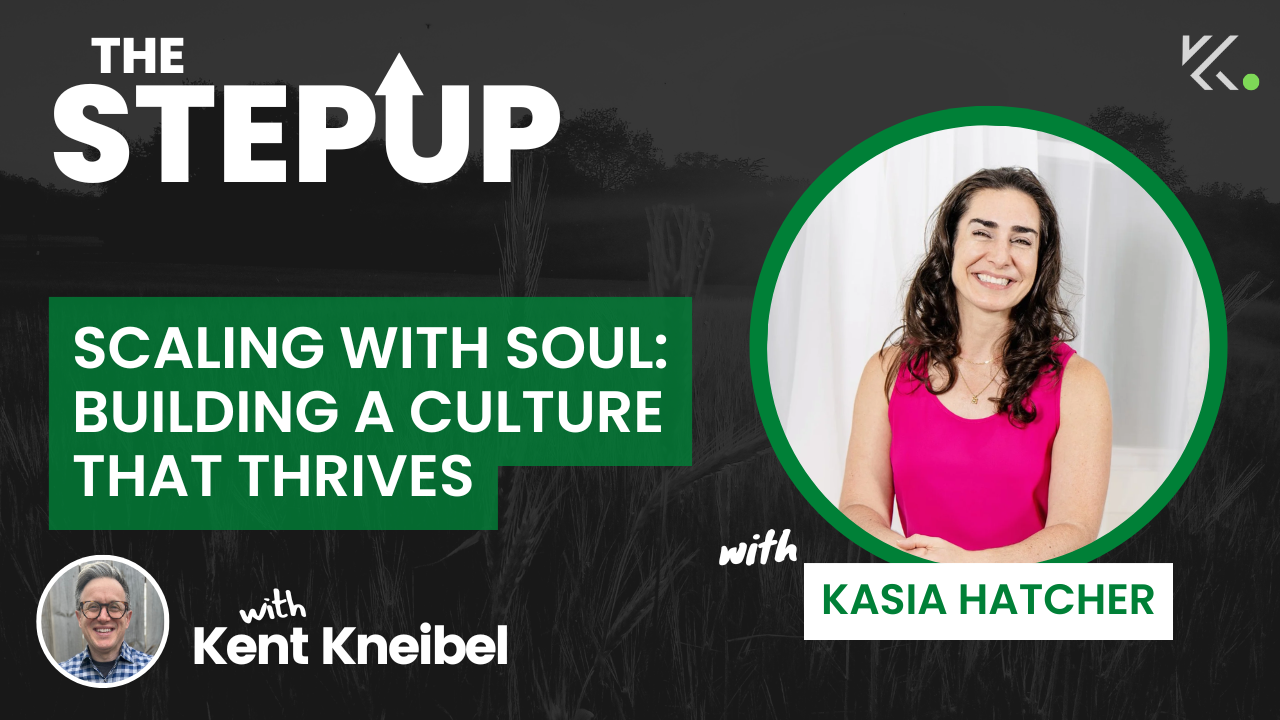
As a certified executive coach, Organizational Development strategist, Impact Measurement & Learning expert, and founder of The Trusted Edge, Kasia Hatcher helps strong women and mission-driven organizations lead with clarity, grounded confidence, and measurable impact. Her 20+ years across 20+ countries includes coaching political appointees, senior foreign service officials, and leaders at Google, Deloitte, and the U.S. State Department. Her approach blends systems thinking, human-centered design, emotional intelligence, and a faith-rooted belief in the power of leading from the inside out.
Today, we're talking about scaling your business while building and/or maintaining your culture.
A good coach doesn’t just hand you a roadmap; they trust you’ve got the answers within and help you ask the right questions to bridge that pesky inside action gap. Today, we’re diving deep into the art of building and maintaining a kickass culture while scaling your business, especially for all you women founders out there. Our guest, the brilliant Kasha Hatcher, shares her journey from international development to coaching, where she emphasizes that creating a thriving workplace culture starts with intention and trust. We chat about the importance of slowing down to make those aligned decisions that can propel your growth without burning out. So, if you’re ready to step up your leadership game and cultivate a vibe that keeps your team engaged and thriving, you’re in for a treat!
Navigating the wild world of scaling a business can feel like trying to juggle flaming swords while riding a unicycle, right? In this enlightening chat, we’re diving deep into the nitty-gritty of creating a solid company culture as you grow from a one-person show into a bustling team. Kasia Hatcher, our brilliant guest, shares her journey from international development to executive coaching, highlighting the importance of intentional culture-building from the get-go. She emphasizes that a good coach, much like her, won’t just hand you the answers on a silver platter; instead, they’ll help you dig deep into your own motivations and insights. We explore the trials and triumphs of women founders, the inner battles of perfectionism, and the necessity of trust—both in yourself and in your team. This isn’t just about managing people; it’s about creating an environment where everyone feels valued and connected to the mission, even as the ship sails into uncharted waters. So grab your headphones, kick back, and let’s unpack how to scale smartly and sustainably while keeping a vibrant culture alive. Trust me, you won’t want to miss these gems of wisdom!
Takeaways:
- A great coach won't just hand you answers; they'll create space for you to find them yourself, which is pretty dope.
- Trust is key in coaching—helping clients bridge the gap between insight and action is what it's all about.
- When scaling a business, intentionally crafting your culture from day one is crucial for long-term success and team alignment.
- Women founders often struggle with perfectionism and trusting others, which can hold back their business growth.
- Creating a culture that promotes trust and shared understanding among team members leads to better collaboration and innovation.
- Slowing down to make aligned decisions is way more effective than rushing through tasks—remember, quality over quantity!
Links for today's show:
**Music for this podcast comes from the song Needle & Thread and is provided with permission by Pert' Near Sandstone. Check them out on PertNeaerSandstone.com and on all major streaming platforms.**
*Editing by Fynn Gentle / www.fynngentle.com
Kasia Hatcher (guest)
00:00:04.000 - 00:00:36.600
A good coach will not tell you what to do. Right. A good coach will trust that you have those answers inside you and create the space to ask the questions to help that inside action gap align.
Because as a coach, my only role is to help you succeed and meet your goals. I'm your biggest fan. I'm in your corner to do that. But I shouldn't be the only one. I hope I'm not the only one.
I hope you do have a therapist and a consultant and, you know, a financial advisor.
Kent Kniebel (host)
00:00:38.440 - 00:02:00.590
Hi there and welcome to the Step up expert Voices for Leadership Growth. I'm your host, Kent Knievel. Every week I talk to experts who focus on helping leaders step up their leadership game.
If you're new to the show, then on whatever platform you're using, I encourage you to subscribe so you never miss an episode. One last thing.
As a leadership development consultant and executive coach, I have a particular interest in supporting recent internally promoted leaders.
If that's you, or if you support a leader who has been recently promoted, I encourage you to visit my website at Kent Coach Playbook and download a free copy of my 90 day blueprint filled with practical advice for you or the leader you support in hitting the ground running and truly stepping up to their new leadership level. Without further ado, on with the show. Welcome, everybody.
Today we are going to be talking about culture, but we're going to take a little different angle than perhaps you're used to hearing about or talking about culture.
We're actually today going to be talking about how do you create a culture as you're growing, right when you're going from a one person shop perhaps to, you know, maybe you have a small team already, but you're growing, you're adding people, you're scaling a business. How do you create a culture? Create your culture with intention, you know, from the beginning.
And with me today for this conversation is Kasha Hatcher. She's an executive coach and leadership consultant. So excited to have you here today. Welcome, Kasha.
Kasia Hatcher (guest)
00:02:01.470 - 00:02:08.110
Thank you so much. It is my pleasure to be here. I'm really excited about this, so thank you for the opportunity.
Kent Kniebel (host)
00:02:08.590 - 00:02:17.900
Yeah, pleasure's all mine. So I'd love to have us start with, just tell us a little bit about your career, your career journey. How did you get into what you're now doing today?
Kasia Hatcher (guest)
00:02:19.180 - 00:11:14.410
Yeah, so I started my journey in international development. I will say I was one of those weird little kids that was like, I know what I want to do.
When I was 15, I was like, I want to work for the U.N. and when I was in my early 20s, I did, I got a chance to move to Sudan and work in Sudan and Darfur and work with the United nations. And that was experience. And went on from there to work for some work for profit and nonprofit organizations that were growing.
I got a chance to work for some really incredible organizations that started as small women owned businesses and were scaling when I joined the company.
And what I saw through my career as I implemented a lot of powerful projects that, that it was just such an honor to be a part of the international development field.
I had an opportunity to do a lot of work with USAID, State Department, DoD, and those were very unique clients because you're going into a country and you're helping to facilitate a five year strategy for the country across all sectors and then helping my clients, who are potentially USAID missions, that's the equivalent of a large organization's international arm, to put processes, systems and procedures in place to then roll out that strategy in very complex environments. And what I learned is there were some companies that when they scaled, they did this really well.
And you felt like, wow, I'm part of this incredible culture and organizations and we get to do this great work. And there were some companies that I was like, man, as they scaled, the culture didn't grow.
The scaling ended up kind of, it was like, okay, we're building the plane as we're flying it and it was like you're flying with one engine and so everyone on board is panicking and there's casualties, there's people being like thrown out the plane and not in the sense of being fired, but in a well being type of sense. Right. Where we need to win at all costs and you're the collateral damage lost along the way. Yeah, yeah. And so we were doing incredible work.
I got the chance to do incredible work.
But as I advanced in my career, both as a consultant, as an employee, doing organizational development, doing helping scale projects, doing change management work. Right. All of these things and international development, you do all of them.
So one thing that I've learned since this year and with the dismantling of USAID and kind of the international development industry, frankly going away in a large aspect in the US and a lot of companies going under, including the last company I work for, what I've learned was, oh, in the private sector, I do HR work. That's not what HR did.
In my experience, they did contracts and employee relations, but the learning and development, leadership development, organizational development, change management, those are actually all separate entities and separate Lanes. And I was like, wait. But I had to do all of that and I did all of that fairly successfully for 20 years. And so now what do I do with it? Right?
And what I found is at the beginning of the year when everything happened and these political changes happened and then the economic changes happened, was I was like, wow, there aren't many organizations that I would want to work for full time. And it made me incredibly sad because I feel like it should be a right, not a privilege, to work for a great organization.
An organization that, yes, will grow and profit and do great things, but not at the cost of the employee and the employee's well being. And the other thing that played into the experience for me is a year and a half ago I got married.
I got married later in life and I started to experience the double burden of what it means to be a woman leader and juggling the professional, the personal, the relational, and trying to figure out what this looks like.
And then I looked and was talking to some of my peers that were talking about then adding being a mother to that, working through perimenopause or menopause or for me, it was my fertility journey. Like, there were all these other things and I was like, wait, wait, wait. I.
When I was single, it was easier to compartmentalize and be like, okay, you're here, you're at work, you do this and then, you know, you go home, you figure it out, right? But when you add all these layers in, I was like, I am a whole person showing up to the job.
And if that whole person isn't taken care of, it affects how I show up. I also grew up in New York City. I'm an Eastern European New Yorker. I moved out of my house in New York at 16 and I got stuff done.
And so one of the reasons that I was deemed a leader early on is because I got stuff done. But I did so very independently. And in my early 20s, as I would hope, I wasn't the only one. A lot of us do this.
We're like, well, I got to prove myself. I have to have the answers. I have to be everything to everyone. And as I transitioned into higher roles, I found that that wasn't sustainable.
And if it hadn't been for my trusted advisors like the 3 to 5 and my village, my community, the 10 to 12, I don't think I would have grown as quickly and have been able to be as effective in making those changes in my leadership as I advanced. And so linking that back to my transition at the beginning of the year. I decided, you know what?
I've spent the last 20 years across 20 countries coaching political appointees, senior foreign service officers, women leaders in Google, Deloitte, the State Department, dod. I was like, man, we all share this journey. There are my people, the people that I call in are the woman who's outgrown doing it all herself.
And it's really what I decided was okay at that point I was like, I want to start a movement. I want to start a movement of women leaders that are equipped like that.
They're, I'm equipping whole women leaders to make aligned decisions faster and deepen their relationships, to lead from and build a life and business that grows with them instead of, of weighing on them.
And I really thought about specifically women leaders and founders because those are the women that I've worked with, the founders that are waking up at 3am Thinking I may have a team of five, but I still need to do that myself. And I have one client who I loved the awareness where she was like, I was going to bring on this huge contract and do these things.
And one of the things was that the property, you know, we needed to make sure the bathrooms were clean. Now this is a powerful woman making multis of millions of dollars. She has at least a team of 10 people.
And at one point it crossed her mind she didn't do it. But across her mind she's like, I can clean the, I can clean the bathrooms myself. No, no, you cannot. You know, like, no, absolutely not.
And I didn't have to say that.
In our work together, she had come to that realization where she was like, you know, I had to come back and say what are the things that I actually need to do versus what can other people do? But the other things that she faced in that was how do I communicate clearly to my team, not just tasks.
And so that's the other thing that I've experienced working in these organizations is like, okay, as you grow, you have to grow in trusting yourself in order to build teams of trust, in order to give the guidance so that, so that your people aren't just doing tasks, but you're still the funnel that they actually, you're teaching them to impart your brand and the experience you want them to have. So that's kind of been like my.
Kent Kniebel (host)
00:11:15.210 - 00:12:57.500
Yeah, well, and I was hoping you were going to say. So a couple, couple, couple, couple comments. Right. I was hoping you were going to talk about.
So I know when we first met you had sort of mentioned like, oh, everything I do For I can't remember how international development is kind of HR worker. I was sort of hoping you would, you would say, you know, hoping you would dive into that. Right.
Because you know, when you're working in international development, you're wearing a lot of hats.
But in the end, a lot of what you were doing there would be translated from at least a Fortune 1000 size kind of company perspective is, you know, work that is divvied out among sometimes a handful of hr, you know, functional areas. Right. And so you've had, you've had all that, you know, experience.
So I guess that, you know, for the listener, if you're interested in doing a whole lot of everything, right.
Looking into sort of work with international development or, you know, if, if it is still much of a thing or when the funding comes back, knock on wood or what have you, that might be an area where you can get a lot of that wearing a million hats, you know, kind of a thing.
And I love how you've kind of dovetailed this experience of, you know, essentially a lot of what you're doing in international development is helping small businesses scale get bigger. And probably, usually I would wager 80, 90%, you, you know, tell me how off I am. Are probably service based, you know, non profit type.
They are serving a need of the community, the country, what have you as well. Right. And it sounds like maybe not all, but a huge, a huge chunk.
Kasia Hatcher (guest)
00:12:57.900 - 00:13:13.620
Yeah, there, there are some service based nonprofits and then there are a lot of for profits also. Right. Who are functioning as a, as a business. They're, they're providing, some of them are providing services, others are providing.
In certain countries, you know, you're building.
Kent Kniebel (host)
00:13:13.620 - 00:13:16.420
Road, you're building infrastructure. You're.
Kasia Hatcher (guest)
00:13:17.220 - 00:13:27.540
Yeah, you're doing infrastructure, you're doing economic growth and micro loans. Right. You're doing agriculture. Yeah, there's this, there's an array of.
Kent Kniebel (host)
00:13:27.540 - 00:13:30.620
There'S a mission driven nature to the work. One way.
Kasia Hatcher (guest)
00:13:30.620 - 00:14:06.680
Yes, there is always a mission driven. Yeah, that I think is the distinction. It's, it's purpose driven organization.
But what I found is really interesting is when I, when then I started stepping into the private sector, I was like, wow, there are a lot of big name companies, especially we relocated from the D.C. area to the Atlanta area.
There are a lot of big name companies in the Atlanta area and large, large companies in this area, more so than I was actually aware of, that are also very mission and purpose driven in a different way.
Kent Kniebel (host)
00:14:06.680 - 00:15:42.040
Yeah, yeah, well, and so you've had all this experience basically Scaling businesses. It sounds like that's a focus area for you today as you've stepped into the world of sort of independent consulting.
And I know, you know, what we wanted to talk about today was, you know, when you go from this small either founder, you know, founder and the only employee kind of company, or a small group, and you're growing, is this question of how do you, you know, keep your culture, create your culture as you're growing beyond whatever the individual or small team was.
I'd love to hear more about your experience with that, because I think, you know, with all the conversation I've had with folks throughout the years around culture, it's been primarily in the Fortune 500 space.
It's primarily with older companies where we are sort of talking about a desired future cultural state based on where the company is trying to go and who they want to be and having to start with understanding, well, who are we? Who have we become unintentionally today and how do we grow to that?
But what I'm hearing, you know, you sort of talk about is maybe it's not all that different, but it's how do we create a culture when we're going from 11 to 10 people to 20, 30, 50, you know, and growing. And I don't think we have that conversation a lot around, like the idea of kind of being able to sort of start from scratch.
Kasia Hatcher (guest)
00:15:43.000 - 00:16:16.100
Yeah, yeah. And it's. You just kind of pointed to this already, but it is not that different. It is, it's the, the, the pillars are the same. It's intentionality.
It's.
A lot of the times what I ask my clients is if I, if I, you know, sounds creepy, but if I crept into the bedroom at 3am of every person on your team and woke them up and asked them, what do you do as a company and how do you do it? Would they all give me the same answer?
Kent Kniebel (host)
00:16:17.140 - 00:16:17.580
Yeah.
Kasia Hatcher (guest)
00:16:17.580 - 00:16:20.260
And the answer is often probably not.
Kent Kniebel (host)
00:16:23.380 - 00:16:35.640
What brought you to focus on this or what brings this into focus for you in terms of what are you seeing smaller companies that are trying to grow, struggle with. When it comes to a.
Kasia Hatcher (guest)
00:16:35.720 - 00:18:33.900
From a cultural perspective, it's, it's being intentional and aware that you, you do get to build a culture.
So you are, whether you're an incredible real estate agent with a niche, a business owner that is providing a service in the, you know, I don't know, the, the food industry. Right. Whether you are a tech person building a tech company. The, the, the thing is not the only thing you're good at.
If you're starting that, what you're creating, if you're going to succeed, is you're creating an experience for your client and how you want to deliver that and why that's important to you. One of the things that I've found working in particular with women founders is there is this drive and passion for why this.
And here's how I do it and the cultural connection is how do I now shift everything that's in here and in here to my team so they embody this? And what we know from our work in leadership development is how do I as a leader convey and model what I want?
And I think the modeling, when you're smart, smaller, has to be intentional because if you start to grow, you have less and less time it can feel like to model. Right? Because you're. Especially if you're the funnel. If you're the funnel and you're.
Let's say you're still doing all the sales yourself, but your team has functions then use. You start to put a lot on yourself of, well, I need to. I'm the client facing and you guys do the rest. Right?
Or you pull a couple people along and you're doing what you're good at, but you're not explaining, this is why I do it this way.
Kent Kniebel (host)
00:18:34.540 - 00:18:47.180
What? Okay, so putting the conversation of culture aside for just a second, I talk a lot with people about, you know, how do you step up to your actual.
The level you're supposed to be operating at.
Kasia Hatcher (guest)
00:18:47.340 - 00:18:47.540
Right?
Kent Kniebel (host)
00:18:47.540 - 00:21:01.330
Because, you know, hence part of the title of this podcast, the Step Up. Right.
Because I've seen this time and time again as an external consultant internal to hr, is this tendency to, you know, quote unquote, operate down a level. And it looks different at every level and it's a problem at every level. Right.
It's sort of continuing to operate as a super version of what you of the role level you left behind versus truly stepping into the level that you're supposed to be at. Right?
So I'm so bear with me here on this cul de sac I'm going around, which is I've talked time and time again with people about, you know, how do you step out of work that you should no longer be doing? How do you fight the urge to have your hand in and on everything? How do you deliver more through your people?
How do you create more control for yourself by even just simple tasks of like, let's look at your calendar. Your calendar might tell you truly what you value based on what you allow to take up Your time.
And I've talked to this from a leadership development perspective time and time again. And I think what's interesting. So I'm coming to the whole point, which is you're talking about it from a cultural perspective. Right.
And I think that's maybe a mission, you know, that maybe a lesson for my, you know, HR peers that are working in these larger organizations is that that this is even just the micro culture of a team in the end, depending on how what your leader is paying attention to. Right.
It's not just, I just like the parallel here because it's not, you know, you're isolating and talking about maybe a woman founder of a small company with a small team and talking about what she is doing, what she's keeping her hands on and how that is shaping the culture. We don't talk about it that way with these, like with a small sort of sales team at a giant company, we just talk about that.
That's a leadership issue, that's a team issue. We don't, we just don't often, you know, isolate that down and say like, this is the culture you're building.
So I, I just, maybe that's a bit of a left hand turn.
Kasia Hatcher (guest)
00:21:01.330 - 00:24:12.890
But no, not at all. And what I love and I, and I was writing this down as you said it, so I would, I would get the words.
But you said step out of the work you used to do. And with women founders and leaders that are growing, right, the stepping out, it's actually as I'm stepping, I'm not stepping out, I'm stepping up.
And I need to bring others with me or into what I'm stepping out of. And that is the opportunity to build culture. Because I'll give you a very example of this from my experience.
So one of the women owned businesses that I worked for early on in my career, it was me and the founder and the president.
And what I loved about that experience is she would call me and she was like, here's what's happening, here's what I'm thinking and here's what I'm going to do as a result of these things. So when that happened, I was like, wow, I'm learning how she thinks, why she's making the decisions that she's making.
And she would just very intimately bring me into her thought process, even when it wasn't necessarily completely booked, cooked or baked. Right.
So an example of this was there was a contract that I was going to be working on and training on and it just kept, it just kept getting pushed and there wasn't a lot of clarity from the client as to when it was going to start or you know, like what it was going to look like. And I felt very much in limbo. And she did such a great job of. She would call me and make sure that, hey, here's where we are in these conversations.
Here's what I'm thinking, here's what I'm doing on your behalf in order to ensure that we bring you on in this way way. Here's the decisions I'm waiting to hear back on.
And I, I just never, I, Even though I was left in ambiguity, I felt so secure and I was like, I want to make sure I had come from a very large company at a senior level position where I'll be very flank. I didn't do that. I, I failed in a lot of ways. I didn't get the support as, as a leader.
I basically, you know, you get the orientation that, that the same person that's starting day two at a. Out of college gets when you get to the company and you're either expected to know how to lead or you're expected to figure it out.
And coming from that experience into this other experience, I was like, wow, this is, this is mind blowing. But what I noticed is as she brought more and more employees on, it was the same thing that there was. And she ap.
Kent Kniebel (host)
00:24:13.830 - 00:24:14.070
She.
Kasia Hatcher (guest)
00:24:14.070 - 00:24:35.110
If she made a mistake or if things didn't go right, she had this radical ownership of things.
And no matter how big or how quickly we grew and how much work was coming in, that stayed present and we started to embody that and that, that became culture.
Kent Kniebel (host)
00:24:35.110 - 00:25:03.690
And did she keep bring, did she keep sort of bringing people along with how she, how she sees things, how she thought of things? The kinds of, and I guess here's, here's my, here's my real question.
Did that translate into people's ability to then independently see something, think through it and ultimately takes independent action that it was likely to be aligned with what she would have wanted?
Kasia Hatcher (guest)
00:25:04.570 - 00:28:21.200
Yes. Yes. Because then the, the, it's. You are, this is like a funny term, but it's like you're making disciples, right?
Like, and what is it, what is a disciple? It's, it's a student that knows the teacher, that knows how the teacher does a thing and then that, that repeats that.
And it's not just here's the action, but here is the, the whole context. And so another example of this is the last company I worked for in the international development space had grown immensely.
I Had followed them, though, since circa 2005, when they were only three people. And I always admired them. I had a friendship with one of the women that worked in the company, and I maintained that.
And then when they grew during the pandemic, they like, tripled in size, which was unheard of. And by the time I joined the company, it was fairly large. It was, you know, 300 staff just in Washington alone.
It was present in eight countries around the world. Lots of systems being built, lots of staff coming in and out, consultants, contractors, et cetera.
And what I was amazed at was there was still this very much this culture of we, we put people first. How do people, how do we. How do we handle conflict? How do we, you know, and when people.
I had an example of this where someone, someone started that was new.
We were working on something, things were going really quickly, and the person, out of panic to please the client kind of just took the work away and cut me out. And I was like, what's happening right now? And that was their regular experience.
They're like, well, that's what, that's what we do at place where I've come from. Like, if, if I, you know, and it was what really was happening though. It, it's a, it's a pull away of trust, right?
Like, I don't trust you to do this. Even though you've been leading it, I don't trust you to do this. I'm new. I need to prove myself. So now what?
You know, I'm, I'm just going to take it and I'm going to run with it. And I, I just was very transparent and was like, hey, this isn't one with that person.
But then with my supervisor and other people, where I was like, this isn't how we do things here. And yeah, maybe I dropped the. And I radical over ownership. Maybe I dropped the ball here.
Maybe I didn't do this in the best way, but just completely cutting me out while I'm still working on parallel right is not, it's just not how we do things. I don't think this is okay.
And what the company was able to do, right, is not to say, not to people, please, and say, oh, well, let's just all get along. Well, it's already rolling, so let's just let it happen. It was like, no, you're right, that's not what we do here. That's not how we handle things.
So how do we help you to resolve it and rebuild the trust? And how do we help the, the to still Produce something for the client that is excellent. Right. And ultimately we did.
Kent Kniebel (host)
00:28:21.600 - 00:28:50.860
Yeah. Well, what are. So just to bring us back to, you know, we're creating culture from or creating or maintaining culture as we grow. Right. Where that's.
We're smaller companies.
What are some of the biggest sort of challenges or opportunities that you see that sort of founders, women founders, need to focus on as they're growing in order to create or maintain their culture?
Kasia Hatcher (guest)
00:28:51.820 - 00:31:10.800
Yeah. The experience is one of making a confident decision fast without a 3am spiral.
It's build and align teams that execute without needing you in every detail. Right. Like, it's creating time and space for strategic thinking instead of constant firefighting. And what.
What often it comes down to is that pressure to, I gotta go faster. I gotta do more shifting out of that, which we know as coaches. Right. Creating that space for them to actually slow down.
There's a woman that I love, that I've known for many years, and she always says, you gotta go slow to go fast. And I adopted that. You do the Creating the space to slow down to think about not, what's the next thing? What's the next thing? What's the next thing?
What's the next decision? What's next decision? But taking a breath and saying, what is the next best, most aligned decision that I can make to get me to my goal?
Because what we do, and that is. That is honestly the key. That is huge. And then to do that with complete trust in self.
And the trust in self, we also know this from coaching comes when your decisions are aligned with your values. And as coaches, what we do is we partner with our clients. We help them breach that insight action gap sometimes.
Most of the women I know that are founders and leaders, they have the insight, they know what has to happen, but it's the action that they constantly feel like, okay, but I need to do all of these things. And so, you know, one of the things my husband laughs at me a lot about is, why did you choose this?
Your clients are the people that you constantly have this experience where your client's like, yeah, yeah, yeah, I need you. But not right now, because I'm too busy.
Kent Kniebel (host)
00:31:11.280 - 00:33:49.840
Yeah, yeah, that's funny. And, you know, you trust a couple a few times. So I want to just go down that road for just a moment because I'm putting myself.
I think what's happening for me is I'm thinking about my own independent practice, right. And I'm thinking, gosh, if this were to grow, right?
Which that's not my goal, but I'M thinking, you know, if I were to grow this into a company that had more than just me. Right. Right now buck stops here. Anything that does or doesn't happen is all on me.
There would be this massive sort of, it's almost the same faith it takes to start a business that takes to probably grow the business. Right. And have trust both in yourself. But also what is it that I need to do so that I can trust these, these people that I'm adding to my business?
That what?
That they will be additive to the business, additive to the growth of the business without necessarily long term, at least taking more of my time and. Right. That it's a multiplier effect. Right.
That's why we should probably, you know, you should probably be adding people if that means it's a multiplier of impact or profit or what have you. But I can, I can see from my time in hr, from my time in dni. Right. I, I, so let's, let's call it a couple quick things.
I don't have the exact stats, but it's, you know, like perfectionism, right. Women are more likely in the workplace to be an opportunity. I don't know, challenge or opportunity for women in the workplace is perfectionism.
And which I totally get. It's this, the feeling of I need to be twice as good, yada yada, everything, you know, things need to be perfect. And so your focus.
So I'm also trying to bring this back to your focus, which is women founders too, which, so I'm sure there's both this, geez, I get it as my own, you know, running my own show, so to speak. You know, the kind of faith and trust that I would have to have to have somebody officially join my little thing.
But also how probably perfectionism plays into and the desire for things to be done exactly how I would want them done, you know, and where is the space to play there? Where, where should things be done? Exactly how you would do them. But also where do you need to let go of that too?
I think I ended up accidentally burying like three questions or points in there.
Kasia Hatcher (guest)
00:33:52.000 - 00:34:28.870
Yeah, well, so the things that I heard you say that kind of come up as themes, right. Is perfectionism, trust. And those actually were the two. I feel like those are the two big things.
And I will say some of the statistics I always go back to is that women owned firms make up almost 40% of the US enterprises and they generate 3.3 trillion in revenue, yet they employ a disproportionately small share of the Workforce.
Kent Kniebel (host)
00:34:29.670 - 00:34:30.470
Interesting.
Kasia Hatcher (guest)
00:34:30.630 - 00:35:05.679
And yeah.
And when I think about that inner battle that I've seen a lot of my clients face, it's this quiet weight of isolation of if I don't handle this, who will? And the exhaustion of being on everyone else with no one to reality check their thinking.
So you're supposed to have all the answers, but you're figuring out figuring it out as you go. And that's a little bit of what I heard you articulating too.
Kent Kniebel (host)
00:35:05.999 - 00:35:40.890
So based on what you're sharing, is it, is it fair to say, you know, a woman, women run firm or small business or what have you, they're employing a disproportionate or not or you know, employing fewer people. Right. Than, than their non women run contemporaries.
And if I'm hearing the correlation you're drawing is it comes down to trust, control, perfectionism, or am I taking too big of a leap here?
Kasia Hatcher (guest)
00:35:41.690 - 00:39:57.210
No, that's. That is it. Yeah. And I think it is.
It's such a powerful thing because the, you know, the reason why I started the Trusted Edge, where the name came from, is I wanted to be a, I wanted to be a movement of whole women leaders who are equipped to do these things.
But the other part of this for me that's really important and even as you were talking about your business is the question that kept coming up in my mind is who are your three to five trusted advisors? Who are the people that you trust that you know, you can trust to go to say, here's what I'm thinking and here's how I'm thinking of doing it?
What do you think? Who have either done it or gotten ahead of you? Right.
But also in that group of advisors, when you look at your village, who are the fathers in that village that you can go to say, well, I'm dealing with this. How do you deal with that? Who are the husbands? Right. Like it is, it is.
Again, it's like we lead from a whole person and we aren't supposed to have all the answers. But when, when you want to scale what the, the reason why people get coaches and consultants and a trainer at the gym and a nutritionist. Right.
These are all people we pull in as our trusted advisors to help us to pull the decisions out. Now, of course, a coach will never tell you what to do. A good coach will not tell you what to do. Right. A good coach will.
Will trust that you have those answers inside you and create the space to ask the questions to help that inside action gap align. Because as a coach, my only role is to help you succeed and meet your goals. Like, that's, I'm your biggest fan. I'm in your corner to do that.
But I'm not, I shouldn't be the only one. I hope I'm not the only one. I hope you do have a therapist and a consultant and, you know, a financial advisor.
But when you have those things in place, you then be.
Have to start having more confidence in, oh, you know, and those people are the people that are listening to the 20,000 podcasts you wish you could listen to on your own, right?
And those people, people are reading different books and so you're drawing on others who are metabolizing all the resources so you don't have to do all of it yourself. I mean, one of the things I love that you even mentioned before we started is like, you have a producer because it's worth your time, right?
But the other thing you mentioned that I think is really important with this trust, trust in particular is if we do not do the inner work and build trust within ourselves, we can't build communities of trust. Meaning we can't, we will not draw trustworthy people.
So the other thing I've, I've seen, which is what a lot of founders are terrified of, frankly, if they are thinking like in a smart way, right, they will say, okay, but I'm going to bring this person, I'm going to train them on that brand and what's preventing them from going and duplicating and starting their own thing and stealing my ideas? Because that also happens in business. And that's something that, when you're in a larger company, starts to look differently, right?
Like it's like, okay, maybe it's someone stealing your idea or someone who is aligning as an ally, but really competing for later on for the same position. But when you're a founder, stakes are a lot higher.
And I've worked again for a company in the past where they did experience that in their growing journey, and they didn't let it steal or change their culture. It happened, but they were like, you know what?
That person, by the definition of their character and what they just did will only be able to go but so far with what we've given them. But we trust what we are building and what we have, and we will surpass what they can do with the little that they basically stole.
And that's exactly what happened.
Kent Kniebel (host)
00:39:57.930 - 00:40:19.060
I feel like we could keep talking, but I'm going to start to bring us, you know, preparing us for our landing here, so to speak. So what's one piece of advice you have for folks, for leaders, right? And let's say, let's just go straight to, you know, women founders out there.
What's, what's one piece of advice that if they could start doing something today, what would that be?
Kasia Hatcher (guest)
00:40:20.740 - 00:41:13.870
Start slowing down and creating space and shift your thinking from if I slow down, I'm going to fall behind to if I slow down, the decisions I will make will be the best decision that is most aligned to take me farther in less time.
You scale smarter and you go farther when you just create space like the, you know, it's like people are like, oh, don't give me that woo woo wawa stuff of like breathing and mindfulness. But it really, it really does make a difference.
And every exceptional leader that I know and that I see on LinkedIn has some sort of practice of, of this, of this kind of creating space to be more intentional for themselves.
Kent Kniebel (host)
00:41:13.950 - 00:42:19.350
Yeah, yeah.
And let me, let me, let me tag onto that with a very practical part too, which is aside from creating space and, you know, mindfulness, take a look at your calendar and ask yourself, like, what, you know, take a look at the last week, the last two weeks, last month and ask if, if what you're seeing there actually represents how you value what you value and how you value your time. Because another way to create space too is looking at and getting. I keep it.
You know, I don't think it, I think it's a common term being, you know, ruthless prioritization of your time and saying, are all these meetings that I'm having truly necessary and value added? Are there meetings I can combine? Are there meetings I can cancel? Are there meetings I can change the frequency of?
You know, is, you know, because creating literal space on your calendar is oftentimes too what's needed in order to spend your time doing the things maybe you should be doing.
Kasia Hatcher (guest)
00:42:21.350 - 00:43:25.980
For, for a lot of women founders. What I. There's two things I will say along those lines. One is because I think the answer can sometimes be, yes, I do need to have all those meetings.
Yes, I do need. You know, like, yes, all those things need to happen.
And so what I will, I will steer them to is on a scale of 1 to 10, how good are you at keeping promises to other people? Usually that number is fairly high, like between 8 and 10.
And then I will ask, on a scale of 1 to 10, how good are you at keeping promises to yourself? I will go to the gym, I will eat healthier, I will take a 10 minute walk I will fill in the blank. And usually that number is lower, a lot lower.
And if it's a litmus test of where and a practical, I will say is don't take calls in the car. Right. You're driving around, you know, you're already taking calls everywhere else all the time.
Kent Kniebel (host)
00:43:25.980 - 00:43:26.380
Right.
Kasia Hatcher (guest)
00:43:26.780 - 00:43:48.380
If you're.
If you're at dinner with someone, what kind of explicit instruction instructions can you leave for someone else that will pick up that call in terms of how you want that client to feel and experience you through them?
Kent Kniebel (host)
00:43:48.940 - 00:43:49.420
Yeah.
Kasia Hatcher (guest)
00:43:49.420 - 00:43:50.860
So not what you want them to do.
Kent Kniebel (host)
00:43:51.250 - 00:43:51.570
Yeah.
Kasia Hatcher (guest)
00:43:51.810 - 00:43:52.170
Right.
Kent Kniebel (host)
00:43:52.170 - 00:43:52.650
Love it.
Kasia Hatcher (guest)
00:43:52.650 - 00:44:00.290
We know you got that. How you want your client to feel and experience you through them so that you don't have to take that call.
Kent Kniebel (host)
00:44:01.170 - 00:44:20.090
Nice. Kasha, it's been great having you here today. The trusted advisor. So for those.
For women founders out there and those who know them, who could, you know, point them in your direction, where can people find you? How can they find you? You know, what would you like them to know about working with you?
Kasia Hatcher (guest)
00:44:20.970 - 00:45:19.070
Yeah. So I'm kashatthetrustededge.com and the website is thetrustededge.com that is the easiest way to find me. I am on LinkedIn. You can find me there.
That's how we ended up meeting. It was amazing. And I think the thing to know is it's just a. It's a. It's a conversation to see if it's a right fit.
I am big on if I'm not the right fit, if I can point you in the direction of someone who can help you, I will happily do it. Right. And so I think it's just these. These kind of moments of connection of, yeah, who. Who could I help or.
And that could be directly or by connecting them to someone else. Because, again, the big part of this is we are part of larger communities and villages, and that is.
That's such a huge part of what I'm passionate about.
Kent Kniebel (host)
00:45:19.230 - 00:45:28.750
Nice. Well, this was a ton of fun. I'm really glad that you agreed to come on today.
I really appreciate it and, you know, I look forward to chatting with you again.
Kasia Hatcher (guest)
00:45:29.550 - 00:45:31.470
Yeah, thank you so much. This is great.
Kent Kniebel (host)
00:45:31.550 - 00:45:56.280
Yeah. All right, take it easy. That brings us to the end of our episode. Thanks for listening.
I'd encourage you to head on over to my website, Kent Coach, and start a conversation with me there, or check out my promotion playbook at Kent Coach Playbook. Before you go on with your day, I ask you please take a moment to leave a rating and a review wherever you listen to Podcasts. Five stars.
That helps put this podcast in front of more eyes and ears. Until next time, Take it easy.


