
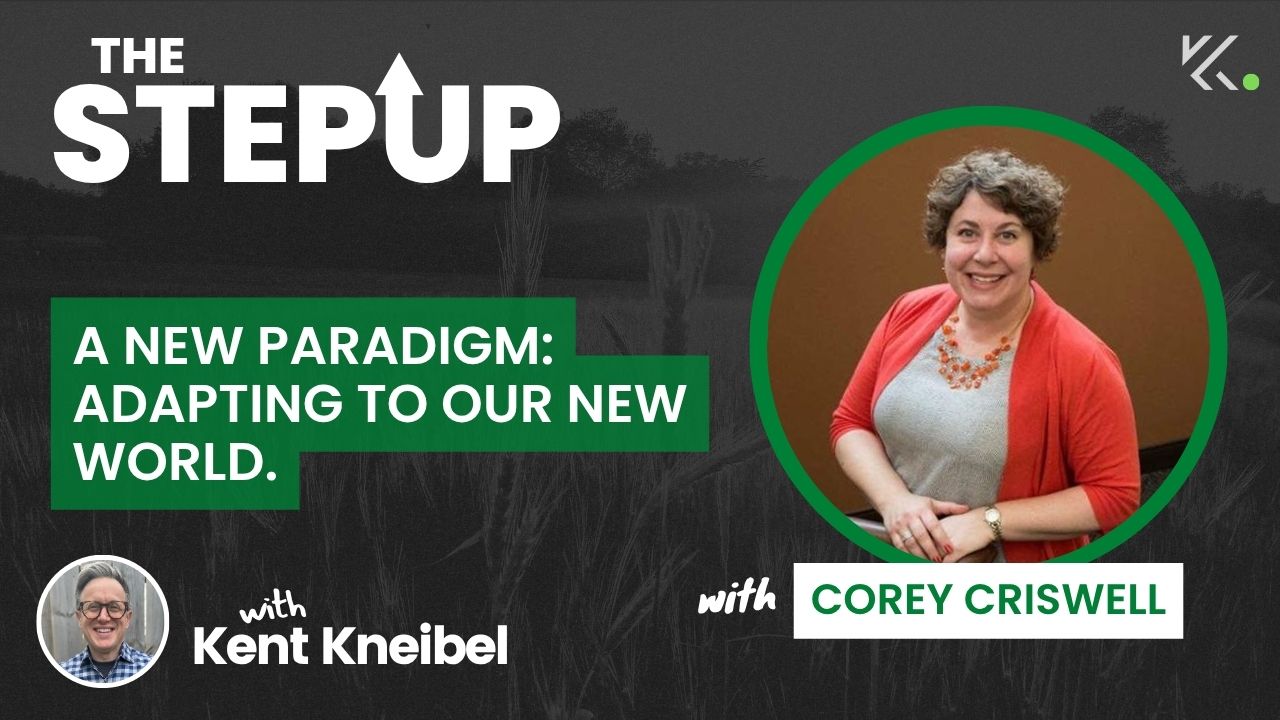
Corey Criswell is the Chief Leadership Officer at Adeption. She brings 25+ years of experience in the field of adult development honed by consulting with companies around the globe and in a $100B, Fortune 30 company. Today we're talking about harnessing AI for Leadership Development.
Change is the predominant theme of today's discourse, as we delve into the intricate dynamics of leadership amidst a rapidly evolving landscape influenced by technological advancements such as artificial intelligence. I have the distinct pleasure of engaging with Corey Criswell, an esteemed expert in leadership development whose insights are particularly pertinent for leaders navigating these unprecedented transitions. In our conversation, we explore the multifaceted nature of change, emphasizing the necessity for leaders to distinguish between technical challenges and adaptive challenges, a distinction that is critical for effective problem-solving. Corey shares her extensive experience, spanning various organizations, and sheds light on how we can better prepare leaders to embrace and drive change. Join us as we uncover strategies that empower leaders to step up their game in an era characterized by continuous transformation.
In our exploration of leadership development, we underscore the necessity for leaders to cultivate a robust framework, one that allows for self-reflection and a commitment to continuous improvement. The discussion highlights the significance of the adaptive leadership model introduced by Ron Heifetz and how it equips leaders with the tools to differentiate between technical challenges, which have clear solutions, and adaptive challenges that require innovative thinking and collaboration. Criswell emphasizes that the ability to engage stakeholders in meaningful dialogue is crucial for deriving actionable insights, thereby fostering a culture of shared responsibility and innovation within organizations. This nuanced understanding of leadership dynamics is imperative for leaders aspiring to thrive in an environment characterized by relentless change and complexity.
Takeaways:
- Embracing the unprecedented pace of change requires adaptive leadership strategies that involve collaboration among stakeholders.
- Leaders frequently misdiagnose adaptive challenges as technical challenges, which can hinder effective problem-solving.
- The integration of AI and technology into leadership development is essential for scaling effective learning experiences.
- Reflection on behavioral experiments can significantly enhance leadership performance by up to 23%.
- Blended leadership development combines in-person moments with ongoing support through AI-driven platforms to ensure sustained behavior change.
- The framework of 'Be conscious, be curious, be better' encourages leaders to connect personal challenges with professional growth opportunities.
Links referenced in this episode:
- Adeption.IO
- Corey Criswell on LinkedIn
- Kent Kniebel on Linked In
- Kent.Coach
**Music for this podcast comes from the song Needle & Thread and is provided with permission by Pert' Near Sandstone. Check them out on PertNeaerSandstone.com and on all major streaming platforms.**
Corey Criswell (guest)
00:00:04.240 - 00:00:39.870
What scales push technology or, you know, push content. It doesn't work. And what works? Executive coaching, one on one, small groups. You can't scale it.
And so we sit in that space of being able to say we figured out what works and scales. And so organizations who are saying that's exactly what we need, they're our best partners and we're enjoying those conversations.
Kent Kniebel (host)
00:00:42.190 - 00:02:20.490
Hi there and welcome to the Step Up Expert Voices for Leadership Growth. I'm Kent Knievel, your host, and each week I talk to experts who focus on supporting leaders in stepping up their leadership game.
If you're new to the show on whatever device you're on, I encourage you to, like, follow and subscribe so you never miss an episode.
And one last thing, as a leadership development consultant and executive coach, I have a particular passion for leaders who have been recently promoted. And if that's you or a leader you support, I encourage you to go to Kent Coach Playbook to download my 90 day success blueprint.
And there you'll find practical advice for any leader in hitting the ground running and stepping up their game and stepping up to their new level.
Today we're talking about change, the pace of change, things like AI that are coming in that people are already noticing are impacting certain jobs we're assuming and trying to look forward and think about how it's going to affect this industry or that, let alone all the other change that's happening technically in different sectors, as well as the whiplash that's coming out of Washington these days. Regardless of what side of the fence you're on, there's a lot of start, stop, pivot, start, stop, pivot happening. So change is the name of the game.
And with us today is Corey Criswell, who's going to talk to us about not only her own career in terms of how she supports leaders and stepping up their leadership game, but I'm assuming we're going to hear a little bit about your company today as well and what you're doing to support leaders through all this unprecedented change. Welcome to the podcast. Thank you.
Corey Criswell (guest)
00:02:20.730 - 00:02:23.210
Thanks so much for having me, Kent. I'm really excited to be here.
Kent Kniebel (host)
00:02:24.120 - 00:02:48.520
Yeah, well, first, I, you know, the first part of the podcast, I just want to hear about you, so I would love to. I know we've met before, so I'm excited to.
And I know you've had some change since we last talked, so I'm really excited to sort of rehear your career story all over again. So I'd love for you to help our listeners in Terms of understanding, you know, how did you get started on this path? Where have you been?
How did you land on the other side of this camera today?
Corey Criswell (guest)
00:02:49.090 - 00:03:26.990
Yeah, I appreciate that. So, honestly, my career started when I was six years old, growing up in Ottawa, Ontario, Canada.
And I read a biography of the foremost shark biologist, Eugenie Clark, and really had a vision that that's what I wanted to do, that I wanted to be a female scientist.
So fast forward many years, got a master's degree in marine ecology, was living in Flor, working for NASA on two different life sciences space shuttle missions.
Kent Kniebel (host)
00:03:27.150 - 00:03:30.830
I'm already seeing our connections to leadership development. I love it.
Corey Criswell (guest)
00:03:30.830 - 00:05:21.530
Exactly. Exactly right. And so during the space shuttle missions, we were studying the effects of microgravity on pregnancy.
And so we did that by flying pregnant rats in the space shuttle. And then my mother was divorced and sick and alone in Colorado.
And so my husband and I moved back to Colorado to help take care of her and get her back on her feet, literally. And I thought, what have I done to my career? I've torpedoed it. So it took a few months to get her back on her feet.
And then I ended up falling into a job at the center for creative Leadership. And what I loved about that was CCL's scientific research based approach to leadership development.
And so I jokingly say I went from studying, you know, rats in space to studying leaders in organizations, because that's really what interested me is what does leadership look like in different organizations?
So I spent 19 years at the center for creative Leadership, loved my time there, learned a lot, and then was recruited to Target, the mass merchandise retailer Kent. That's where you and I connected. Spent six and a half years at Target and then was really curious about what would be next for me.
Did I want to go back on the consulting side like I'd been at ccl, or did I want to stay internal in an organization? Was really open to both.
And as I was talking to people in my network about what I was looking for, two people recommended that I speak with Carl Sanders Edwards, the CEO and founder of Adeption.
Kent Kniebel (host)
00:05:21.820 - 00:05:22.300
Okay.
Corey Criswell (guest)
00:05:22.460 - 00:05:28.140
And I did that, had one conversation and thought, oh, my goodness gracious, this is what I want to do.
Kent Kniebel (host)
00:05:28.540 - 00:05:29.020
Cool.
Corey Criswell (guest)
00:05:29.500 - 00:05:29.980
Yeah.
Kent Kniebel (host)
00:05:30.060 - 00:05:33.580
What was it about that conversation that kind of hooked you?
Corey Criswell (guest)
00:05:33.820 - 00:06:02.600
Yeah. So what Adeption focuses on is the integration of technology and AI into leadership development.
So what does it look like to scale high quality leadership development? And, you know, the secret behind that, honestly, is AI and technology.
So this was a place where I didn't know a lot and Thought this is going to be fantastic for my learning curve.
Kent Kniebel (host)
00:06:02.920 - 00:06:48.080
Cool. So I.
So I think we were saying right before we were recording that I think you and I had some interesting similarities in our path of Now, I didn't study sharks, or was it rats in space? Mice in space. I actually was doing data entry for insurance before I fell into leadership development.
And I similarly started kind of in an entry ish level role and worked my way up.
And honestly, I found that to be the foundation, even still to this day, for a lot of what I do and how I think about leadership and leadership behavior, leadership success. So I'm just curious, like, how much do you feel like you still lean on your CCL days?
Corey Criswell (guest)
00:06:48.640 - 00:07:58.070
I think it's such a great question. I do still lean on, on my CCL days. I had two real insights there early in my career. Had never spent time thinking about leadership development.
But there were two things that really stood out to me. Number one, that voice in our heads that tells us we're not good enough. People around me might find out that I'm not good enough.
Leaders at all levels, including top three levels and Fortune 500 companies, they have the exact same concerns. And so I often think about, we really are just people trying to do the best that we can.
And then the second realization I had is how amazing it feels to work with leaders because the vast majority of people come to work wanting to do the very best job possible for themselves. Their teams, their communities, their organizations, their families. And so those two insights, honestly helped me fall in love with the field.
And those are some touchstones I come back to.
Kent Kniebel (host)
00:07:59.110 - 00:08:48.610
I was just saying to someone today that I'd imagine it's rare that someone wakes up in the morning like a leader wakes up in the morning, hoping to make everybody's lives miserable. You know, most are trying to do their best, want to do good, want to leave people feeling good. So I love hearing that. What dragged you into hr? Right.
So I know for me, I was looking at, and I think I was saying this earlier to you before we were recording, like, I was looking at, I have a lot more of my career in front of me than behind me. Loved PDI and Korn. Ferry would go back for sure, but I was like, I want to go and see how this stuff comes to life inside organizations. Yeah.
What was it that dragged you into and had you already moved to the States? I guess is my first question. And then what brought you to Target?
Corey Criswell (guest)
00:08:49.330 - 00:10:02.860
Oh, yeah. Such a good. Such a good question. So, yeah, moved to the States when I was still in elementary school.
And then, I mean, honestly, I started at CCL by just doing a project and then other people came to me. I have a project, I have a project. And I really fell in love with CCL's culture, the warmth of it and the field.
So that's what, that's what attracted me to begin with in terms of my move to Target. I had one of my client contacts, she was a former Ccler Vidula Ball. She reached out and said, what would you think about coming to Target?
And I said, no thanks, I'm really happy here at ccl. And she said, and this is such a genius question. She said to me, what do you have to lose by being open to a conversation with the recruiter?
And I said, oh gosh, that's a good question. I have nothing to lose. Had a conversation with the recruiter, talked to Vadula afterwards, and I said, you know, I walked away curious.
And she said, oh, that's one of our target behaviors. Be curious. And I thought, oh my goodness gracious, I'm leaving CCL and going to Target.
Kent Kniebel (host)
00:10:03.740 - 00:10:41.050
Wow, that's awesome. I want to talk about Target, but you also said something that really reminded me of my days at pdi.
And I think a lot of coaches, I think still experience this even if you're on your own.
But when you get those opportunities to collaborate with other coaches on projects or other consultants on projects, is the camaraderie in the coaching field or the consulting field, the hallway conversation of like, whose life did you change today? Who did you, you know, who got hard hitting feedback that they've never gotten before today, you know, that kind of stuff.
So I, I'm just curious if you have that same sort of experience at, at CCL as well.
Corey Criswell (guest)
00:10:41.450 - 00:11:03.610
I really did.
I mean, all the way along with every one of my, my positions and organizations, just the opportunity to collaborate with people who also love this same field that I love has given me so much gratitude and learning and just appreciation.
Kent Kniebel (host)
00:11:04.090 - 00:11:42.040
Yeah, yeah, now, now for me, I had this reel. I want to see how this all comes to life inside organizations.
I felt, you know, when I was with PDI and Korn Ferry that at times I felt like I was a cog in too many wheels, so to speak, and wanted to go really be in one place and see how all this, you know, comes to life inside.
So I'm curious, you know, did you have that similar draw and then what did you find when you, you know, in your six, six plus years at, at Target, what were some of your big AHAs or learnings about being in HR and being in an organization.
Corey Criswell (guest)
00:11:42.680 - 00:12:51.120
Such a good question, Kent.
I'd say I really learned a lot moving from the consulting side and then going in house with Target, such a large organization, 400,000 plus team members and really the skills that I added to my toolbox were around alignment. I mean you really have to make sure that the ship is pointing in the right direction and everyone's rowing in the same direction.
So I'd say alignment, the power of stakeholdering and just the opportunity to integrate, I think as consultants. And I'll be curious whether you have had that same experience.
You know, you really need to integrate with what's talent management doing, what's the talent acquisition strategy versus when you're with a consultancy it's easy to just have blinders on and only see, you know, executive development, not understand the broader context. Did you have that experience as well?
Kent Kniebel (host)
00:12:51.920 - 00:15:06.800
So I had the good fortune of being in HR in three different fairly good sized organizations and I would say I've seen it done a little differently at every place, right. And so I won't name names because I don't want to, I don't want anyone to have any, you know, feelings one way or the other about it.
But I've seen one or you know, in organizations where there really isn't the system to be integrating these things, we're sort of still early in that maturity model, so to speak. And, and then at another organization I saw like nary the twain would meet, right?
Talent was over here doing the talent things, leadership development over here doing leadership development things, HR business partners over there doing, you know, HR business partner things and just not enough integration.
And so my experience there was lots of good intention and really good work that like didn't have the pull through that it otherwise could have had had. We knitted those groups together and, and the one organization that I was at that did that the best, they did that, right?
So in that organization talent had like part ownership over leadership development.
Now they weren't the facilitators, they weren't organizing it, but they were tightly connected to who, like who was being tapped to go to this program or that program and how they were tightly connected to their client groups on who was going to be developed and what did they need for development. And so that that connection both with and so talent was kind of the hub at that organization.
So talent was the connection to leadership development, to dni, to as well as like, you know, how they, we were direct shoulder to shoulder partners with the HR business partners. And I would say if I had to, like. And I probably. I've talked about them in the order of what I would say is effectiveness. Right. And I would say that.
Yeah. So I think that has been my. And you don't know it when you're in the water. Right.
You don't know, at least for me, coming in from the outside, you don't know what you're seeing until you've left it.
Corey Criswell (guest)
00:15:07.530 - 00:15:08.810
Absolutely. Great point.
Kent Kniebel (host)
00:15:08.810 - 00:15:18.810
You're asking me the question at the right time, which is like in hindsight. Yeah, they really knitted it together well and got more mileage out of everything because of it.
Corey Criswell (guest)
00:15:19.290 - 00:15:42.560
Yeah, I love that. I think that's super well said. I've just had the one experience internally and Target did exactly what you're talking about.
Just a really great job of knitting together all the disparate, you know, centers of excellence that touch a learner, a leader as they go through their journey.
Kent Kniebel (host)
00:15:42.800 - 00:16:47.690
Yeah, well. And I think there's always a tension between business, hr, HR business partners and COE type roles.
But I would say at least getting your COE connected and not having this like, don't reach into my sandbox and I won't reach into your sandbox, you know, if you can at least have. Get everybody on the same page of awareness and what the. How the one area's inputs affect another areas.
I just think the, the mileage is there because that will help you better integrate with HR business partners which will not, you know, let alone help you better integrate directly with business leaders.
Because I think that's one thing that I think can cause some struggle in an organization is when the experience is so disparate on the business leader side. It sounds so silly, right?
It sounds so silly to say like you have to have a 1 hr kind of mentality and you have to try to breathe life into that and live that.
Corey Criswell (guest)
00:16:47.690 - 00:17:14.030
I think completely agree.
I think that's one of the things that I've really learned and honed skills on at adeption and is just the, you know, our co design process, our human centered design and making sure that we are hearing directly from those business leaders because honestly, they know best. Right. They know better than we do in HR about what's required.
Kent Kniebel (host)
00:17:14.510 - 00:17:48.370
Yeah, cool, cool, cool, cool. Awesome. Well, that's kind of, I think dovetails us nicely into part two. So.
And I think I want to start with kind of how we teed this up at the beginning, which is change. Right. So talk to me about what's the 2025 has been what, what a time to be alive. It has been a wild, wild ride.
So, like, what's been the broader sort of strategic conversation happening at adeption and the challenge that you're trying to both probably better best scope and identify, let alone meet?
Corey Criswell (guest)
00:17:49.090 - 00:19:37.570
Yeah, absolutely. So two things there. I love you calling out just the amount of change and disruption. That's the number one challenge.
We're hearing from organizations around the globe and think, you know, large organizations think medium, smaller, public, private. What we're hearing is its complex challenges and the amount of disruption and ambiguity they bring.
And organizations are saying to us skill and competencies still matter.
And the rate and level of disruption today really highlights the importance of the ability to adapt and to meet opportunities with a greater range of approaches, mindsets and behaviors.
So I'll say that on the change side and then in terms of the problem that we're uniquely positioned to solve, typically what we find is that what scales push technology or push content, it doesn't work. And what works, executive coaching, one on one, small groups, you can't scale it.
And so we sit in that space of being able to say we figured out what works and scales. And so organizations who are saying that's exactly what we need, like there are best partners and we're enjoying those conversations.
Kent Kniebel (host)
00:19:38.610 - 00:20:42.490
I love it. There is so much to go into there. And I think the poll is to talk about the last thing you said.
And I'm going to force both myself and our listeners to hang on to that one for a minute. Scaling. But let's first talk about adaptability. Right, Because I think it's probably pretty easy for us to talk about.
Let's just talk about the competency of adaptability or resilience, grit, you know, I don't know what other both similar and related, you know, words we can come up with. It's probably pretty easy for us to talk generally about adaptability, but how are you now starting to talk more specifically about adaptability?
Right. Because some of the changes are. It's very specific. It's, you know, to how are we. And I'd imagine with AI, right.
There's probably some conversation around how are we relating to and working with AI, which is still there's so much gray area of what is truly going to happen here. So I just would be really curious, go more, tell me more about adaptability.
Corey Criswell (guest)
00:20:42.490 - 00:22:47.910
I guess I'm happy to. I'm happy to. And I appreciated you, you know, your interest in, as we talk with organizations, what are we seeing, hearing, recommending.
And so the first one is adaptive leadership. For those of you who are familiar, this is the work of Ron Heifetz out of Harvard and many others as well.
Here's really what his research has shown, that there are a continuum of challenges. On the one end, we have technical challenges. These are the challenges. Where known solutions exist, best practices apply.
You're leveraging expertise and excellence, maybe not your own, maybe someone on the team, in terms of who's responsible for coming up with a solution. This is really experts. And so on the one end we have technical solutions. On the other end we have adaptive solutions and adaptive leadership.
And this is really where no known solutions exist. And what you have to do is experiment and learn the solutions you're going to come up with.
Stakeholders are going to come up with typically are disruptive. And they drive innovation in terms of who's responsible. And you can't just rely on one expert.
And the responsibility really lies with all of your stakeholders. And you really have to tap into hearts and minds and values. And so I'll just say one more thing and I'll see what you're curious about.
But that is what we're finding is leaders often misdiagnose and treat adaptive challenges as technical challenges. So there's already a known solution for this, even when your organization has probably never seen this type of challenge before.
Kent Kniebel (host)
00:22:48.470 - 00:23:54.040
Yeah. Yes. And I would say not to keep bringing it to AI, but I mean, it's the perfect example of the moment. Right.
So what I'm hearing is, you know, I'm almost hearing this. I'm trying to think like, you know, the practicalities here. Right.
So we're probably talking about how do we bring more self awareness or reflection that, you know, willingness to stop, pause, think. Right. Which it's easy for us to talk about that. Right.
But we've also both been inside and we see how getting leaders to pause is such a hill to climb. Right. There they are.
And for all the good and noble reasons, they are really focused on what's immediately in front of them, continuing to deliver on whatever today's, this week's, this month's metrics are. So how are you trying to bring and build this muscle, so to speak? If I'm on the right track here you are.
Corey Criswell (guest)
00:23:54.520 - 00:25:11.830
So a couple things.
Number one, typically when we describe this technical challenges versus adaptive challenges, people immediately say, oh, here are examples of technical challenges that I'm facing. Here are examples of adaptive. So this gives language and vocabulary to something that people already are experiencing.
And then we'll say to them, think about a challenge you face right now, today, chances are it has technical components and adaptive components and you need to peel those apart. And again, people tend to say, oh, I can do that, I can peel them apart. And then the technical challenge is just give those to the experts.
But on the adaptive side, what are the stakeholders that you need to bring together?
Not to come up with the complex solution at the end because you don't know it yet, but what insights do they have that helps determine the next step or, or two? Because that's going to give you the information you need to continue on with making progress on this adaptive challenge.
People liken it to an agile approach.
Kent Kniebel (host)
00:25:12.950 - 00:25:39.050
Yeah, I was going to say like the thing that, that's popping into my head is change management. Right. And I think it's not a new field. Right.
But I do do feel this sense of renewed energy in change management, which I'm not saying that's, that's what you're doing or even how you're talking about it necessarily, but that, that does, it seems to borrow a fair amount from change management.
Corey Criswell (guest)
00:25:39.850 - 00:26:05.290
It. I agree with you completely.
And you know, we're hearing a lot about change fatigue and this helps people understand why they may have led change efforts that didn't go well.
When we ask people tell us about a change effort that you've been involved in that didn't go well, they tend to describe an adaptive challenge that they treated technically.
Kent Kniebel (host)
00:26:06.010 - 00:26:11.330
That's amazing. Yeah. Cool. So I'm watching the time. I want to talk about scaling.
Corey Criswell (guest)
00:26:11.330 - 00:26:12.570
Yeah, absolutely.
Kent Kniebel (host)
00:26:13.210 - 00:27:50.540
You said some really meaty stuff there. And I'm going to give you my bias.
So now my bias is not that we need to be having three day off site training programs because I don't think those work very well either. And my bias is not also towards coaching.
Like it's just everything's got to be individualized, you know, coaching which, you know, don't get me wrong, not asking for people not to call me about coaching, but some of the ways that I look at and think about leadership development is you have to build in practice and accountability. Right. And which is where I know the eventized training tends to fall flat. Right. We get people together.
Maybe that doesn't happen as much nowadays, but I think surprisingly more often than we would hope, right. That we get leaders together for one, two, three days, hopefully.
The coffee is hot and the cookies are delicious and we pour knowledge into them and then we cross our fingers and hope they learn something and go and, you know, behave differently, do something different. And so I'm Curious, because what I've seen with different. And I'm not gonna, I don't want to shoot anybody's. I don't want to, yeah.
Call anybody, anybody's baby ugly. But I've seen various, you know, basically SAS models step up where we're able to push, just push content out.
And I still think that is missing practice and accountability to it. And you're a smart cookie. So I'm assuming that this is where perhaps some of the scalability that Adeption's working on is going.
Corey Criswell (guest)
00:27:53.020 - 00:28:24.720
I love you bringing this up. And if content, if this was a content issue, people can't solve their problems because they don't have the right content.
All the problems would have been solved. Solved. We have so much content available. That's not the issue.
There's a quote by Eric Hoffer I love here and he says in times of change, the learners will inherit the future while the learned will be perfectly equipped for a reality that no longer exists.
Kent Kniebel (host)
00:28:26.080 - 00:28:26.880
I like that.
Corey Criswell (guest)
00:28:27.040 - 00:28:27.920
It's good, right?
Kent Kniebel (host)
00:28:28.160 - 00:28:28.880
I like that.
Corey Criswell (guest)
00:28:29.040 - 00:28:49.520
So here's how we help exactly the, the problem you were talking about. People come together, it's in person. They are hungry for in person moments. It's inspiring. It's amazing.
They make new connections across the organization and they go back to work and they do the same thing that they've always done.
Kent Kniebel (host)
00:28:49.760 - 00:28:56.800
Yeah, well, and just to interrupt you quick, I feel like there's even been more of a pull back to in person, you know, coming out of the pandemic.
Corey Criswell (guest)
00:28:56.800 - 00:30:08.360
Right, Yeah, I agree completely. So here's what we're finding in terms of impact, meaning the likelihood that your learner will experiment with new behaviors on the job.
And that is blended leadership development.
There's no doubt that in person moments, whether they be physically in person or whether they be live moments virtually, that those definitely have a place. But it's not enough. We can't just inspire people with a moment of provocation and hope that that's going to lead to behavior change.
So what we have is an AI driven platform that supports the learner through a 6, 9 12, 18 month experience. And the platform allows the learner to engage one on one with the content that is most relevant for them.
We're using AI to analyze the verbatim comments that people speak or say onto the platform and then recommending tools that are most appropriate for them.
Kent Kniebel (host)
00:30:08.920 - 00:30:23.060
So you're, you're addressing like I am. I need in, I need influence. Right. I'm, I'm working on a project.
I need to get people on board you're serving up or I've got too much on my plate, I need to delegate more. You're serving up delegation.
Corey Criswell (guest)
00:30:24.180 - 00:32:43.820
Yes. And I'll say this, Kent, because we don't go in there and say, what's your biggest challenge? And people neatly, cleanly say it's influence.
The challenges are more complex than that. And so the AI is looking at multiple verbatim comments and serving up a variety of tools.
Or sometimes an organization will say, look, we really want people to get our teams model or we really want them to get our leadership competencies or whatever so we can build in that kind of tool. But here's really what we're doing. We have at our core development framework and we call it B3. Be conscious, be curious, be better.
And if you're familiar with some other kind of development frameworks, you'll, you'll see some similarities. But the first thing we want to do is get the learner connected to the content, the topic.
And so we do that through be conscious by asking them, why is this important? What do you already know? What do you already have? What gaps are you noticing?
Because people are then connecting themselves, their own challenges to what we're going to talk about about. And then we move into be curious. And so we do this.
Whether it's an in person leadership development moment or whether you're going through a workout on our platform, we're always using this development framework.
So in Be Curious we're offering some tools, some models, some ideas so that the learner can take a step into learning and help close the gap, which helps them build confidence. We are not saying you need to go do this workout or LinkedIn, learning on influence, delegation or whatever.
We're just saying here's some things that might help. And then we ask people every single time, what action are you going to commit to? What experiment are you going to try?
Our research is showing, not surprisingly, that the more specific you are with the what, when, how of that goal you set results in better action.
Kent Kniebel (host)
00:32:44.220 - 00:32:44.700
Cool.
Corey Criswell (guest)
00:32:44.940 - 00:33:24.110
And so what we're able to provide is, you know, Ken, I've always felt like you send people to a leadership development experience, but you don't honestly know what people do as a result.
Maybe you run into them in the hallway, maybe they send you a note, but you don't actually know because we're capturing that, because participants are capturing that in the platform, we actually know what actions they're taking and we can map it back to the leadership competencies or whatever. So that's what we're finding Is having the best impact to actually get people to experiment with new behaviors.
Kent Kniebel (host)
00:33:24.980 - 00:34:16.640
Awesome. Yeah. The hardest part is how do you get people to try something, do something differently?
And at a micro level, I try to build one program I've been doing. It's one, maybe two pieces of content in month one.
So we're going to talk about delegation and feedback this month and you're going to build a plan to delegate something and a plan to give someone feedback to something. And we're going to get back together next month and talk about what you did and how you did it. Exactly.
Right now that's a smaller company and a cohort. Right. It's.
You can, you know, so I think the scalability play and it almost sounds, it sounds like it's a blend of frankly coaching and leadership development. Right. Because the prompts are saying, if I'm hearing you right, basically when are you going to do this? What's going to get in your way?
Corey Criswell (guest)
00:34:16.720 - 00:34:17.200
Yes.
Kent Kniebel (host)
00:34:17.440 - 00:34:26.720
And then is it then prompting them around that day, like when they said whatever their when was, is it hitting them on their email and saying, did you do it?
Corey Criswell (guest)
00:34:26.720 - 00:34:38.640
Like, yeah, it's such a great question. So here's what we do. We ask people, how do you want to be reminded? So me personally, I want to be reminded Mondays at 8am Via email.
Kent Kniebel (host)
00:34:39.280 - 00:34:39.720
Nice.
Corey Criswell (guest)
00:34:39.720 - 00:34:52.150
But you can set that reminder, the calendar notification, however you want it. And that is surprisingly useful to just get, you know, nudged in the right direction.
Kent Kniebel (host)
00:34:52.630 - 00:35:22.560
Very cool. Very cool. So I think I said, I think I called this out as part two.
So I guess I'm gonna have to call the next part part three though, you know, we'll, we'll sort that out over time.
So I want to move into talking about and I think I teed you up to say, hey, I want to hear, I want you to be able to tell our audience about three things. Three things that they could take action on.
You know, that could be advice or how to get a hold of adeption and for what and why or how to get a hold of Corey. So I'll just turn the floor over to you.
Corey Criswell (guest)
00:35:22.880 - 00:37:05.730
I love that. So my first one would be, you know, I'm going to go back to adaptive leadership that we talked about at the beginning of our time together.
And I would just say think about a challenge that you currently face. What are the pieces or components of that challenge? Whether technical solutions delegate to an expert. Maybe it's you that that's the expert.
What are the pieces that are adaptive and bring stakeholders together for conversation to help you understand what's going to be the next step. So that's my first tip.
My second tip is going to be around our Be conscious, be curious, be better, and think about, you know, maybe it's delegation or influence without authority. We hear a lot about that. So maybe you have something around influence without authority. Why is that important to you? What are you already doing?
Well, what do you wish you were doing better?
Go look at just Google influence without authority, find two or three different tools, models, videos to watch, and then think about a small action or experiment you can take in the next handful of days and just notice what that cycle is like for you to be conscious about it, to be curious about it, and then to commit to being better once you've done the experiment or the action. What we'd love to have you do is reflect what worked about that process.
Our research is showing that leaders who take time to reflect post a behavioral experiment have 23% increased performance.
Kent Kniebel (host)
00:37:06.370 - 00:37:07.170
Oh, awesome.
Corey Criswell (guest)
00:37:07.250 - 00:37:14.610
So 15 minutes a week of reflection leads to 23% increase in performance. So that would be my two.
Kent Kniebel (host)
00:37:15.010 - 00:37:38.860
And then I just want to jump in because you said one thing, which is experiment. Right. And I've, I've. First of all, I had a VP once who said if you slap the term pilot on it, you can try just about anything.
But also I've been in my coaching, I've been talking to people about like, let's just call this an experiment you're going to do this one time. Right. So I love it. How do you give people permission to just try it?
Corey Criswell (guest)
00:37:38.940 - 00:37:39.660
I love that.
Kent Kniebel (host)
00:37:39.660 - 00:37:41.020
I love that forever.
Corey Criswell (guest)
00:37:41.180 - 00:37:46.290
I'm also a bit of a sidebar. I'm also studying for French on Duolingo.
Kent Kniebel (host)
00:37:46.370 - 00:37:46.930
Okay.
Corey Criswell (guest)
00:37:47.170 - 00:38:33.000
Just learned that the word for experiment in French is the word experience. So experience. Love that that concept is tied. Like every time you're having an experience, there's an experiment in there.
And then the third one is if you want to connect with me, I would love to connect with people. You can find. Find me on LinkedIn. You can visit us at adeption.IO A D E P T I O N I O. And I'm just, I love, I love leadership development.
I love what we do. I love having a front row seat to how people want to improve themselves. And I'd love to learn from the audience.
Kent Kniebel (host)
00:38:33.480 - 00:39:29.920
Awesome. Well, I'll make sure to include all those links, including how to find you, as well as how to find adeption in our show notes. Well, thank you.
Thank you so much.
That brings us to the end of our episode so I'd encourage you to not only check out Adeption and Corey online, but also again, if you have a passion like mine for the newly promoted, head on over to my website, Kent Coach. That's the easy way there. Or Kent Coach Playbook if you want to access my 90 day success playbook blueprint.
And before you go, I do ask that all listeners do me a huge favor rate. Give this a five star rating and a comment in your rating. It will help put this show in front of more eyes and ears.
Corey, thank you for your time today. I really appreciate it.
I learned a number of things that I'm going to have to think about and talk to you about offline, but really appreciate your time and generosity with our with our listeners.
Corey Criswell (guest)
00:39:30.240 - 00:39:33.760
Thanks, Kent. I loved being here. Thanks for the thoughtful questions.
Kent Kniebel (host)
00:39:34.080 - 00:40:06.730
Great. Thank you. Well, and so all to my at least my one listener who really loves me, if not multiple listeners. Thank you as well.
And until next time, that brings us to the end of our episode. Thanks for listening. I'd encourage you to head on over to my website Kent Coach and start a conversation with me there.
Or check out my promotion playbook@kniebelleadershipadvisory.com totes playbook. Before you go on with your day, I ask that you please take a moment to leave a rating and a review wherever you listen to podcasts. Five stars.
That helps put this podcast in front of more eyes and ears. Until next time, take it easy.


