
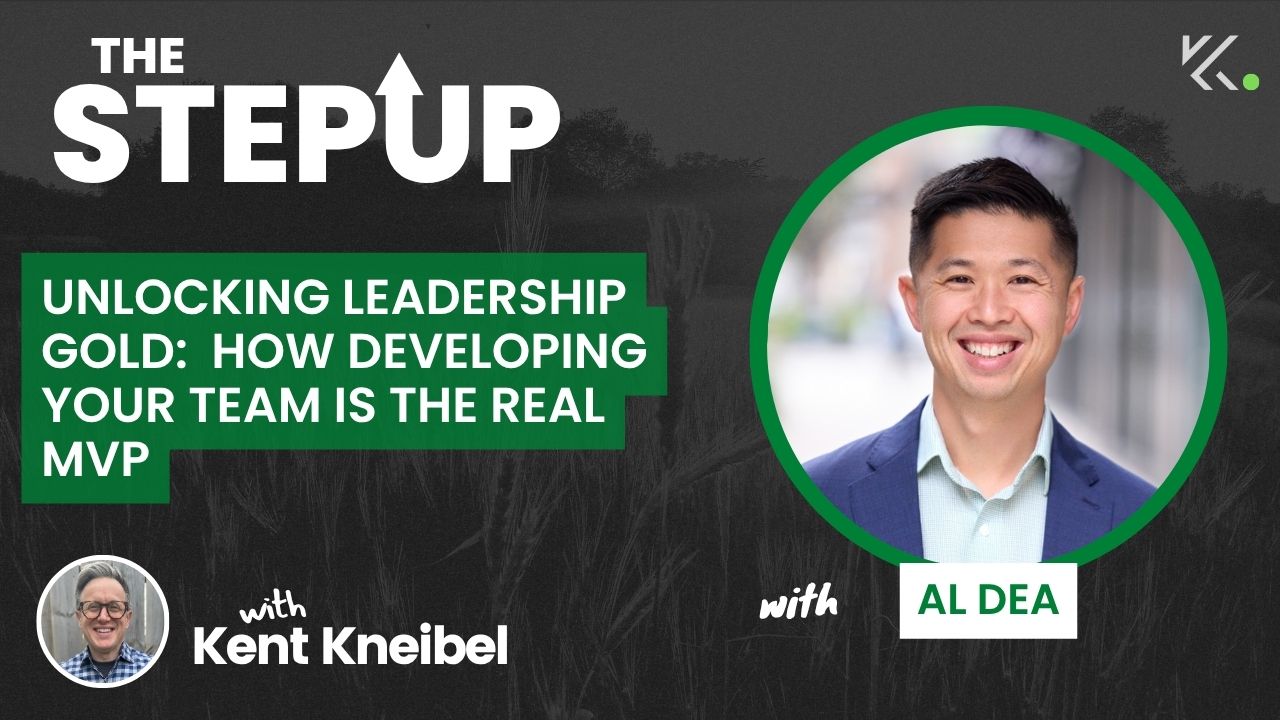
Al Dea is a speaker, entrepreneur, consultant, and podcast host. He advises leaders across industries to help them understand how the workplace is changing, and the implications for leading and growing people and organizations.
Drawing on his work advising the next generation of managers and leaders across diverse companies and industries ranging from Fortune 500 companies, non-profit organizations and emerging startups, Al speaks on topics around talent, culture, and leadership to inspire audiences to sense and respond to market changes and lead in more effective and people-first ways.
Al’s mission is to create a better world of work by working with leaders to create human-centric workplaces that unleash the potential and performance of their people.
Developing your people isn’t just a nice-to-have; it’s a crucial part of leadership that often gets sidelined. In this episode, we dive deep into the reality that while leaders might say their team members own their own development, the truth is, they often need support to truly thrive. Al joins me to chat about how many successful folks credit their achievements to the help they received along the way, and how leaders can create the right conditions for growth instead of just piling on more tasks. We also explore how the pressures of daily operations can make developing talent feel like an afterthought, even for well-meaning leaders. So grab your headphones and get ready for some insightful banter on how to prioritize people development without losing your mind in the process!
When we think about leadership, it’s easy to get bogged down in the day-to-day grind, right? Well, today’s dialogue with Al shines a light on the often-overlooked art of developing talent. Al starts by painting a stark picture: leaders are often given more responsibilities without the necessary support to prioritize people development. He brings to life the struggles of first-time leaders who might not even realize that fostering their team's growth is part of the gig. The discussion is rich with anecdotes and practical tips, from the importance of having regular career conversations to the necessity of creating an environment where team members feel safe to express their aspirations and challenges. Al stresses that while it might feel easier in the moment for leaders to handle tasks themselves, this short-term thinking can lead to long-term headaches. By investing time in developing others, leaders not only enhance their teams' capabilities but also free themselves up to tackle more strategic initiatives. This episode is a goldmine for anyone looking to elevate their leadership skills and create a thriving team culture.
Takeaways:
- Leaders need to own the development of their people, but they often forget this amidst their busy schedules.
- Success in organizations is rarely achieved solo; most successful individuals credit support from mentors and peers.
- Developing talent is not just a nice-to-have; it’s essential for long-term organizational success and sustainability.
- Leaders should regularly audit how they spend their time to prioritize people development amidst their many responsibilities.
- Investing time in developing others can lead to greater efficiency and effectiveness in the future, creating a win-win situation.
- Creating an environment where employees feel supported in their growth can significantly enhance overall team performance.
Links for today's episode:
**Music for this podcast comes from the song Needle & Thread and is provided with permission by Pert' Near Sandstone. Check them out on PertNeaerSandstone.com and on all major streaming platforms.**
*Editing by Fynn Gentle / www.fynngentle.com
Al Dea (guest)
00:00:04.080 - 00:00:33.490
All of our people, they own their own development, right? It's a very great aspirational thing to say. It can be very empowering for people to say that.
But the reality of it is, is that if you talk to most people who have, quote, unquote, achieved a level of success in an organization and you try to pull up themes between all of them about what actually enabled the success, my confidence was pretty high that almost all of them would talk about how to a varying degree, they wouldn't have gotten where they'd gotten without the support or help of someone. Right.
Kent Kniebel (host)
00:00:35.330 - 00:01:38.240
Hi there and welcome to the Step Up Expert Voices for Leadership Growth. I'm your host, Kent Knievel. Every week I talk to experts who focus on helping leaders step up their leadership game.
If you're new to the show, then on whatever platform you're using, I encourage you to subscribe so you never miss an episode. One last thing.
As a leadership development consultant and executive coach, I have a particular interest in support supporting recent internally promoted leaders.
If that's you, or if you support a leader who has been recently promoted, I encourage you to visit my website at Kent Coach Playbook and download a free copy of my 90 day blueprint filled with practical advice for you or the leader you support in hitting the ground running and truly stepping up to their new leadership level. Without further ado, on with the show. Welcome, everybody.
Today we're here to talk about one of the most important tasks that leaders have, which is developing their people. And with me today for this conversation is Al D, founder of the Edge of Work executive coach and facilitator. Al, thanks for coming today.
Appreciate having you here.
Al Dea (guest)
00:01:38.640 - 00:01:41.680
It's great to be here with you. I'm excited to have this conversation.
Kent Kniebel (host)
00:01:42.080 - 00:01:51.280
Yeah.
Well, as always, before we get into the topic du jour, would love to hear about your career story and how you sort of got into what you're doing today.
Al Dea (guest)
00:01:51.680 - 00:05:36.720
Sure.
So I was a business and philosophy major in undergrad and I decided to start my career like every business and philosophy major in terms of becoming a management consultant.
That was a joke and I was being facetious, but I really what I really knew at the time, I didn't necessarily know what I wanted to do, but I liked solving problems, I liked working on teams, I liked working with other people. And so I started my career in management consulting, really working at the intersection of technology and change management.
So working on a lot of large cloud, global, complex technology transformations and really working on the change management and people side of that. And so thinking about change Management and org redesigns and day one readiness and operating models and things of that nature.
And I really enjoyed that work, particularly kind of at the intersection of how does technology really impact people? And how can organizations use technology in new and novel ways?
And this kind of happened around the time when social media started making its way into the enterprise.
At that point in time, a lot of us were kind of using things personally for social media, like having personal Facebook accounts or having a personal Twitter.
But it was a little out of the left field to think about how do we actually use these within organizations and how do we use them to better service our customers or better help our employees work better.
And so it was an exciting time to kind of work at this kind of shift and change and went to business school, came back to the firm, and when I came back, I started doing more work in this space.
But one of the things that kind of kept coming up, quite frankly, was something that I'm sure you probably know is that no matter what technology you're implementing, or no matter how cool it is, or how interesting it is, or how innovative it is, if you're trying to drive working in new ways, it has so much less to do with the technology than it has to do with the people and specifically kind of the leadership and the culture.
And so I just started following the curiosity first in terms of the client work that I did, but also internally at the firm that I worked at, there was kind of a whole track you could go down in terms of learning kind of the tools of being a coach, being a facilitator, and being a trainer.
And so I decided to do that because I just was genuinely curious in IT and started getting tapped to kind of lead leadership programs internally in terms of being a facilitator or coach at high potential programs, at promotion programs, things in that nature, and just kind of fell in love with that world. So much so that for fun, I started writing about kind of leadership development on the side outside of work.
And I started a little side hustle, doing some coaching, some training and some speaking. And little by little just kept doing a little bit more and a little bit more of it.
Eventually left the consulting world to go work in the technology industry and just kind of kept doing kind of that side hustle, so to speak. And so every year I did a little bit more and a little bit more.
And then during the pandemic, my side hustle, in terms of doing a lot of speaking, coaching, leadership training, just kind of elevated significantly because the demand for those services, particularly in a virtual world, as we were trying to adapt, just kind of grew pretty significantly. And so but the first year of the pandemic, kind of trying to kind of manage both my full time day job and my full time side hustle.
And then I just kind of realized after about five and a half years of doing a side hustle, I just, I wanted to make that the main thing. And so at the end of 2021, I decided to kind of go off on my own and to build my own leadership and talent development consulting practice.
And so that's what I've been doing for the last couple years of partnering with organizations to design, deliver and facilitate leadership programs to make sure that leaders are equipped to lead in kind of this world of work that we are in today, with a specific emphasis on leaders who are kind of earlier in the journey of being a people leader and then also advising some organizations on their overall kind of talent and people strategies in terms of how they think about how they develop people internally, how they attract and retain talent, things of that nature. And so that is kind of what has at least partially gotten me to kind of being on the call right here with you this, this afternoon.
So that's a little bit about my journey and a background.
Kent Kniebel (host)
00:05:37.120 - 00:06:13.900
Nice.
That sounds quite the opposite of what I've heard a lot from a lot of other independent consultants at the beginning of the pandemic was, you know, a lot of them saw work pulling away and it's an interesting opposite story I'm hearing from you on that's when things sort of took off for you. Right. And I think were people who had that comfort had already been working in webinar delivery and sort of virtual work who maybe had.
It sounds like you maybe had a bit of an edge at that time for that kind of delivery.
Al Dea (guest)
00:06:14.300 - 00:07:21.470
Yeah, no, it's one of those things where I mean, first off I had the benefit of having kind of like a full time day job that I mostly enjoyed. Right.
And all along in many ways it kind of felt like playing like with house money because at the end of the day, like I was still doing something that I genuinely like, enjoyed in my day to day work.
And then I had this other thing look like, you know, I didn't have to do those things like those things outside of work, but I did because I was excited about it.
And I think anytime you're playing a game where you have a lot of intrinsic motivation to play and you're not necessarily doing it for other reasons, there's nothing wrong with that. It's just a different set of calculus and a different set of constraints.
And, and so, yeah, I mean, I think that, you know, something, you know, that has been something that would say if I actually reflect a little bit more deeply, just a common theme in my life of just trying to be more attentive and pay more attention to where that intrinsic motivation is emanating from and trying to see how I can bring that more front and center for whatever it is.
And when I've done that, I, again, if I reflect back on it, I often feel like those, those were some of the more transformational moments have, have come for me.
Kent Kniebel (host)
00:07:22.260 - 00:07:44.180
Nice. That's awesome. Today we're talking about leaders developing their people.
I think in my own experience, it's an often aspirational, easily neglected part of the leadership expectations, however you want to put that. So I know you've been doing a lot of thinking about this. Would love to know where do you want to start that conversation?
Al Dea (guest)
00:07:44.580 - 00:10:04.280
No, your framing resonates with me.
And I think it resonates with me because I think about not just my own experience having been a people leader, but in all the work that I do and all the conversations I have just talking with other leaders today, I think it's a couple things. I think the first thing is that again, we've gotten really good at adding things to the plates of leaders and giving them more things to do.
And we have not gotten as good at taking things off their plates or even for that matter, at times telling them which mean more or which mean less. Some of this is a math game, right?
In terms of, well, if you're always adding and never ticking away, people are going to make judgment calls in order for them to be able to survive, Right? And sometimes the thing that often gets dropped is kind of that people leadership and the people development piece.
And that's where your comment about it being aspirational really resonates. Because even leaders with the best of intentions, if they're under the gun sometimes that's the thing that often goes by the wayside.
The other aspect of it is, particularly for newer leaders, sometimes they just don't know that it's part of the requisite elements of being a leader is that you have to do this thing.
And sometimes you can't blame them for not doing it if they've never been told, if they've ever been trained, if they've never been given a set of expectations that, hey, this is actually part of your job. That can often kind of be something where you can't Necessarily fault them for not being able to perhaps engage in it, if you will.
And you know, I think the last kind of reality of this sometimes is that sometimes these things can be sometimes the act of investing in developing your people or developing talent, it can feel a little more amorphous and a little less concrete than some of the other output driven activities that a leader may have. And sometimes it's a little bit easier to kind of glom onto things that are a little bit more discreet, a little bit more concrete.
Yeah, understandably so. And so they kind of just like naturally kind of fall to the, to the wayside, if you will.
And so even in the best of intent, with the best of intentions for people who arguably are trying to do the right things, there are some just barriers that often get in the way and again, I think really align with that idea that you had of like sometimes it feels a little bit more aspirational than, than actually like a lived reality.
Kent Kniebel (host)
00:10:04.680 - 00:11:27.880
Yeah, I. So I've been in a number of sort of assessment centers and coaching conversations lately where I just want to add to some of that. Right.
One is there's the allure of, and I think this is what you were saying too. There's the allure of accomplishment, the feeling of accomplishment.
And so sometimes it is really easy for leaders to get involved in a layer down, so to speak, and their people's stuff and executional tasks because you know, you can check those off, it's boxes you can check and you feel like you did something today because I find, you know, a lot of leap struggle with the, you know, strategic things are longer term. Some of the strategic projects they're working on are longer term.
So the day to day doesn't feel you don't have that same sense of accomplishment day in, day out that maybe you did in the prior role.
And then also, you know, to your second point of not being taught, I mean, I think in my experience this is developing talent, finding time for strategic endeavors. Even that is a challenge at every layer. Right. It's not just, you know, first time leaders that need to figure this out.
It's like you have to keep relearning how to let go of what you were doing before at each level. And so sometimes you're not being taught that because the layer above you is struggling with that very same challenge.
Al Dea (guest)
00:11:28.280 - 00:12:53.490
Yeah, no, and I think you're right.
And I think to your point, navigating kind of the what's important in the short term, that which a lot of times we can see versus some of the things not in this case, not just the act of developing talent, but other types of longer term endeavors like strategy, like others that can be hard to sometimes have confidence in that if you've got to make trade offs, it's okay to invest that time. Because look, for a lot of us, we're only as good as our last quarter, right.
And there's a real lived reality to that that I don't, I don't want to overlook for sometimes for some leaders, right. But I do think like with a lot of things in life and in business, it's not always an either or, right.
Like there's got to be room for a both and there's got to be room for navigating those polarities of the short term versus the long term. You know, assuming that you work for an organization that would like to be in business for a prolonged period of time. Right.
Because the reality of it is, is that you only can do that if you have great people in the wings who are ready to kind of continue to kind of keep plugging away and doing the work that matters.
And, and so if you don't do anything for your future, well, no matter how, I don't care how good the last quarter was, like if you're not going to be around for a few more after that, you know, what are we doing here?
Kent Kniebel (host)
00:12:53.490 - 00:13:06.490
So, yeah, yeah, I've heard some, you know, again, it's, it's this aspirational thing too, right. Where I've heard some leaders say, really go on the record of saying like my goal is to be an exporter of talent. Right. And that. Exporter of talent.
Al Dea (guest)
00:13:06.570 - 00:13:07.130
Yeah.
Kent Kniebel (host)
00:13:07.530 - 00:13:45.860
Right.
And we talk about succession planning and things like that, but really when the rubber hits the road, are you truly preparing people to take over for you to do some of the things you're doing? Right. So there is that. And as you're saying that investment, right.
The people fall into this trap of, as well, of like, well, it's, it's just going to be easier and faster for me to do this than to coach someone up on it. Right. Which you know, from an investment strategy perspective, right.
You're, you know, you're just not thinking about the long term and what the kind of payoff you might get further down the road. So you were, you know, the first thing we were, you were talking about here is making the time, right.
Al Dea (guest)
00:13:45.860 - 00:13:46.140
Yeah.
Kent Kniebel (host)
00:13:46.140 - 00:13:57.700
Which I think is part of the equation.
So what other challenges do you see with leaders release, stepping up to step, you know, stepping up to the plate or stepping up their game when it comes to developing talent.
Al Dea (guest)
00:13:57.700 - 00:18:12.120
Yeah, sure, it's a good question.
Well, and even let's take the time thing for a second part of the challenge there sometimes perhaps is just kind of thinking about that in a very closed minded way, or maybe closed minded is not the right word, but maybe in a more narrow way. Because I could also try to make a rational argument that taking time and investing in that actually gives a leader back time. Right?
And so sometimes it is one of those things where it really just is a little bit more of like a narrow view around.
Oh, that's like the one the example you gave is a really good example of I'm just going to do it because it's going to save me time versus the amount of time that it would take for me to work with them or have them observe or you know, walk them through it, etc. That may be true in this moment, but what happens the next time that this comes up? Right?
Or the other upside of this is that what happens when you do spend the time right now and then the next time that this comes up you don't hear about it because they are already taking care of it. Right?
Or what happens when because of the time that you spent with them, they not only can do this thing, but they can do a bunch of other adjacent things because you gave them the confidence and self belief that they have capacity and so they can not only save you time, but then maybe do something additional to that. And so all of a sudden now we're, we're talking about a whole different set of calculus and equation.
But if we're just looking about this as just saving time in the moment, we miss a little bit of that expansive and creative nature of how investing time actually can save you time and even buy back additional time in other kind of ways. So that's just like one example.
I think the other example is truly, truly understanding what level of expectation and requisite responsibility a leader has, either because of what a leader has been told or what they believe.
And so an example of that might be something to the effect of look like a lot of times over the past couple decades organizations have moved to this idea around, well, we want to empower our people. So all of our people, they own their own development. It's a very great aspirational thing to say. It can be very empowering for people to say that.
But the reality of it is that if you talk to most, I would argue most people who have quote unquote, achieved a level of success in an organization and you try to pull up themes between all of them about what actually enabled the success.
My confidence is pretty high that almost all of them would talk about how to a varying degree, they wouldn't have gotten where they'd gotten without the support or help of someone. Right. It could have been a mentor, it could have been a sponsor, it could have been a cross functional peer. Right.
And so the whole idea that someone owns their own development and is solely responsible on their own for doing these things, I think is a little misleading with how systems and organizations actually work. Right.
And so even, you know, and so having that belief that, oh, well, my people, they will just do this on their own, I think can also be like a limiting factor.
And then the last piece of it is kind of the flip side of that, which is feeling like that means that they, as the leader, have to do it for their employee. And that's also not true too, because at the end of the day, the employee is the employee and they have to have some skin in the game.
And as someone who works in this space, I'm sure you can appreciate kind of the concept and idea of creating conditions. Right.
And that's ultimately kind of, I think, where part of the goal is it's not you necessarily doing it for them, but it's you enabling you, empowering you, helping kind of create spaces where this can happen. Because ultimately even it's kind of the, the, the phrase, like you can lead a horse to water, but you can't, you know, make them drink.
Like at the end of the day, like the employee still has to, has to be the one who carries through with this. And so just some of those kinds of mindsets and beliefs sometimes get in the way of actually seeing what's possible with this for a leader.
And I think perhaps maybe limit their visibility and which thus maybe factors into why they either have missteps with this or, or why maybe they just don't maybe take the time to actually do it on a more regular or consistent basis.
Kent Kniebel (host)
00:18:12.440 - 00:18:43.700
Yeah.
One of the things that I found is so even if you can get through the process of developing or making development plans, for example, I have found that your regular one on one is also where the best of intentions to have development conversations go to die. Yeah, right.
So I always recommend to people, you know, not only, you know, well, I mean, first of all, you should probably have a career conversation a couple times a year. Right. Because you never know what's changing in someone's life. Right?
Al Dea (guest)
00:18:43.780 - 00:18:44.540
Sure. Yeah.
Kent Kniebel (host)
00:18:44.540 - 00:19:23.680
You know, some, a major life circumstance could happen that might change someone's career goals or they've now been through enough reps in their current role. Right. That might change their career goals. Right. And then on top of that, I recommend that people have at least a quarterly development conversation.
And these should be aside from whatever your regular cadence of one on ones are. And these should be dedicated meetings to that topic. Not we'll just fit it into our, you know, our one on one cadence.
Because the, the same challenge of even making time for development will happen in your one on ones, which is we're, oh, we've got five minutes left after talking business, we'll just talk about development next time, right?
Al Dea (guest)
00:19:24.560 - 00:22:51.150
Yeah, no, I think that's right. And I think a couple things, I mean, I think it ends up being one of those things where it's small practices done consistently over time.
And I think that using that approach, what I think people realize when they start doing this is that the actual things in and of themselves are a lot less in the moment, but when you do them over time, it compounds and it adds up. And part of it is just getting into the mindset and belief about making a more intentional effort to do these things in a more deliberate fashion.
And I actually think in a lot of ways removing kind of the stigma sometimes that comes from this large episodic thing that happens once a year. Right. And breaking it down into something smaller that may happen more times a year, but is a little bit more, less meaty, if you will.
Actually helps both people in that regard because it takes a little bit of the pressure away of, oh, we have to solve this in the next 30 minutes. Right. And that's not necessarily the point.
Like the goal is to have the conversation to learn and to co collaborate about, okay, well what could this lead to in the immediate short term next step? Like what are one or two, you know, actions that we can kind of go from, from here.
And I think sometimes when one, you know, in a lot of work that I do in terms of having leaders, like think about this, when you actually start breaking it down to like the behaviors and the micro actions, it starts to become a lot more palatable and a lot easier to see to your point, how if we just make a couple adjustments to how we conduct our one on ones, how we can actually just bring this up pretty casually in a one on one conversation that we have once a week or once every two weeks or like whatever it is.
And I actually think that tends to work a little bit better in the workflow of what someone's already like doing and engaging with versus, you know, trying to do big things which may have a place and may have a point in time.
And the other thing I was just going to say to, to just to kind of like add, add some more color onto to some of the stuff that you said is that I think that when you.
There's a framing of this too, of like part of what you're trying to do in these conversations or, or just to any of these engagements when you're actually developing people is that they actually, they give you as a leader a lot of insight. And that can be so helpful for so many different things.
You may realize that the person who is doing that thing should be doing a whole bunch of other things because of the skill set. When you observe them, you may realize that you may have them in the wrong role. You may. They may, because they don't know I'm just making this up.
But like, let's say you're trying to help them learn something that learn a process or an initiative that they haven't done before by them asking a question. You may learn that that thing you're having them work on actually is not something that you should be working on.
And so I think there's another framing in this too, of that, yes, it is for development and for having them learn and grow, but this is actually helpful to the leader themselves. Right.
Of in and, and getting those connections and those moments with your people that is really, really insightful to the leader in terms of how they want to lead more holistically. And so there is actually a really added benefit of that in doing some of these things as well.
Kent Kniebel (host)
00:22:51.550 - 00:23:30.990
Yeah.
I think having even a broader career conversation too, that's not just what do you want to be when you grow up, but what are some of the things you like doing? What are some of the things you dread doing day in and day out too? Right. Because there's so many opportunities you might have.
You know, I always, I, I always say, you know, these conversations give you so much context to work from throughout the year too. Right. You're coming across something, you're like, oh my gosh, that is 100 Al's jam. And something that, you know, he's working to develop.
You know, let me see if I can, you know, bring him in on that or give that, you know, delegate that over to him. Right?
Al Dea (guest)
00:23:31.710 - 00:26:36.790
Yeah. To your point, like, there are so many little nuggets of insight that a leader could use to help run their team more effectively.
If you are kind of having these Little kinds of check ins or conversations and, or, and paying honestly just paying more attention. Right.
And I think that is actually, it's probably separate podcast or topic, but I do think that like actually a leader's attention is kind of like one of the most valuable resources that they have. Right. And what they choose to kind of point that towards. Right. And so there is so much that's there.
I'll tell a quick, quick story that illustrates this. So as you know, I also host a podcast, it's called the Edge of Work. And about two years ago I had a journalist who also wrote a book.
And her book was a little bit about kind of her journey with finding ways to kind of grow and develop like in your own role. And the story that she gave for why the Book event is a book is that she was a reporter and working for one of the news outlets.
And at the time there was like this big push to like write these like articles that were essentially like article slideshows.
I'm sure you've seen some of these before in the past where it's like, you know, it's like slideshow and like you kind of click through the photos and things like that. And like she just absolutely dreaded it and like it was just a slog and so much work and it was becoming so much a good part of her job.
Like it got to a point where she was like, I don't want to do this anymore. I need to start looking for a new job. And so she goes down the rabbit hole of looking for a new job. She starts interviewing.
She tells this story about how one day the leader of her team came back from something and was like sent him a note out to the Slack channel of everyone just said hey everyone.
It's come to my attention that I've not been as good in the past about really making sure that people are in the right roles and working on the right things.
So what I want you to do is to take the next three days and to think about the things you really enjoy doing and that light you up and the things in the part of your job that you do not enjoy doing at all. And safe harbor like you can be honest, I'm the only one that sees this.
It's not going to anyone else, but I want you to at least come up with two to three things of the plus and two to three things of the Midas. And that was her invitation to share that she did not want to do those things. So her boss looked at all those and made some adjustments.
And modifications, and then the rest is history. Right.
And it was like this, like, aha moment for her, and I think her boss, even for that matter, of just like, sometimes it literally is just the little things like that of like, taking, like, a couple things off of someone's plate. Right. To be also paying attention to what people are doing or, like, where their energy is.
And in this case, like, her boss was able to retain a very competent and capable, like, worker who is literally like, like a foot out the door simply by having a simple conversation around. True. Tell me, like, what are the things you like doing and the things that you don't like doing?
And, you know, there are so many other versions of that.
But, like, I think that really illustrates sometimes, like, this doesn't have to be a massive grand, you know, investment of things, but it does mean you do have to be more intentional and deliberate about it.
Kent Kniebel (host)
00:26:37.510 - 00:27:45.000
Yeah, I love that I have had similar conversations with leaders on this. On that exact point too. And of, you know, getting to know what people like, what they don't like.
And some of the pushback I've gotten in the past, you know, about both kind of having a career conversation and knowing what someone wants to be when they grow up and what do they like and not like is like, well, what if I don't see that path for them? Or what if I can't remove the things, you know, that they don't like? And my usual response to that is, well, don't make promises you can't keep.
Right. You can talk about like, well, if that's something you want to do and be here are the things that, you know, we need to be working on.
And you could even throw that back. You know, how do you think that matches up with your skill set? And then on the things you like, you don't like peace.
I always just kind of come back to, well, you might not be able to remove everything. And sometimes there's a conversation that needs to be had around, like, everybody has to shovel the horse stalls from time to time. Right. Sure.
You can't, you know, promise that you'll remove everything somebody doesn't like, but, but the gold and what you can gain and when you can do something meaningful from what you've learned, like the benefit that can come from that.
Al Dea (guest)
00:27:45.240 - 00:30:04.940
Right? No, I think that's right. And I, I've gotten that conversation or that question before.
I, I literally was doing a workshop on this a couple weeks ago, and this topic came up, and I think it's a couple things and, And I Agree. I agree in principle with what you said. I think again, the first thing reminder again, you don't have to solve everything, right?
And that's not your job, right? So just remembering that. The second thing is that how do you know that you can't do anything, right?
The only way you find out is if you actually have the conversation, right?
So there's another aspect of this of like, yes, it's a very real and lived concern and if you're going to think about the worst case scenario, well, you're also going to have to gameplay this in your head of like, well, how realistic? Like how realistic that there's like legitimately like nothing that you can change, right?
And if you were, you know, like if I'm just making this up but like if you had a hundred people that you had this conversation with, you might have a handful. But like it's just not like realistic that like every single person that reports into you, you couldn't do a right like thing.
So like, let's like put that aside. But you know, I think it's okay to have those conversations and be transparent when that happens.
And I don't think that the issues are that managers can't give you the thing that you want. I think the bigger issue is when the expectation doesn't meet like, or what's said does not meet, like what's acted upon.
Like, I actually think people are pretty reasonable and rational when you're transparent and honest with them. And what I also think is that there is a very real outcome of this that can be positive where it says that thing you want. That's amazing.
I may not necessarily be the best person to be able to provide you for that, but could we have a conversation so I could understand a little bit better about what that thing really means to you?
So that I might come up with a couple or we might be able to come up with a couple ideas together or I might be able to connect you with a couple people who can help you with that thing. Like, I think that reasonably speaking, like people, if an employee heard that, I don't think they would criticize their manager.
Like I think they would actually respect that.
Like the manager had enough self awareness and enough maturity to know when they were out above their skis or in, you know, because again, like I don't think people are stupid. Like I think they get it, you know. And so yeah, so I think there's definitely ways to kind of navigate around it.
Kent Kniebel (host)
00:30:05.660 - 00:30:11.260
Yeah, I've had similar experience with appreciating and Seeing the value of.
Al Dea (guest)
00:30:13.180 - 00:30:14.300
Right, yeah, yeah.
Kent Kniebel (host)
00:30:14.700 - 00:30:17.180
That treating your people like adults.
Al Dea (guest)
00:30:17.180 - 00:30:20.860
That was literally the thought that came to my head. Yeah, that's 100%. Yeah.
Kent Kniebel (host)
00:30:20.940 - 00:30:32.940
Yeah. Awesome. Well, I'm trying to think here. So before we get into the advice section, what else on this topic did you want to dip into today?
Al Dea (guest)
00:30:33.660 - 00:31:24.160
You know, I think that the.
I want to go back to something that you said earlier, I think, because I think it'll help make it a little bit more real, but also help people see kind of like, you know, there's, you know, there's, there's nuance to this too. Like the, you brought up the idea of like, you know, people aspirationally want to be like talent exporters. Right. Like that's a great vision. Right.
And so for those who aren't familiar with the concept, the whole idea behind it is that, you know, as a leader, like you potentially want to be known as someone who not only has great people that are working for you, but those people end up going on to either other roles or other parts of the business or other places.
And you know, part of why they're able to do that is because of the fact that you've developed them, you've given them room to grow, but also that like when the time was right, you got out of their way and allowed them to go and do the next thing.
Kent Kniebel (host)
00:31:24.240 - 00:31:24.640
Yeah.
Al Dea (guest)
00:31:24.640 - 00:31:36.180
And you know, the benefit potentially of that is A, having a good brand, but B, also when you do that, people tend to like talk in a positive way and that leads to other great people wanting to come work for you.
Kent Kniebel (host)
00:31:36.180 - 00:31:36.580
Right.
Al Dea (guest)
00:31:36.580 - 00:34:07.250
Aspirationally, that sounds great.
And there's really good examples of this, particularly in professional sports, in particular, either of coaches who have developed a set of assistant coaches who have then gone on to become head coaches at other places or other teams, things of that nature. I understand why sometimes that is an aspiration that doesn't get into reality because to a certain degree you are making a little bit of a bet here.
And I want to acknowledge that. Right. Because yeah, like you're going to be.
If this is something you ascribe to as something that's important, it means you're going to investing time into something. Right. Not all investments pay off. Not all investments pay off all the time.
And so I want to honor that because like, I don't, you know, prescribe that this is a full, a fail proof like solution by any means means. I've seen plenty of benefits personally and for other people, but I'd be lying to you to say that this is a foolproof strategy.
But what I would offer, and I would say is this, that I do think that of all the things that a leader could do, developing their people, I think really is a good investment of their time because of the fact that at the end of the day, most of us, if you're hiring, you're not just hiring people for being able to competently do the specific job or tasks that you hired them to do. You probably hired them because you thought they were capable of doing more than that.
In case a new type of customer problem came in, in case a new type of product needed to be spun up, or in case there was something that came into your kind of remit under uncertainty that, like, you maybe didn't have to solve on your own.
Well, if you want to be able to tackle any of those things, part of what you kind of have to do is to find ways to create space for your people to actually do that, and you need to support them in their ability to do that.
And the reality of it is, those examples, those use cases I gave, they're probably more realistically part of how a lot of people experience work today anyway. How many of us are actually doing specifically the job wreck that we were hired for. It's just too. We don't live in a static world.
We live in a very dynamic world. And so I think that, like, I recognize, fully acknowledge that, like, this is not a foolproof strategy. Like, it's an investment.
Sometimes investments don't pay off.
But given just how work gets done today, I think taking the time to actually develop your people is a really good investment because it just maps very well to the kinds of work that, like, actually happens. And for most of us, at least.
Kent Kniebel (host)
00:34:07.250 - 00:34:09.830
Today, yeah, it's worth the gambler.
Al Dea (guest)
00:34:10.060 - 00:34:10.300
Right.
Kent Kniebel (host)
00:34:11.020 - 00:34:26.780
If you have a sizable team, is everyone going to develop and move along? No. But also, not everybody's aspirations will be to do so either. Right.
Like, some people want to do the job that they're in and want to do it well and build expertise, right?
Al Dea (guest)
00:34:26.940 - 00:34:28.140
Yes, yes.
Kent Kniebel (host)
00:34:28.620 - 00:34:43.430
Move along well. So let's. Let's dive into our advice section. So love to focus on and, you know, the first piece of advice for leaders.
So what advice do you have directly for leaders out there?
Al Dea (guest)
00:34:43.750 - 00:35:58.330
Yeah, so I'm gonna sound like a broken record, but I'll try to make it really tactical. It really is gonna be around developing talent. Right.
I think my first piece of advice for anyone here out there is to kind of take stock and, like, literally audit how you spent your time over. We'll call it the past week or two weeks. Right.
And just to get a level set to understand, better understand where you're spending your time and see if there is anything on there where, upon reflection, you really didn't need to be doing that thing.
Well, I just gave you an opportunity to free up some time where you could start to maybe focus on activities, tasks or opportunities of literally time where you could spend on developing talent. And so, you know, the best place to start is right where you are. But you need to have an actual understanding of that.
That might actually just even be a helpful exercise just to do on like a semi regular basis just to make sure, not even remove developing talent for a second, just to make sure that you're actually working on the things that are actually driving the most impact or are of the biggest priority.
But I think that would be like the first place I would start is just to even just map out and think about like, hey, like where am I actually spending my time and is it actually aligned to the things that I know are really important and how might I be able to free up some time that I could actually allocate towards other things like developing talent? So that would be kind of like the first piece of advice.
Kent Kniebel (host)
00:35:58.970 - 00:36:22.210
Nice. Yeah, I want to wholeheartedly endorse that. Right.
I think sometimes people cringe at this idea of like writing down an activity like this, but the value of once you've actually put pen to paper and literally can zoom out and see how have I been spending my time and is that in alignment with how I'd like to be spending my time is extremely valuable.
Al Dea (guest)
00:36:22.210 - 00:36:22.650
Yeah.
Kent Kniebel (host)
00:36:23.650 - 00:36:46.050
So the other piece of advice I asked you to prepare is, and I try to say it broadly for those who support leaders. Right. So that could be senior leaders. Right. Who are supporting the leaders that report to them.
Or more traditionally, from my background, people in talent management, leadership development, hr, business partner type roles. So what advice do you have for those who are supporting leaders?
Al Dea (guest)
00:36:47.410 - 00:38:20.940
So I would say you can use whatever metaphor you want to use for this, but walk the walls, do ride alongs, go meet people where they are in the work that they're doing and experiencing and find out what's going on directly observing it to the degree that you kind of can for your work environment.
I think that anytime you're working in a role where you're enabling others or that you're serving a stakeholder or a user group, it's very easy sometimes to kind of talk to them in the language that you want to use. It's A little bit harder and a little bit more of a mindset shift to speak to them in their language, to communicate what you want to say.
And I think you've got a much better shot of doing that when you actually immerse yourself in their day to day lived experience, whatever that is. And I know there are definitely some companies out there. I've seen some examples.
In particular, I find retail and hospitality where if you work in corporate, you got to spend time, you know, working on the shop floor or in the drive thru or you know, in the call center, like whatever it is.
But even if, even if you don't have one of those, like, I think there's a lot of value in that in terms of, like, once you kind of have a more concrete understanding of their lived experience and what they're dealing with, your ability to tailor solutions, services, products, whatever you, whatever it is that you do, I think will be far richer. And also the way in which you communicate them will be a lot more appealing because you're going to be speaking with two.
You say what you want to say, but in their terms, but not necessarily yours.
Kent Kniebel (host)
00:38:21.500 - 00:38:45.060
Yeah, yeah, yes, yes. And the amount of influence you gain by being seen doing this, right, by actually walking the halls or going on ride alongs. Right, awesome.
So the third piece of advice I always say is just grab bag time. So anything that you know, anything else you want to leave the audience with could be how to find and get more Aldi in their lives.
Al Dea (guest)
00:38:47.460 - 00:40:06.520
I would say this. I think that everyone to a certain degree is navigating their own challenges, personal, professional, etc.
Right now, to a certain degree, that's no different than ever. But it does feel recently, particularly in certain parts of the world. I'm in the United States. Kent is as well.
It's hard to find someone who is just kind of just like chilling right now and just like everything's great, right?
And the piece of advice that I would offer up is that based off of everything I've read about history and just what I know just about my own personal life, many of the biggest challenges that we've ever faced have come when we've turned outward versus turning inward.
And so my invitation or piece of advice to all of you is that if you are someone for whatever it is you're struggling with or you're challenged by, to the degree that you can, if you can turn outward to whatever that is for you, whether that's, you know, if it's, you know, needed like professional help or just, you know, peers, colleagues, friends, people in your network, whatever big that anyone is dealing with. Again, like, I think the solutions often come when we go outward versus inward.
And so that would be my invitation to all of you is, you know, call a friend, call a colleague, check in with them, try to make it a regular practice if you will, because it will probably make you feel a little bit better and it will help you from suffering alone. It will probably make them feel a little bit better too, as well.
Kent Kniebel (host)
00:40:07.160 - 00:40:15.800
Nice. I like that. All right, so how can people find Al D if they want a little more Al D in their lives?
Tell us a little bit about where to find you, what you're up to.
Al Dea (guest)
00:40:16.360 - 00:40:43.630
Thank you so much. Like you, Kent, I spent a lot of time on LinkedIn, so an easy place to find me and some of what I'm doing is certainly you can follow me on LinkedIn.
I'm sure, sure we'll put my link in the show notes. But if you could find me there.
And then if you want to find out more about how I work with organizations to develop their leaders and things like that, you can certainly follow me on LinkedIn. But also you can check out my website. It's just al-dea.com. yeah, that's where you can see a little bit more about what I'm up to each and every day.
Kent Kniebel (host)
00:40:44.030 - 00:40:47.870
Nice. Well, that brings us to the end. Thanks, Al. Appreciate having you here today.
Al Dea (guest)
00:40:48.270 - 00:40:50.430
It's great chatting with you. Really appreciate it, Ken.
Kent Kniebel (host)
00:40:50.590 - 00:41:18.370
Yeah, had a really good, good time and thanks to all of our listeners and everybody. Take it easy. That brings us to the end of our episode. Thanks for listening.
I'd encourage you to head on over to my website, Kent Coach, and start a conversation with me there or check out my promotion playbook at Kent Coates Playbook. Before you go on with your day, I ask that you please take a moment to leave a rating and a review wherever you listen to podcasts. Five stars.
That helps put this podcast in front of more eyes and ears. Until next time, take it easy.


