
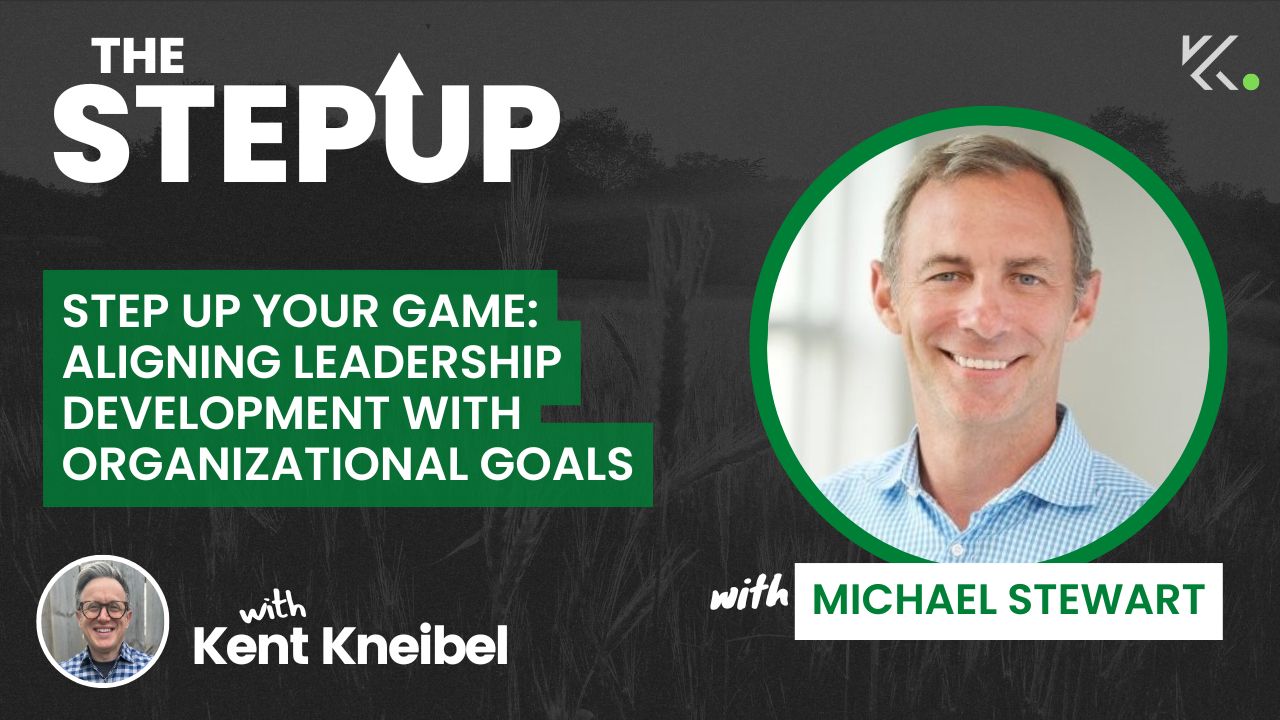
Michael Stewart, for the past 25 years, has consulted to hundreds of organizations ranging from the Fortune 50 to small non-profits. He has partnered with numerous thought leaders and organizations including David Campbell, Marshall Goldsmith, Blanchard, CCL, Covey, Lominger, Korn/Ferry and others. He is known for data driven solutions that appeal to the strategic CEO, the strategic Human Resources leader, and the practitioner.
Michael Stewart’s team of Ph.D. consultants and industry leaders has conducted hundreds of executive leadership programs, coaching engagements, training courses and delivered more than 4.5 million assessments working with organizations in more than 90 countries. His holistic approach aligns the leadership and culture of an organization to better execute their strategic intent
Values are the real deal in organizations, and today, we're diving deep into how they explode in importance and truly shape the workplace vibe. We kick things off by busting the myth that values are just some fancy words hanging on a wall—they're about how we live and breathe them daily, holding ourselves and each other accountable. Our guest, Michael Stewart, takes us on a journey through his experiences, revealing how we can align these values with our organizational goals to create a thriving culture. We dig into the nitty-gritty of balancing individual coaching with the bigger picture of organizational strategy. So, whether you're a fresh leader trying to find your footing or a seasoned pro looking to re-energize your team, this episode is packed with insights to help you step up your game!
The conversation dives deep into the world of organizational values and their real impact on company culture. We kick things off with Michael Stewart, who brings years of experience in leadership development and talent management to the table. He emphasizes that values should not just be some fancy words framed on a wall; they need to be lived out and integrated into the everyday actions of employees. It’s all about accountability—how do organizations ensure that these values translate into real behaviors? We explore how to create clarity around these values, establishing them as the baseline for how things operate within the company. Michael shares anecdotes from his extensive career, illustrating how organizations like Citigroup have transformed their cultures by aligning their values with actions and expectations. This isn't just a fluffy conversation; it's about laying down the law on what behaviors are acceptable and what are not, ensuring everyone is on board and moving in the same direction.
We also touch on the importance of viewing leadership not just from an individual perspective but rather from a broader organizational lens. Michael shares insights into his methodology, including his 4R model, which breaks down leadership into Relationships, Roles, Responsibilities, and Results. This framework prompts leaders to assess their effectiveness not only in driving results but also in how they build and leverage relationships. It’s a fascinating discussion that challenges the traditional siloed approach to leadership development, pushing for a more integrated view that services the entire organization. As we wrap up, we reflect on how leaders can better understand their role in supporting organizational goals while simultaneously fostering the personal growth of their teams.
For anyone serious about leadership development, this episode is a goldmine of practical advice and insights. Michael’s experiences and the frameworks he discusses provide listeners with actionable takeaways that can be applied immediately in their own organizations. Plus, we sneak in some humor along the way, making this not just informative but also an enjoyable listen!
Takeaways:
- Organizational values are not just fancy words on a wall; they must be actively lived out and integrated into the culture.
- Being a leader means holding people accountable to the organization's values and ensuring everyone understands how they contribute to the bigger picture.
- Effective leaders balance individual development with organizational goals, ensuring that everyone is aligned and working toward common objectives.
- It's crucial for HR to connect their expertise in people management to the broader organizational strategy for greater influence and effectiveness.
- The 4R model emphasizes the importance of relationships, roles, responsibilities, and results in effective leadership and organizational alignment.
- A successful culture transformation requires aligning employee behaviors with strategic objectives while keeping the organization's unique context in mind.
Links referenced in this episode:
Michael Stewart (Guest)
00:00:04.080 - 00:00:35.450
We've seen an explosion in terms of the importance of values inside of an organization. But values aren't just sheets of paper, the words that hang on a wall.
It's really how are those lived out and how do you hold people accountable to those?
And so we are often building our models around what are those values and how do we make sure that they are super clear and that it is kind of a minimum standard of how things get done around here.
Kent Kniebel (Host)
00:00:37.030 - 00:02:15.826
Hi there and welcome to the Step Up Expert Voices for Leadership Growth. I'm your host, Kent Knievel. Every week I talk to experts who focus on helping leaders step up their leadership game.
If you're new to the show, then on whatever platform you're using, I encourage you to subscribe so you never miss an episode.
One last thing, as a leadership development consultant and an executive coach, I have a particular interest in supporting recent internally promoted leaders.
If that's you, or if you support a leader who has been recently promoted, I encourage you to visit my website at Kent Coach Playbook and download a free copy of my 90 day blueprint filled with practical advice for you or the leader you support in hitting the ground running and truly stepping up to their new leadership level. Without further ado, on with the show. Welcome. Welcome to the Step up today.
Want to talk about systems and organizations and how we are of service to the overarching system organization. It's really easy for us at times, especially folks like me who I'm a solo consultant, to really focus on individual leaders.
The leader I am trying to support in their growth and development and attainment of their objectives, to really zero in on the individual, but thinking a lot more and having some conversations around. But how are we also making sure that we're in service the broader system and organization?
And with me today is someone who's very passionate about this subject is Michael Stewart, who has been doing this for a number of years and I'm not going to tell his story for him. So. But I'm going to welcome you, Michael, to the podcast and glad to have you here today.
Michael Stewart (Guest)
00:02:15.978 - 00:02:43.442
Thank you, Kent, for having me. And this is one of the debates that I often find with people like yourself and lots of consultants out there of this.
Is it about the person or the organization and who is the customer at the end of the day? Right? We always get that sort of a question. And my journey is I'm not an IO psychologist like many folks, but I always say I play one on tv.
So just given my background, that's my.
Kent Kniebel (Host)
00:02:43.466 - 00:02:44.030
Line.
Michael Stewart (Guest)
00:02:46.250 - 00:04:20.454
You know, way Back when, when I was in my undergrad I thought I was going to sell robotics to big manufacturing companies and the market at the end of the 80s wasn't that great for that. And I found myself in the headhunting business and then from there I moved to the outplacement side of the business.
There's lots of folks were laying people off and so I trained people how to sell themselves basically and how to, you know, how do you build those large contracts.
From there I ended up at NCS Assessments, which most of what they did was sort of clinical assessments and they had this small group of HR things with David Campbell was certainly one of the authors and one of my mentors out of there, Kathy Gayaluka, who built the MMPI, certainly renowned IO person. So those were my sort of trainings out of that I built that practice area up to be a few million dollars.
We then acquired the Kilty Goldsmith side of all of their 360 processing. So I followed Marshall Goldsmith around for a number of years putting in large scale leadership programs.
And then from there I went to Questar, which most of what they did was employee surveys, customer sat, and I built out their partnership practice area where we built all of the systems and the processing for Covey and PDI and Blanchard and oh boy, Ominger and all of the big players. We probably hit 75.
Kent Kniebel (Host)
00:04:20.542 - 00:04:22.822
I was going to say. I recognize that name.
Michael Stewart (Guest)
00:04:22.926 - 00:06:13.332
Right. And then back in 2000, right as the dot com bubble crash, I jumped off on my own. And not great timing, but hey, what have you?
Most of what we did in the early days was large scale custom talent management solutions for multinational companies.
And so if you think about something like a scorecard for private wealth managers, where you're taking in what's their financials, what's their 360, what's their performance standards, what's like seven different pieces of data and how do you put it on one page or how do you do tracking team assessment for Pfizer that says what's the impact that teams are having on the outcomes of getting drugs approved with the fda? So just custom weird stuff. We still do a lot of that. And then about 10 years ago we sort of jumped into the culture journey.
And what I've sort of taken from all of that is how do you build these talent solutions, these behaviors in a global or a large organization that's in service to them accomplishing the strategy. And if you think of a company like Citigroup as one of our clients, you know, to change the behaviors, there you know, takes a.
It's like turning the Atlantic fleet command. I was told when we first started working with them that, you know, even A town of 200,000 people has a jail. So there's going to be bad actors.
And I'm like, well that's not a very good approach. So let's try to change that and sort of step that gap game up. Right.
And I think today Citigroup is probably one of the least fine big banks in the world and trying to drive in. Here's how we provide accountability around the behaviors and expectations that they have. So that's a little my background and journey.
Kent Kniebel (Host)
00:06:13.396 - 00:06:24.680
Nice. Yeah. So tell me just a little bit before we get into our topic.
Tell me just a little bit more about work effects and what are some of the major spaces that you play, so to speak.
Michael Stewart (Guest)
00:06:25.030 - 00:07:46.680
So again, probably 60% of our work is in again those large scale custom talent types of solutions. And so people want to do something upside down, purple.
And the kind of three big blocks of what we do is how do we build the right content, what's the right things that we're going to measure in terms of a survey or assessment, what's the technology that we need to use to do that with and then how do you create action out of that? What's the coaching, training, development that needs to go with that?
And I learned a long time ago that being in a professional services business is not very profitable. So I'm the only person that does any consultants. All my staff are programmers and project managers.
And then I use people like yourself, Kent and others to go out into kind of the person facilitation, delivery, training, types of things.
Most of our clients are probably mid to larger size organizations where they have a good understanding of talent and what are all of the different pillars that go into those practices. But I would say growing over the last number of years is maybe the smaller to mid size.
Certainly looking at our organizational culture approach and how do we connect that to the strategy of a business.
Kent Kniebel (Host)
00:07:47.150 - 00:08:11.958
Yeah, organization of culture. I think that's when you and I first met. I think I contacted you just interested to learn more. Would have been seven years ago or so.
Well, so let's get into our topic a little bit.
We had a bit of a pre conversation talking about how do we make sure that what we're doing is in service at a larger system and organization topic you're pretty passionate about.
Michael Stewart (Guest)
00:08:12.094 - 00:09:45.820
Yeah.
When I fundamentally am looking at a client and how do we help it is how do we help them achieve the goals of that organization, what is their strategy if they have one, if they don't have one, how do we get them one and make it very clear how do we cascade that what in an appropriate way so people understand how do they fit? How does what they do on a day to day basis fit into the goals of that organization? And how do we certainly dial that magnetic attraction of that up?
Right. As we dial that up, there's also going to be the negative attraction where people don't necessarily fit and may self select.
And so that's always the lens at which I view how do we service our clients and how do we sort of benefit them. And I think that when I've worked with a lot of other consultants, that is not kind of their first approach. Right.
Their first approach is what is the needs of that person or of that small group of leaders or even leadership in general. And they sort of get stuck in that silo.
And I always try to get back to what is the business, what's the organization about, what are they trying to achieve? And it's always coming back to in service of that.
And I see a lot of people that again, this is my bias that they put their training, their coaching, their facilitation centered around the person and not necessarily the organization as a whole.
Kent Kniebel (Host)
00:09:46.480 - 00:10:27.916
Yeah. So I know our advice portion comes later, but this just gave me two questions I wanted to pose to you and it's probably an advice type question.
So when we think about the typical, could be a head of HR or head of talent or head of leadership development who is contacting you or another consultant, what would your advice be for those internal HR folks in terms of thinking about the system, the organization on the front end, maybe before even picking up the phone, metaphorically or sending that email to get in touch with consultant.
Michael Stewart (Guest)
00:10:28.028 - 00:12:00.560
I mean we've heard for a long time is how does HR get a seat at the table? Right.
And I think that to have a seat at the table they have to truly understand what is their domain area of expertise and how does that enable the accomplishment of the organization as a whole. They don't need to be experts in finance, finance has that. They don't need to be expert in sales and marketing.
They don't need to be expert in operations or supply chain. But what they do have expertise is, is around the people.
And I think growing that we're not in, we're in a knowledge worker base for the most part for organizations. And how people think about doing the work is the catalyst for accomplishing the goals of that organization.
And that is the domain expertise of the HR folks.
And so really look at how does the people aspect of it and whether that's leaders, mid level management, frontline employees, how does that collectively help to accomplish that and how do they get that aligned, both in terms of the structure of the organization, but also in terms of the just fundamentally how people think about doing the work.
And I think as they bring that type of a conversation forward to the executive team and play in their domain area of expertise, but always in service to, to how are they going to help accomplish the goals of that organization, that they'll find themselves being included more and more, if you will, at the seat of the table.
Kent Kniebel (Host)
00:12:02.260 - 00:12:28.934
Nice. So let me flip that a little bit too, right.
Cause you were saying one thing you notice about other consultants is they can get really zeroed in on the individual or that group of leaders that were being asked to maybe come in and either do a program workshop or coaching. What's your advice to the other consultants out there on how to zoom out and help their client see where this sits in the broader scheme of things?
Michael Stewart (Guest)
00:12:29.102 - 00:13:34.520
I think it is always it's asking questions to get contextual relevancy, that understanding what is the strategy of the organization, where are they not as successful as they may want to be in execution of that strategy? Is it a structural problem, is it a capital problem? You know, what are the different aspects of that problem?
And most of the time you're going to find that it's a people problem, that it's the people aren't fully executing or don't fully understand or don't have the right skills or the right behaviors to sort of execute that.
But I think if you lean into understanding what is the context of that organization and their strategy and what are the challenges, 90% of the time it's going to come back to people, which is I think the expertise area for consultants. Putting the business consultant hat on versus the leadership consultant hat on for a little bit in leading with that, what.
Kent Kniebel (Host)
00:13:34.560 - 00:13:40.220
Led you to focus on this more intentionally in your practice?
Michael Stewart (Guest)
00:13:40.720 - 00:14:19.940
I found that as we focused more on that side of it, that the nature of our programs grew.
That as we looked at the full context of that organization, the other data points that we're able to sort of capture and put together in one place to sort of connect the dots, if you will, that the size of our projects grew and the level of impact that we had with those organizations grew. And that's really, you know, trial and error. Certainly that came from that. But I think that's really where that sort of comes from.
Kent Kniebel (Host)
00:14:21.120 - 00:15:02.870
Yeah, I think, you know, and we've, we've had some correspondence ahead of time too. Right. And throughout the years, and I think we run the risk.
Right of, and I probably going to be using some of your words here, is putting forward either pretty generic programs or approaches that may ultimately fall flat. Right. Because they're focused on reuse of quote unquote tried and true content.
How have you seen a focus on really trying to put it in the context, or as you were saying, focusing on contextual relevance. How have you seen that change the shape of the solutions that you're putting forward?
Michael Stewart (Guest)
00:15:04.050 - 00:17:05.240
So I'll just take our sort of custom 360s that we do. Right. We don't really use off the shelf 360s. We have one, we use it when people don't really have a model.
But I think for the executives to communicate what are the expectations of behavior, that's the minimum standard is I think the key component to that. Certainly we've seen an explosion in terms of the importance of values inside of an organization.
But values aren't just, you know, sheets of paper, the words that hang on a wall. It's really how are those lived out and how do you hold people accountable to those?
And so we are often building our models around what are those values and how do we make sure that they are super clear and that it is, you know, kind of a minimum standard of how things get done around here. And that's sort of where assessments sort of come into play. And that is making it germane, contextually relevant for that organization.
You know, if it's a fast growing new product type of a company all the time, innovation is going to be hugely important. You know, and other organizations, something around teamwork may not be as important. If it's a startup type of an organization, right.
There's going to be a small team, but it's not large team.
If we start thinking about what is the vision for an organization as you get larger, how do people really communicate a compelling and optimistic view of that vision?
Depending on the organization and where they're at, the different types of behaviors and expectations, expectations, they're going to be different and how do you make that again germane for that organization?
Where they sit today, that may not be true again in three or four years for that organization, it's going to morph and change, but really underline what are those expectations that's going to propel that version of that strategy forward.
Kent Kniebel (Host)
00:17:06.580 - 00:17:27.464
So this makes me wonder if now's A good time to talk about your 4R model, because I know that I had a chance to really dig into that a little bit recently as well. And how do you. Would love for you to introduce that to the listeners and maybe bring that, you know, into connection with contextual relevance.
Michael Stewart (Guest)
00:17:27.592 - 00:22:40.460
Yep. So some years ago, maybe 12, 13 years ago, we partnered with Mark McCluskey to look at all of the different leadership models that are out there.
So I think it was 100 plus different leadership models. We said, okay, how do we simplify this? How do we take all of them into account and make one simplified sort of a model?
And at the center of that, and as a backdrop, I always use this model, even when we're building out custom content, to say, have we checked the box in enough of these areas? That sort of covers what we need to do custom side of things. But the 4R model at the core, at the center is really relationships.
You know, that what a leader does, what people do, it's relationships. How do they build, how do they utilize? How do they leverage those relationships?
Then they have to take those relationships and put it into their roles. Right. They have multiple roles that they're playing. How do they take those relationship capabilities and apply it to the roles within those roles?
Then you have responsibilities that there's different types of responsibilities that you have, and how that looks and feels may change a little bit. And then lastly, they're ultimately accountable to the results. And so the 4R model is about relationships, roles, responsibilities, and results.
And again, the center of that is what we call the basic virtues of being a leader. And basic is spelled out to sort of accomplish what are those behavior expectations?
And so if we look at B is beneficial partnerships, how do we have a win win? How do we earn trust and respect? How do we sort of get people to serve us? How do we create followership? Right.
The second part is around aligned emotions. So that's the A part. How do we make sure that, you know, our emotions are fitting the situation? You know, how do we not let.
We ran over our kid's bike this morning and we take it on the staff like that's not aligned. And it's not to say that you can't get upset or angry or jump on the desk or what have you. You can have outbursts if it's contextually relevant.
Yet again, if it's aligned to the situation, how do you have sustained determination? That's the S part of it. How do you recover from, you know, failures or challenges that you've had?
How do you persist when you're faced with obstacles, how do you show lots of endurance to sort of push through on those things, right? And then the I is intellectual flexibility and that's around. Are you open to new ideas? Do you collect information from multiple sources?
Do you encourage, you know, debate among folks? Do you learn from past mistakes? Do you change course when things are clearly not working?
So that's sort of the intellectual flexibility and the last one is character. You know, do you do the right things when it's required? Do you keep your promises and control commitments? Do you apologize for your mistakes?
Do you don't pressure others to sort of compromise on their ethics? So that's really the basic part of building relationships. If you do those things well, you're going to accomplish building effective relationships.
If you don't, we call it, you're going to have a hole in your boat. How big that hole is, you're going to how much water are you taking on, right?
Then you have to apply those, those relationship capabilities to the roles. And essentially you have a current state, current looking role and you have a future state of where that's going to be.
You have an internal, external. So that's sort of our two by two internal and current state. You're really being a coach to people, right?
You're helping, you're coaching, developing who those people are around you. If I look at internal, future state, that's about how do you be a change agent? How do you sort of propel that organization to morph into change?
If I think about future state and external, that's really being the spokesperson, what's the state of the state, where are we at, right? And then the last role is really that future and external is really being that direction setter, right? That's what we oftentimes account to.
That person was a really good leader. They're really being a direction setter.
And we find that people often over index on those external sides of the roles and under index on the internal sides of things. Being a good coach, being a good change agent isn't oftentimes we think of as being a good leader. But those are super important.
And then you have to take those roles and apply it to the responsibilities that people have. And within those there's basically five kind of key responsibilities you need to, you need to set what is the strategy, you know, what is that?
That vision if you will. You need to be able to execute upon that strategy, the strategy implementation. You need to align people, right? They need to come together.
You need to motivate them to go accomplish those things. And then you have to have good analysis and judgment. So those are kind of the five sort of key response responsibilities.
And if you do those well, you'll find that you sort of get the quantitative, qualitative, the outcomes, the results that you're really looking for.
Kent Kniebel (Host)
00:22:40.840 - 00:22:46.192
Love it. It's sort of like leading metrics versus lagging metrics. Right.
Michael Stewart (Guest)
00:22:46.296 - 00:23:35.162
The type of person based on their results. And when you're sort of figuring out who that person is. Right. As the intake part of it, like, okay, are they the. The crusty person?
Like, no, it's just my way. It's all about the outcomes. It's about the results. I don't care about all of this foo foo hr. Then we're going to start with what's the results?
Are you getting the results that you need? Are you performing these responsibilities? So we sort of work backwards from results to responsibilities to roles, to behaviors.
If it's somebody that's reading all the books, studies all the leadership stuff, listens to all the podcasts, we're going to start with the, with the, with the relationship side of things and sort of move forward from there. And so it's whether we're moving left or right or right to left in that model sort of depends on where that person is at.
Kent Kniebel (Host)
00:23:35.346 - 00:24:46.502
Yeah. I love that you said something earlier that I wanted to circle back to, which is, you know, if you're.
You're so many leaders are focused on the external piece that they neglect the internal piece. And I think you were specifically talking about developing the team or leading change. And something that I've.
I kind of keep coming to in both coaching and some of the leadership development work that I've been doing is we put off, or leaders, you know, put off really focusing on development or say, change leadership for when things slow down. Right. When things slow down, I will attend to that. And I don't know that things ever slow down. Right.
And so which is where I have found, at least from when it comes to coaching, which isn't always that scalable. Right.
But when a company is investing in coaching with a leader, the biweekly or weekly or monthly meeting with that coach sometimes is the other than sleeping, the only time that that leader has sort of the permission to just stop and slow down. So I just was wondering if you wanted to drill in a little bit more on that.
Michael Stewart (Guest)
00:24:46.686 - 00:25:59.340
I come from a perspective of maximizing your strengths and delegating your weaknesses, but oftentimes I find leaders don't delegate very well because they don't trust is maybe too strong of a word, but they don't have the confidence in the other people to perform those tasks in the way that they would do them or if they do delegate, then they oftentimes are micromanaging to do it just exactly the way that they want it done. Right.
And I think that recognizing and giving the coaching and change agent kind of approaches to give people small tasks where they can be successful in sort of building up that confidence and getting them to learn, you know, what are the different decision matrices and what are the different components that go into those things? Things is where they can greatly exponentially expand the capabilities of them, their team and the organization.
And that's why I think focusing on that coach and change agent role to develop the capabilities of the people around you is so critically important for being an effective leader, because that again, it multiplies your own capabilities.
Kent Kniebel (Host)
00:26:00.000 - 00:26:45.290
Yeah, well, and I want to go back to the last thing you were saying when you were going through your model, which was, you know, you either you sort of take where the leader is at, right?
If this is a very results focused leader, let's start there and work our way the other direction towards relationships, or if it's a really relationship focused leader, you know, let's work our way towards, you know, results left to right, so to speak.
And I wonder if you can talk more about like how that is sort of the balance you're trying to find between kind of going back to what we were talking about earlier in the conversation, which is let's focus on where the organization, where the system is going first, right? And so tell me, I just would love to hear a little bit more about how you try to leverage that approach to sort of balance between.
Michael Stewart (Guest)
00:26:45.750 - 00:28:40.640
So, you know, as we find out what is making this organization tick, right. What is their strategy, what is getting in the way of their strategy? Where is the focus effort need to be applied? Right.
So that's sort of the big picture context, the systems level approach, as we find the chinks, if you will, of why isn't it being as effective as it could be in executing that strategy? Then we're going to take this for our model and sort of apply it to that.
And what we'll find oftentimes is that the effective relationships in with certain people or certain areas are not what they need to be. That's a multiplier effect, the relationship capabilities.
And when I particularly look at the role side of things that we may find that people are very focused on, what is that direction set aside this is what it's going to look like when we get there, but not as focused on the here and the now and what needs to be done internally to make the opportunity operations flow smoother, to make the communications work across the silos much easier, that the effort needs to be spent in that coach and change agent role more effectively, taking the relationship capabilities, applying it to those roles to sort of break down the silos, to get the engine moving inside of that organization. And that's sort of how we take the context of the system. What are the challenges?
What are, where are the chinks, if you will, and apply that for our model to that. You know, maybe it's. They're not motivating people enough. Maybe it's in the responsibilities area.
That's, that that's sort of lacking in terms of getting people to accomplish those things.
Maybe it's in the strategy implementation that they can't break down this big picture goal into what needs to happen this month, this week, today type of a thing.
Kent Kniebel (Host)
00:28:41.020 - 00:29:06.140
Nice.
Well, I know I sort of dipped us into the advice section a little earlier on our, on our episode here, but I, I'd like to, I'd like to kind of get into and start bringing us in for, you know, our dissent here, which is, you know, I asked you to prepare a few things that you could leave the audience with that they could take some action on or begin taking some action on. So would love to hear what you had in mind for that today.
Michael Stewart (Guest)
00:29:06.260 - 00:31:57.782
Yeah.
So one of the things, and I'll talk about our culture approach a little bit, which I think gives a little bit better sense of what's contextually relevant for that organization. How do they really need to think to execute upon that strategy?
And our culture approach is a little bit different in that we divide it into two sides. One side is what we call the healthy culture, which is the traditional values, engagement, all the things that are sort of bad to good.
They haven't really changed since Aristotle or Plato in a couple thousand years. What is good is good, right. Ethics and teamwork and trust and, you know, capabilities and innovation and all quality, all those things.
Every organization, they're kind of the same. The degree to which they achieve those is different, but the words are kind of the same. Right.
On the other side is what we call our purposely aligned side of culture, which is directly connected to the strategy. And so if you think of something like customer service, Right. That's a bad to good.
You're either doing a great job, you're doing a poor job, or somewhere in the middle. But how do you really go about executing that customer service? Is it world class, transactional or deep customer, intimate?
Where along that continuum do you need to be? And that's very different. Right. When it comes to the types of people, the types of process, the types of product, how you go to market.
And so we have sort of 10 different areas that we look at from that and identify to accomplish the strategy.
How do people need to think and what are the three or four most important sort of areas that they need to be aligned on to execute upon that strategy? So that's how we're sort of getting to in a simplistic, very quick way.
We have our free culture check tool on our website that you can go through as a team and go, okay, where's our current culture? Where do we need? What's the most important areas?
It's not the whole in depth conversation, but it gives you a quick slice in terms of what is relevant for that organization. Again, how do people need to think?
At the end of the day, what we're trying to do with leadership is have them always connect the what, what needs to be accomplished today, this week, this year, this, this whatever, this three year strategy piece with the how, how do we need to think about that so that if it's a sentence that's describing the what, what's the extra three words that describes the mindset or how we need to think about that, or if it's a paragraph, what have you, that there's always that how.
And then taking your, the 4R model or the relationship or the, you know, responsibilities, your leadership capabilities and applying it to how do you more effectively connect that what and how. And our forum model, you can see that on our website as well. It's pretty simplified model.
Kent Kniebel (Host)
00:31:57.926 - 00:32:11.414
Nice. Yeah. Well, and I'm glad you brought up culture because I think that's where we had originally connected some years ago.
So I'm glad, glad you brought that up. And it sounds like there's a free sort of quick assessment for teams on your site.
Michael Stewart (Guest)
00:32:11.502 - 00:32:36.618
Usually for the executive team. I look at the people who are deciding the strategy should be the ones who determine what is the culture needed to execute that strategy.
I think in terms of where is your current culture at the people who are living that the rest of the organization sort of determines what is their current culture and then what's the delta in the middle? Right. That's what needs to be changed in terms of creating better alignment.
Kent Kniebel (Host)
00:32:36.794 - 00:33:02.770
Right.
And I think that's one thing we had connected on at a sort of conceptual level years ago, which is there's the culture that those who are leading the organization say they want and maybe have, and then there's the actual culture you do have today and that is usually told to you from the bottom up versus the desired culture, which comes from the top down. Yeah. Cool. So what else?
Michael Stewart (Guest)
00:33:03.190 - 00:34:37.239
Well, I think that what I would look at is how do you always get contextual relevancy? That's sort of where we started with what is the system, what's trying to be accomplished.
And I think designing, implementing the programs that are addressing the biggest challenges or needs for that organization today, Whether that is, what is the expected behaviors inside of that organization, what are the challenges in terms of execution, executing that strategy that I think that you have to put in play in things that are addressing those problems today. And I think that's where some of the generic programs, the generic assessments, the generic sort of tools out there sort of fall down. Right?
We oftentimes go, well, we did this whatever, three months, six month long coaching thing, but we didn't really affect change in that person or we had a short term period of change. Where's the follow through? How do I get the stickiness, if you will, of those initiatives?
And I think if you can make it relevant to solving the problems of that organization and how that person fits in there, you're going to find that 80% of the people are going to be attracted to those solutions to those programs, to those assessments, because it is truly giving them tools, capabilities to solve the problems that they're faced with every day.
And I think the more that you can be again, what is that system view and apply the solutions to solving the problems that are causing, that are being caused in that sort of systems view.
Kent Kniebel (Host)
00:34:37.779 - 00:36:03.108
So I've had the fortune of working for pretty large organizations and one of the ones that I was working with, I feel like the learning and development group, separate from the leadership development group really was zeroed in on what, where is this business going, what are the big problems, hurdles, how can they address that? And I thought they were doing that really nicely and working in pretty good concert with leadership development as separate functions.
Data analysis being a really huge and some level of data fluency for the organization was this big push.
You had L and D coming in with the learning that was needed, tools, job aids, whatever that was that, you know, was needed for people to learn how to get more fluent with data.
And you had, you know, leadership development or, and, or talent management coming in and helping, like how do we make sure that People understand why this is important and how do we enable our leaders to lead, you know, in that way. The reason I bring up that context is I know you've been working or saying recently you've been working with a lot of smaller organizations, right?
So they might not have the advantage of having like these distinct, you know, functions.
I think it's just some good, practical, good practical advice to like, hey, make sure you're stepping back and asking where the organization as a whole is heading.
Michael Stewart (Guest)
00:36:03.284 - 00:37:58.660
And that's where sort of our 10 dimensions help those organizations sort of pull all that apart. Right? So if we look at something like decision making information, are you going to be fact based or is it more intuition, experience based?
And, and if you sort of set, what is that add to your example like your organization or that organization probably decided to be very fact based in decision making. They didn't say it that way. But here is the data that we need to use to inform all of those decisions.
So if you can get people to align, oh, we make decisions based on the numbers, the facts, the details.
Right now that means everybody else goes, okay, well where's the data that's going to support what is the points or persuasion arguments that we're putting forward?
It's going to carry a lot more weight than a person says, well, I've been doing this for 20 years, I know the whole market, I know what the situation is that's going to carry less weight inside of that organization.
So I think being really clear again about how we need to think about doing the work that needs to happen, you know, if we take another one around, you know, operational approach, are we looking at a high variation or low process variation and we're along that continuum. And what does that really mean? It means, okay, well we get five ways to do it or do we get 500 ways that we can do this?
And that really starts to set, you know, what is the principle, what's the operating system of that organization?
And I think that's again, figuring out pulling that apart for the smaller to mid sized organizations gives them real meat to go in and go, okay, how can we really execute upon this strategy? What's the most, two or three most critical areas that we really need to change or get aligned in terms of how we think about doing the work?
Again, it's always connecting the what and the how with the leadership capabilities to sort of drive that connection.
Kent Kniebel (Host)
00:37:59.080 - 00:38:24.340
Yeah, nice. Well, I feel like we could keep talking for.
I feel like maybe I say this towards the end of all of my podcasts and maybe that says more about me than anything else. But I'm like, I think we could talk about things from like an hour or so more.
But just to start to bring us into, you know, our, the final part of our descent here, how can people get a hold of you and or work effects?
Michael Stewart (Guest)
00:38:24.660 - 00:39:01.110
Probably the easiest way is through our website, work-effects.com. it has all kinds of resources. It talks about how we work. It talks about our leadership approach, our culture approach shows, you know, our 4R model.
It shows the process that we use for sort of culture transformation as well. And there's certainly an info and forms to reach out to us directly. I can also be found on LinkedIn.
I have quite a big following on LinkedIn and I'll probably be posting more often on LinkedIn.
I used to post a lot and sort of COVID years I just sort of go, okay, LinkedIn's too overwhelming now, but I'll probably be back to posting a lot of things on this.
Kent Kniebel (Host)
00:39:02.530 - 00:39:39.126
Nice. That's where I found you. I can attest that you're not hard to find on LinkedIn. Well, thank you so much, Michael.
I kind of enjoyed the conversation here and I think it's always a good reminder to take a step back and ask, where is the organization heading? What are we trying to accomplish and how do we make sure that we're bringing a company strategy approach, your focus into anything.
Those of us who are sort of in leadership or development kind of consulting, how do we make sure that this is aimed at what matters to the company? I think it's a good reminder. So thank you so much for being here today. I really appreciate it.
Michael Stewart (Guest)
00:39:39.198 - 00:39:48.864
Thank you. And I think the bottom line is without a what, it's pretty hard. Hard to get to a how.
And so always looking at what's the what I think is the key point out of all of this.
Kent Kniebel (Host)
00:39:49.032 - 00:39:56.336
Nice. Well, thank you so much. Well, thank you. And that. That's it. Appreciate your time and appreciate all of our listeners. Take it easy.
Michael Stewart (Guest)
00:39:56.448 - 00:39:57.540
Thanks, Kent.
Kent Kniebel (Host)
00:39:58.280 - 00:40:20.410
That brings us to the end of our episode. Thanks for listening.
I'd encourage you to head on over to my website, Kent Coach, and start a conversation with me there or check out my promotion playbook at Kent Coates Play Playbook. Before you go on with your day, I ask you please take a moment to leave a rating and a review wherever you listen to podcasts. Five stars.
That helps put this podcast in front of more eyes and ears. Until next time, take it easy.


